The Vanguard has a new home, please update your bookmarks to davisvanguard.org

Saturday, November 18, 2006

Eleanor Roosevelt: Affordable Senior Housing Project Goes Awry

Established as a means to provide afforable housing for Davis seniors, Eleneaor Soosevelt Circle provides Seniors 62 and over with a place to live. 35% of the 60 units are set aside for disabled seniors with the rent ranging from $250 up to $1,000 depending on household income level.

Unfortunately the project seems wrought with a variety of problems. Mayor Sue Greenwald announced at the most recent city council meeting that they were having trouble getting local applicants. They had managed to attract only a few seniors from Davis. And shortly they would advertise the project regionally and open it up to seniors from a variety of other areas. This was obviously a bit of a disappointment since they had wanted to great a facility to meet the needs of the local population.

Anne Evans, who is a local advocate for the disabled pointed out that the age barrier might be prohibitive. She suggested that there were a number of disabled seniors from the age of 55-61 who were not eligible for this project because of the age restriction of 62. And she made the point that it is very difficult for seniors over 55 who were disabled to find affordable housing in Davis.

It seems only logical that they would extend the age range down to 55 before they had to advertise regionally. There is not legitimate reason why a 55-year-old could not live there.

Apparently this is not the only problem with the project. It is too close to students and a number of seniors do not want to deal with the noise and late night activity. But perhaps some of this could be mitigated with a more realistic age range.

---Doug Paul Davis reporting

Dunning's Mandate

As I've said a number of times on here, one of the chief reasons I decided in late July to create this blog, the People's Vanguard of Davis, was in response to Bob Dunning and the Davis Enterprise, in my view, running roughshod over the Buzayan family and their rights. For that, the Davis Enterprise will have to answer it appears in the court of law (more on this coming up on Monday).

More importantly from my perspective is that there was no clear and obvious means of response to the battery of unrelenting attacks day after day against the Buzayans, the HRC, the progressives, Heystek, and even the ACLU. Fighting Dunning through letters to the editor meant a 350 word response to his five columns a week. Even esteemed members of the ACLU and former Mayors of Davis were not immune to the well-oiled Dunning machine, with full backing from both the DA's office and the DPOA attorneys.

As Twain wrote, never pick a fight with someone who buys ink by the barrel, clearly he had Dunning in mind as he wrote this.

Ironically, Dunning has been fairly quiet in the ensuing months, but on Friday, once again, he chose to fire off an attack. This time aimed at a Lamar Heystek claim that the Measure K vote was "by no means a mandate." A modest statement if there ever was one.

Dunning points out that in fact, Target doesn't need a mandate, just a one-vote victory. The implication was that Heystek was somehow a sore loser.

My interpretation of Heystek's statement is somewhat different. Dunning is correct, that Target needs no mandate, it simply needs authorization--which it received. However, as Dunning should darn well know having been a long-time resident here, Heystek's statement was a reflection of a broader importance and that goes to the heart of the issue--Target was a vote on a single-issue and not a broader mandate for growth, for big boxes, or an acceptance of varying other possible constructed outcomes that the council majority might be willing to use to further their future goals.

The city remains closely divided on the issue of growth, what kind of growth we would like to see, and our acceptance of large corporations moving into our close proximity. Also just because the voters narrowly approved Target, does not necessarily mean they oppose the living wage, a point that Dunning eludes to in a short comment. He writes:
living wage... an admirable goal this living wage, but why not provide it for everyone? does Nugget charge you less for a loaf of bread if you can prove you are employed by a small, independent, local business.
Interesting that he would used almost identical verbiage as Souza did when he argued against a living wage ordinance. Cleverly veiled as it is, it is also tranparent the point tht Dunning is ultimately making. Dunning talks the talk of a non-commital and impartial observer, but he rarely walks that walk.

Dunning is also naive if he believes that the council majority would not be claiming a huge mandate for growth if Target was approved by say a 60-40 margin instead of by a 600-plus vote margin.

Heystek was the target of Dunning during the elections, the question is, whether this will be a mere passing moment where Dunning takes a few parting shots at the young councilmember or whether this will mark a turning point where Dunning begins to focus his attention on Heystek, who he may view as the next progressive theat. It was noted to me, that in the past Dunning has taken open shots at other progressive members of the Davis City Council when they emerged as threats to his world view.

---Doug Paul Davis reporting

Friday, November 17, 2006

Victim of Alleged Racial Profiling Speaks Before Council

A few weeks ago, we reported on an alleged incident of racial profiling. This Tuesday the victim came before the Davis City Council to relay his account of the incident. Additionally, the video was sent to the office of the Police Ombudsman for review.

School Board Meets Over Junior High Harassment

In an emotional and sometimes contentious meeting last night, the Davis Joint Unified School Board agreed to create a climate in our schools where everyone feels safe and accepted. There was little in the way of specifics, but the consensus of the board was to direct the Climate Coordinate Melvin Lewis to create an action plan.

I came away from this meeting with very mixed feelings. On the one hand, it is clear, very clear in fact that the school board has a commitment and the desire to fix the problems. It was also clear that the intentions are good. What was disturbing however is that I did not get a good sense that they knew what needed to be done. This meeting seemed long on rhetoric--Keltie Jones, the school board president who is openly gay, talked about her dream of a society where the gay lifestyle is accepted on equal footing with the straight lifestyle, where billboards and magazines in society depict same-sex couples just as they do opposite sex couples.

On the other hand, I just don't know if they really know what to do to fix these sorts of problems. In some ways, this is not even a gay-straight-anti-gay problem, it is as much a problem of bullying and kids possessing the ability to pick on others by going to their most vulnerable spot. And for this young junior high school student, it was the fact that he has gay fathers.

Board member Jim Provenza hit on a key point that got lost in the multiple discussions about what to do. The immediate concern--and Provenza was duly disturbed by this--is that there is a student who does not feel it is safe to come back to school. He came back initially and was harassed again. He then came back on a Monday, and was harassed by one of the same kids who was involved in the first incident and the Principal felt he had no proof this time and let the kid go back to class. This is very disturbing. And this is the part, that I don't think has been dealt with. I think the district has done a very good job with the bigger picture, but a very poor job with dealing with the immediate concern.

The other really good comments came from Hui-ling Malone, who is the daughter of Reverend Tim Malone and the student member on the board. She talked about the need for students to step out of the spectator's role. Moreover, teacher's need to be consistent about enforcing a no tolerance policy towards harassment. It is not enough for them to ask the students to write a reflective essay after the fact, they need to be vigilant and proactive.

Tim Taylor, another board member, emphasized that there is a strong need for a school district to educate. Everyone saw this as an opportunity to educate the students and the parents and the community on these issues.

Everyone on the board clearly seems to have the best of intentions. There was agreement that action needed to be taken, agreement there needs to be more education and the need for it to move beyond tolerance and towards something stronger. The big picture was well addressed but I think the short-term was not focused on nearly enough. The family is upset with how this was handled from a disciplinary standpoint and that seemed to be the weakest area of focus. Everyone has a sense for what to do in the longrun, no one offered much in the way of suggestions for the family to get their son back into school in the shortrun.

In the coming days, we'll have video clips from this meeting. In the meantime, there was an interesting dichotomy between those who were surprised that this could happen in Davis and those who were not. That's the bigger lesson that this community needs to take away from such events. It goes back to what Rahim Reed said last week at the HRC meeting--people in Davis tend to bury their heads in the sand and believe that these types of things do not happen here.

The striking thing was the message from the gay and lesbian community that they do not feel welcome in this community--at least some members conveyed that. In the last year, we've focused heavily on the minority community in terms of police harassment, but it seems clear that the gay and lesbian community have a number of under-addressed concerns as well that need more focus and scrutiny. If there is a teachable moment on this, perhaps it is this one--that we need to be vigilant, not because the majority of people in Davis are hateful, but because when a minority of people are, it reflects poorly on the rest of us.

---Doug Paul Davis reporting

Thursday, November 16, 2006

Heystek Raises Target Website Accessibility Concerns

Last week reported on the fact that the Target corporation has refused to make their website accessible to the visual impaired. Their reasoning is basically that the 1990 ADA Act does not require them to do so. Thus they would rather pay to fight a legal case than comply with the requests to make their website more accessible to millions of disabled and elderly people. This is particularly concerning because the relative costs of making their website accessible is pretty minor and it would probably be mitigated by increased usage by disabled and elderly customers.

Councilmember Lamar Heystek, brought up as a suggestion the city council author a letter to the Target corporation requesting that they make their website accessible to the visually impaired.

Councilmember Don Saylor began to ask questions as to whether other corporations do this and whether the City of Davis does this. In fact, the City of Davis does have a fairly accessible web site thanks to the efforts of the Human Relations Commission and the work of local activist, Anne Evans, who brought this issue to the attention of the HRC.

Councilmember Saylor may want to take a look at the City of Davis website where they have a lengthy explanation of this.

http://www.city.davis.ca.us/misc/SiteTips.cfm

The City site has been developed to be "text-only" friendly and considerate of users accessing the site with special devices whenever possible. We use descriptive alternative tags (ALT tags) to supplement graphics. If you turn off image loading in your browser, the pages of the site can still be navigated and viewed. For use with special devices, the site has been tested using Bobby.

Adobe PDF documents can be converted to HTML or ASCII text using Adobe Accessibility Tools.

Accessibility is an important issue for our webpages. We are working hard to meet W3C Accessibility Guidelines and Section 508 Accessibility concerns.

Americans with Disabilities Act (ADA): The City of Davis has a strong commitment toward meeting the goals of the landmark Americans with Disabilities Act. We follow practices to make our web site compatible with text-based and speech-based web browsers, and to provide information useful to those who are unable to easily access basic City information by other methods. Should you have an ADA-related concern about our web site, please let us know by contacting webmaster@ci.davis.ca.us

Now the Section 508 Accessibility requirements are as follows:

In 1998, Congress amended the Rehabilitation Act to require Federal agencies to make their electronic and information technology accessible to people with disabilities. Inaccessible technology interferes with an individual's ability to obtain and use information quickly and easily. Section 508 was enacted to eliminate barriers in information technology, to make available new opportunities for people with disabilities, and to encourage development of technologies that will help achieve these goals. The law applies to all Federal agencies when they develop, procure, maintain, or use electronic and information technology. Under Section 508 (29 U.S.C. ‘ 794d), agencies must give disabled employees and members of the public access to information that is comparable to the access available to others. It is recommended that you review the laws and regulations listed below to further your understanding about Section 508 and how you can support implementation. (Source: Section 508)

The City of Davis website is now in compliance with Section 508. There is no reason why Target should be in compliance with these requirements—their addition is not an expensive undertaking and there are many Americans right now who cannot have access to these websites. It would be like constructing a building that you cannot enter if you have a wheel chair. In the year 2006, this seems to be common sense. Hopefully once Councilmember Saylor educates himself on this issue, he will recognize this as well.

---Doug Paul Davis reporting

Harassment Incident Escalated into Fire bombing

Last Friday we reported that a Junior High School student was being harassed because his fathers were gay. Last night, the Davis Enterprise finally reported on the story, five days after we first broke the news. Of course, there are little details given in this article and it is noteworthy that the family was never interviewed.

The article describes an assembly held at the junior high school meant to educate the students about harassment. However, the family is angry that stronger disciplinary steps were not taken. Only a very small handful of students involved in the incident were punished in any formal way, moreover, the student has had to be pulled out of the school three times and he has now missed nearly four weeks of school. Tonight the school board will hear about the incident and make a determination as to what has been done and what further needs to be done.

The father appeared Tuesday night before the Davis City Council. In a disturbing escalation of the incident, the father described that the harassment leaked into the community from the schools. Their car was firebombed and burned to the ground on their driveway. Only quick action by their son allowed the family to avoid their entire house burning down.

According to the father, the police have been very slow to respond to this incident. They have made the determination that this was arson rather than an accident and they have identified a person of interest. But they have no suspects or arrests in an incident that occurred now over a month ago. Nor have they contacted outside agencies such as the ATF or FBI to aid in their investigation.

At this point there are two separate issues--one is the continuing harassment of a junior high school student on campus that is a matter that needs to be addressed by the school district and the second is the escalation of this matter in the form of a criminal act of arson. The family feels neither have been treated with due diligence.

The initial response that I witnessed by the school district at the Human Relations Commission meeting was disturbing because they appeared from my perspective more interested in damage control than in dealing with this problem. Chief among them was the climate coordinator whose response to the family was basically that Davis was better in this regard to other school districts and he mentioned specifically West Sacramento. That may be true, but a family going through something like this does not want to hear that type of rhetoric, they want to know how this is going to be prevented from happening again.

At this point, the school district is telling the family that the student needs to be in school, but family fears for the safety of their son. Hopefully most of this can be resolved tonight at the school board meeting.

---Doug Paul Davis reporting

Wednesday, November 15, 2006

City Running Short on Parking Fines

There was an odd moment last night when Finance Director Paul Navazio was presenting an update on the budget, one of the areas that had a shortfall was in public safety. It turned out they were running a deficit on parking fine and vehicle infractions. And we're not talking about chump change, it was in the tens of thousands if not higher.

Basically right now the city relies on the enforcement of parking violations as a steady source of revenue. What has happened however is that as they have gone to more and more strict systems of enforcement, the revenue has fallen off. With the implementation of the new GPS system and the no re-parking policy, the number of parking citations that have been issued has apparently fallen, moreover the expense of the system has risen. And so there is now a budget shortfall because the number of violations fell short of projections.

You have a catch 22 system going--you have a system that relies on people breaking the law in order to finance it. That seems archaic at best. You want to people to commit fewer not more violations of the law and yet you have budgeted the revenue from parking violations. It is just an odd system.

It seemed that the council acknowledged that this system is problematic at best and that you should not be relying on the revenue from parking violations to make your budget, and so I would guess that in the future they will fix the system.

So this is an item more of bemusement than of true criticism, but you still have to say... only in Davis is a reduction of traffic and parking violations a bad thing. (Actually I'm pretty sure that other cities problem have similar problems).

---Doug Paul Davis reporting

Divide and Conquer is a Risky Strategy for the Council

One of the first lessons that my political mentor taught me a long time ago when I first got involved in politics was to avoid too many polarizing issues. He drew it out for me on a chalkboard quite clearly. You may take the majority position on each issue, but you will anger a different constituency as well. You may win on each issue, but at the end of the day those constituencies may add up to over 50%.

When the council took on the HRC and the police issue, it seemed that a majority of people were on their side. But these were very contentious issues and they angered a number of constituents who may have been with them on growth and development issues. Likewise the Target issue did not just anger the progressives who normally oppose the Council majority, but also it angered small business owners, particularly in the downtown. So while they might have had the barest of majorities support Measure K, they may have mobilized a powerful new constituency against them who will join forces with the progressives to work to oust them in 2008.

That brings me to yet another constituency that may be in the process of being mobilized against the council. The issue of the merger of the Senior Citizen Commission has angered many seniors. We’ve covered this issue a few times as it has developed. Overall the community seems indifferent to the issue of the merger of the Senior Citizen Commission with the Social Services Commission. However, one group that is angry is a group that has not generally asserted itself in Davis nor have they generally sided with the progressives. The council may once again have the majority that can get this through the council, but they may in turn mobilize another group against them.

The chair of the Senior Citizens commission Elaine Roberts Musser writes:
If council members are concerned about the tone of the conversation in the community, it is comments such as those aforementioned that get seniors' blood boiling. They know full well when they are being had... A total of 138 outraged seniors want their commission to be left alone to do its business — advancing the interests of Davis seniors.
That may not seem like a large number, but it probably speaks for a larger group. Small numbers of voters who change their loyalties in an evenly divided town could be pivotal in swinging an election.

As we wrote a few weeks ago, we were unimpressed with the reasoning behind the move. Musser was not either.
Councilman Stephen Souza claims, "By combining the power of both bodies, you wind up with a more powerful body and focus ..." What you really end up with is shortchanging constituencies of both the Senior Citizens Commission and the Social Services Commission, focusing away from seniors in particular.
Further she takes exception to the notion of making the Senior Citizens a subcommittee, since many are not able to drive at night and would not be able to attend the new commissions meetings which occur after dark.
I was also very troubled by a comment Mayor Pro Tem Ruth Asmundson made at the Oct. 24 City Council meeting. There was an indication that if seniors were not able to meet in the evening, then they could join a standing subcommittee. Why should seniors be relegated to subcommittee status, just because they cannot drive at night?
The Council majority may once again have the support both on the council itself and in the community to prevail on this issue. But at some point they will have polarized so many people, that they may have polarized themselves right out of power.

---Doug Paul Davis reporting

Tuesday, November 14, 2006

The PG&E Aftermath

I have delayed my writing of the PG&E decision until a week after the election (hard to believe it has only been a week). The problem with any analysis is that while H&I were extremely close elections, the fact that Sacramento had to approve it as well and it wasn't even close to passing in Sacramento, makes it difficult to do a true post mortem. It is disappointing though not surprising that it would fail by a large margin in Sacramento. After all, the benefits to Sacramento rate payers are not as immediately evident and it is far easier for PG&E to scare them.

Still I believe that had H & I passed in Yolo County it would have sent several loud and clear messages to PG&E. That message is mooted by a split decision. Dunning thought this was an odd outcome not understanding why someone would vote for one and not for the other. But in actuality it's not that odd with one passing by 400 or so votes and the other failing by a similar margin, as close as the two are to each other, this amounts to little more than random error by a small number of people not fully aware that these are two sides of the same coin, it's likely that 98 percent of the people voted the for both and only a tiny percent split their vote.

And yet, even granting the large defeat in Sacramento County, I'm a bit disappointed with the Yolo County results. Had Yolo solidly voted to support SMUD, it would have been a loud and clear signal. First, that PG&E could not buy our votes with their ten million dollar plus campaign, fraught with deception. Second, that we were not happy with our service from PG&E. (Obviously PG&E prevailed by casting doubt about the SMUD move more than by convincing us that we liked them).

This was a rare election in so many ways. There was near animous support among Yolo County Elected officials--every member of the three major city councils and all five members of the Board of Supervisors won. How is it then possible that PG&E wasn't soundly defeated in Yolo County?

The obvious answer was the slew of deceiving mailers and TV ads in Yolo County. PG&E managed to turn the strength of SMUD into an uncertainty by casting doubt on their ability to lower the bill for rate payers. This had to do with the costs of annexation. Watching the debate between SMUD and PG&E, it seemed that the pro-H & I side was ill-prepared for this argument even though they knew it was coming. Frankly after watching the debate, I had doubts myself about their plan even though I knew going in I was going to vote for SMUD regardless. The PG&E arguments were extremely effective unfortunately.

The second problem was that just like Target, PG&E tried to turn the issue of the environment--one of their weaknesses in their favor. So they launched a massive campaign to convince Yolo County voters that PG&E was environmentally friendly and perhaps as importantly that SMUD was not environmentally friendly (easier to convince people of negatives). They even went as far as to compare PG&E's effort to the No on X effort which we covered.

The bottom line of the PG&E effort was to convince the rate payers that they may not like the current system, but a new system may be worse, so stick with the devil you know. And when you have a resource advantage, it's easy to convince people to stick with the status quo by voting no. The no side almost always has the advantage in these types of races.

It is obviously difficult to fight back when you are facing a 10 million dollar plus campaign. But one way that might have been helpful would have been for each of the 20 officeholders to contact their core constituencies with a direct message of support for SMUD and an explanation of why it was important for them to support H & I. I'm not being critical of the SMUD effort, because they did very well facing overwhelming odds and an overwhelming resource disadvantage. At the end of the day, given that disparity, it was hard to win. I had hoped that the voters in Yolo County would see through the smoke and mirrors, but it seems very obvious that PG&E was able to obtain their by creating enough confusion and uncertainty to nudge a defeat on Measure I.

As I said previously, it was rendered moot by the large and overwhelming defeat in Sacramento County. This was a long and difficult process, so it is hard to know if this is the end of the fight or if they will try to revisit it. If they do wish to revisit it, they need to conduct a long and very concerted education campaign prior to the fact and they need to make it very clear exactly how much this will cost, so that PG&E has a more difficult time of mucking the waters.

---Doug Paul Davis reporting

Monday, November 13, 2006

Will Target Election Re-shape Davis Politics?

In politics as in life there is a proverb, be careful what you wish for, you just might get it. In the aftermath of Measure K, this seems to be at least potentially ringing true. While Don’t Big Box Loyalists hold onto to the hope that the conclusion of the ballot count may push the No on K side over the top, some real changes may have occurred due to the tactics used in the Yes on Measure K side.

As we reported earlier, a number of downtown merchants have left the DDBA and Chamber of Commerce, over a difference of opinion over Target and those organizations at least tacit support for Target. In fact, the Chamber was extremely duplicitous in their position on Measure K. They supported Target when it came before the City Council in June. The vast majority of their leaders and board of directors also publicly supported Target and Measure K. However, in almost of an afterthought to a letter from Don Stor, Sherry Puntillo informed the public that the Chamber had supporter Target in June but now had no position. No explanation was offered. Nor was an explanation provided in a brief letter co-authored by Puntillo and Adamsky. It was almost a CYA move while providing tacit support.

Apparently, a number of small merchants and downtown businesses grew tired of these political games. Don Shor last week informed us that in fact a number of businesses have formed an independent association and will be working hard to get a third vote on the Council in the elections in 2008. (Are we surprised that this gets no coverage in the local paper?)

The heavy-handed tactics by the political establishment coupled with the business associates may have won the election in terms of getting a Target approved, however, it may end up at the same time mobilizing opposition for future fights. They may have won the battle, but lost the war. The progressives in this community now have strong new allies in fighting against the current council majority, and hopefully in the future we will see everyone work together to defeat Souza and Saylor in 2008, should they decide to run for re-election.

In the meantime, I for one will continue to vote with my pocketbook by purchasing my goods downtown. I have long since decided never to shop at Target again. My hat is off to the brave downtown businesses who have stood up against the political establishment. And once again, my hat is off to the grassroots effort by Davis residents who nearly defeated Target despite being outspent by more than a 10-1 margin and despite the strong support from the political and business establishment and the mainstream Davis newspaper.

---Doug Paul Davis reporting

Davis’ Commitment to Civil Rights Suffers

Rahim Reed said it all on Thursday--Davis thinks it is a progressive town but it is not. People have buried their heads in the sands as incidents of racism, racial profiling and other episodes have occurred on repeated occasions.

While these incidents have occurred, the residents of Davis are largely in denial about them. The average person does not know what minorities face on an everyday basis.

During the course of the past year, person after person has come forward documenting cases of differential treatment of minorities as opposed to whites. African American students came out in masse several times to complain about racial profiling incidents where students have been repeatedly pulled over by the police for no apparent reason. The collective response from the majority of Davis has been to back the police and deny any allegations of wrongdoing. The majority on Council aided and abetted this mindset, turning the community against those making the allegations and turning the Human Relations Commission into a scapegoat for stirring up discontent.

In the meantime, on one of the few occasions when the local chapter of the ACLU spoke out last spring, they were roundly criticized with a series of columns from local columnist Bob Dunning, who, aided by legal advice from the very agencies under fire in the Buzayan case, argued repeatedly that there was no wrongdoing in that case. Who gave him the legal advice? Lawyers for the Davis Police Officer’s Association and Lawyers from the District Attorney’s office—both of whom are being sued by the Buzayan family. That case is currently in federal court and moving towards depositions. And yet people used Dunning’s arguments as reason to dismiss the allegations and exonerate the officer involved.

The degree and heat of the criticism caught local leaders of the ACLU off-guard and they have largely been muted to the other problems. The latest siege on civil rights is occurring right now, quietly, almost unreported in the mainstream press. In October, the HRC met for the first time under new membership. One of their first tasks is to evaluate the 1986 Anti-Discrimination ordinance, after it was brought to the attention of Councilmember Stephen Souza, that the authorizing resolution of the HRC passed earlier, was out of compliance with language in the Anti-Discrimination Ordinance.

At issue is a paragraph that specifically authorizes the HRC to mediate and investigate cases of alleged discrimination.

Section 7A-15(C):
"Any person who believes he or she has been discriminated against in violation of the provisions of this ordinance may file a request to have the Human Relations Commission investigate and mediate his or her complaint. The Commission may adopt rules of procedure to accommodate the needs of such investigation mediation. A complaint to the Commission shall not be a prerequisite to filing a civil action under this section, and the findings and conclusions of the commission issued in response to such proceedings shall not be admissible in a civil action."
During the past year, the community complained that the HRC had gotten away from its mission. They saw the language in the charter that the mission was that of “promoting tolerance” in the community. However, what they did not know was that the HRC was specifically authorized to do exactly as they had been doing—investigate cases of alleged discrimination. The City Council was unaware of this charge either. The revelation came as a shock to Souza in the October meeting.

Unfortunately as is often the case, the only way to make change is to rock the boat. Martin Luther King, Jr is a hero to most Americans but he rocked the boat. Rosa Parks rocked the boat when she refused to give her seat up on a bus. You cannot make changes in society without rocking the boat. No one wants their boat rocked. No one wants their comfortable illusions shattered. But sometimes it is necessary. The HRC learned the hard way that sometimes when you rock the boat, you toss yourself into the rough waters.

Unfortunately it appears that the new HRC has learned this lesson all too well. The preferred solution by the Council seems to be to do away with this section of the ordinance and weaken the protections to the landmark Anti-Discrimination ordinance. And the new HRC appears ready to let them do exactly that. Once again civil rights in Davis are under fire. Very little has been said about this danger. However, it appears that the Davis commitment to civil rights remains quite weak.

---Doug Paul Davis reporting

Sunday, November 12, 2006

Wildhorse Ranch: The Next Big Development Controversy

Just when you thought it was safe to watch your city council meetings... A few days after the voters have apparently narrowly passed the Second Street Crossing Project--better known as Measure K and Target, we have a new controversy developing.

On Tuesday night, the City Council will have on the agenda an item to approve an EIR Consultant Contract for the Wildhorse Ranch Project.

This is the early stages of the Wildhorse Ranch project. It is approximately a 25.8-acre parcel that will be developed into around 192 single-family homes.

The key thing here is that this will involve an amendment to the General Plan land use designation of the site from Agriculture to Residential and also a rezoning.

Anytime you make a general plan amendment it is subject to Measure J voter approval.

In other words, it would have to go before the voters for approval. The city since 2005 has gone through two bitterly divisive campaigns on growth. The first, Covell Village in November of 2005 was soundly and thoroughly defeated. The second, just this week, was approved by the narrowest of margins in the form of the construction of a Target.

The City Council figures to try to push this one through as well, leaving city residents once again divided on the issue of growth. Moreover at the pace of these enactments, you can figure that the city council is trying to wear down the opposition. The developers largely will front the money for these campaigns, just as Target did this fall, and it is up to the grassroots citizen groups to organize against. While the Target people put up a valiant fight against Measure K, it was somewhat smaller than the effort against Covell Village and this time the council was able to eek out a narrow victory.

Right now the applicant has requested that this project be placed on the ballot in November of 2007. If this ends up on the ballot in November of 2007, figure that the progressive community will be suffering from exhaustion. Fortunately, city staff does not believe that's enough time to deal with the legal and practical constraints of the Environmental Impact report. Thus a 2008 ballot measure would be more feasible. However, we need to remember that since 2008 is a Presidential election, that means there is a March primary rather than a June one. That extends the time period only by four months at the most.

Regardless of whatever machinations come forth on Tuesday, it's obvious that this item will pass 3-2 and that eventually the Davis voters will once again have to weigh in on a development project that is likely to bitterly divide the city. While Measure J provides us with a bit of a firewall against growth, the only real defense is a 3-2 majority on the City Council so that these projects will not go forward to begin with. We have less than one year and a half before the next council elections and that is where we really need to find a way to pick up a third vote on the council.

---Doug Paul Davis reporting

Saturday, November 11, 2006

Target Related Items

I have about several separate things to write on Target today, so I'm combining somewhat different things into a single column.

Someone from the Don't Big-Box Davis passed along this little nugget of truth. I swear you can't make this stuff up. Target hired a sign waiver for election day on the corner of Covell and Pole Line. They paid that person $25 per hour. Talk about showing us where the priorities are. Obviously it was extremely important for them to win this election. And obviously much less important to pay their workers well as I don't think they even pay their managers $10 an hour. This is likely twice as much as they'll pay any employee at the new store. But to win the election, they'll pay whatever it takes. In this case, $25 per hour to a sign waiver and over $300,000 overall.

I'm operating under the assumption that Measure K will be approved once the final votes are counted. It is however, worth noting that Measure K was ahead by 1200 votes after the pre-election day absentees were counted and ended up ahead by around 600 votes overall, so on election day, the No on K side actually got very slightly more votes. I still expect Measure K to win after the last votes are counted, but it's worth noting anyway.

I have said this before and I'll say this again, I have nothing but the utmost respect for the No on K folks--they faced tremendously long odds on this one. I know polls in June showed that Target would pass easily--60-40 range. I never quite believe those kinds of polls, but I tend to think that's the case that Target was heavily favored in June. Most people in the end are not ideological about such things--especially the students who I am fairly certain pushed this over the top. I completely understand the reasoning of the students on this. The people I have a problem with are those who were swayed by the green Target campaign, that makes me sick. If you want a Target that's fine, but let's not pretend this is something other than a large corporation that practices exploitative policies on the environment and workers around the world. If you can live with that fine, but no amount of giving Target a green spin and a leed building is going to change what they are. I accept losing, I detest deception.

That leads me to my next point--the small businesses who are deadly opposed to Target and went public with that--I have tremendous respect for them. But my next question is to them--come next election are you going to continue (if you have in the past) to support Souza and Saylor for council or are you going to back the people who were on your side in this battle. Make no mistake here, part of what progressives wanted to preserve was the character of our city and the downtown is a huge part of that character. But if next election, those same small businesses are backing Souza and Saylor, then we'll be having this fight again in a few years. For so many reasons, we need change on the council, hopefully the businesses of downtown will join us to fight those who gave us Target and Covell Village.

Finally, I wish I had had time to put this on before the election, just too much going on in this town leading up to the election. But even more reason to oppose Target, they are not very compassionate toward the disabled community. The disabled community often gets overlooked in these battles. Fortunately they have fighters like our own Anne Evans to advocate on their behalf. Here's an article she wrote about how Target is being sued for not having accesible web site for the blind:

http://www.indybay.org/newsitems/2006/11/06/18326960.php

The National Federation for the Blind, an organization that represents blind people, is suing Target Corp., because Target’s Web site is inaccessible to blind Internet users. Target's argument is their Web site isn't subject to the Americans With Disabilities Act, a 1990 law that requires retailers and other public places to make accommodations for people with disabilities. Target argued that the law only covered physical spaces. Making information technologies available to persons with disabilities is not only a matter of human rights, it also makes good business sense. Take aim at practices and policies by the Target Corporation that discriminate! Boycott Target!
Evans brought this up with the Human Relations Commission a few years ago pointing out that the city's website was not blind accessible and the city at the insistance of the HRC made changes with their website to be accessible. This is a very telling thing, because, while Target is arguing that the law only covers physical spaces, it is not exactly difficult to make a website blind accessible. It is certainly not very costly and as they point out, it only makes good business sense to be able to reach a maximum amount of customers. So again very telling that Target would choose to fight this legally rather than make a change. To me that is inexcusable.

I will probably never shop at Target again, previously I might have gone to Target once or twice a year. I shop at Costco, good cheap prices, but they pay their employees extremely well and give them outstanding benefits. Wal Mart keeps their prices down by paying their employees very low and then browbeating their suppliers and threatening them to keep their supply end low. What Costco does is they sell one single national product per type. So the products have limited competition. So if you want to buy Ketchup, you can get one brand of Ketchup. And if you sell Ketchup to Costco, you know you'll get a huge share of the Ketchup market and that allows you to sell it for much less and still make a worthwhile profit--because basically you sell more of your products. Then Costco (again unlike Target or Wal Mart) turns around and gives their employees huge shares of the profit and have one of the most progressive health care policies in the country. I wouldn't want a Costco in Davis either, but it nice to have one in Vacaville that I go to a few times a year to stock up in bulk products.

---Doug Paul Davis reporting

Friday, November 10, 2006

Lieberman will be with the Democrats

Just in case you were worried...

WASHINGTON (AP) -- Sen. Joe Lieberman, who won re-election as an independent, has a message for his Senate colleagues in the next Congress: Call me a Democrat.

The three-term Connecticut lawmaker defied party leaders when he launched his independent bid after losing to Democrat Ned Lamont in the August primary. During the campaign, he vowed to be an "independent-minded Democrat" if he were re-elected. In Tuesday's election, Lieberman won strong GOP support and given the closely divided Senate, Republicans are expected to court him.

So will he count as a Democrat or an independent who caucuses with the majority Democrats? In an e-mail message late Thursday, Lieberman spokesman Dan Gerstein said the senator will begin his new term as a Democrat.

With the Democratic takeover of the Senate, Lieberman is in line to become chairman of the Homeland Security and Governmental Affairs Committee.

In a post-election news conference, Lieberman said he was reassured by Senate Democratic Leader Harry Reid that he would retain his seniority when the new Senate convenes.

New HRC: Welcome to the Real World of Davis

Last month the new Human Relations Commission met for the first time and began to try to think about its new charter. Many of the members I do not think really understand what goes on in Davis. But last night they got their first taste of the real Davis.

First, the Principal from one of the Junior High Schools came and told about an incident where a student was harassed by over a dozen of his classmates who attacked him with anti-gay statements. From listening to the Principal it sounded as though the school was taking many necessary steps to rectify the problem. But then the father spoke up and told us that only a few of the culprits were suspended for their action. More alarmingly is the fact that the student returned to class a few days later and was harassed again. So he was pulled out, and came back again, and harassed yet again. Now the student has missed three weeks of school. They were attacking this kid with anti-gay slurs because he has two fathers. Both fathers came and told about the situation and both expressed concern about what they saw as the lack of response by the staff to this situation.


Despite the claims of the HRC Chair, John Dixon, this is not merely an issue of the school district. The harrassment of the student has also occurred off campus to the point where the harassers have followed the student home and even vadalized his home.


The response to the parents concerns by the HRC was mixed. At a personal level members expressed shock and dismay. Shelley Bailes was outraged. But Chair Dixon expressed the fact that this was now largely an educational body. Other members seemed uncomfortable with those prospects.

This dovetailed into an agenda item raised last week by Heystek that the resolution re-authorizing the HRC was at odds with the anti-Discrimination Ordinance. One of the tasks set forth by the council for the HRC was to determine whether the two are incompatible and what should be done including the possibility of re-writing the anti-Discrimination ordinance, one of the most sweeping in the country. The other possibility was to recommend to the council to re-write the resolution to be in compliance with the ordinance.

Two of the members including Bailes and Vice Chair Najme Minhaj seemed very uncomfortable with doing this. Arthur Clinton and alternate Thomas Hagler (who was acting as a full member with only five regulars there) seemed comfortable with the idea that the council could change the ordinance.

This is a real threat to the anti-discrimination ordinance--a landmark ordinance written in 1986 that authorizes the HRC to be far more than just an educational body and authorizes it to mediate and investigate acts of discrimination. The previous HRC, despite what certain members of the community said and what certain councilmembers stated, was actually acting within their full authority.

There were members of the new HRC that were clearly caught within a quandary of the obvious intent of the majority of council to roll back the duties of the HRC and the obvious need to address acts like the one they listened to last night.

At the end of the day, the new HRC is going to realize exactly why the old HRC did as it did. They are going to hear complaint after complaint come forward and become increasingly frustrated if they indeed change the ordinance to remove the power from the HRC to investigate.

The most refreshing thing was to listen to the comments of Rahim Reed. I had not seen him or met him in person, and so it was unclear where he stood on a number of issues. Reed is the Vice Chancellor of the Officer of Campus Community Relations. He's an African American man, and he stood up there and said what a number of us have been saying for the past year. Davis thinks it's a progressive community and an educated community, but many citizens simply bury their heads in the sand and don't see the problems that exists with racism, with racial profiling and with incidents such as last year's with the Muslim teenager. It was music to my ears to hear this man say this. I wish he would have gone before council in February and said this. I wish he would have gone before council in April and said this. I wish he would have gone before council in June and said this. But he said it last night in November and it was exactly what the new members of the HRC needed to hear.

The new HRC is going to learn very quickly what the real Davis looks like in the very underbelly that no one wants to admit exists. The HRC is the body that deals with it. As people attacked the HRC and the Chair last year, I kept wondering how they would react if they witnessed what the HRC witnessed. If they had to listen to parents and community members coming before them time after time with the same stories of harassment and intimidation. And in many ways I was very grateful that this new body got a taste of this before they decided whether to recommend to the council to remove the last of their formal powers to actually investigate complaints of discrimination. We shall see where that goes, but I have both hope and dismay after watching the meeting last night.

---Doug Paul Davis reporting

Thursday, November 09, 2006

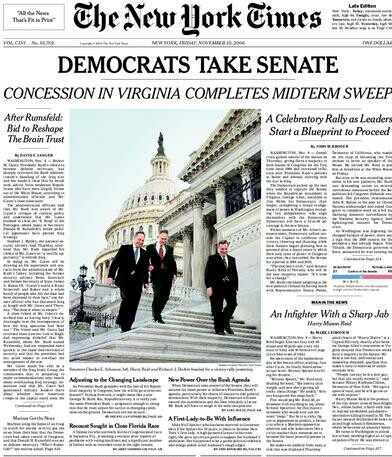
NY Times Headline: Democrats Take Senate

Enterprise Engages in Spin Control


Folks, you just cannot make this stuff up. It is hard to imagine and yet utterly predictable at the same time.

Here we are, literally two days after the election, one day after the election addition of the paper, and now the Davis Enterprise is trying to mend fences for the city.

On the front page of tonight's paper is an article that was written in the Providence (Rhode Island) Journal. Now when was the last time you saw an article from the Providence Journal picked up? Two days after Target passes, and you have an article called "Thinking outside big box."

Forgive me if I'm insulting your intelligence. I'm not a conspiracy theorist. I believe and live by the maxim that you should never ascribe to malice what can be explained by stupidity. But let's be honest, is there any other reason for this article from a medium sized paper from across the country to be on the front page of the Davis Enterprise? I'll listen to reasonable alternative theories, post them in the comments below.

In the meantime, let me spell this out... Here's the message--the Davis Enterprise supported Target, Debbie Davis supported Target, Sherry Puntillo supported Target, the Council Majority Supported Target. Target presumably has passed. Now most of the small businesses from downtown wrote into the Davis Enterprise and signed a letter of opposition to Measure K. The power elite in Davis now fear that the businesses in downtown will leave before Target comes here. And so they have put this article in the paper to show the businesses of downtown that they can survive.

The caption says it all "Small stores fend off large retailers with service, specialties." Message to downtown: specialize with good service and you can survive.

Now let me tell you a nice story, a few months ago, the wife and I went to the matress store downtown, she's very particular about the matress, and the guy patiently spent a good hour making sure that we were happy with the matress. He gave us a good deal as well, but I'm certain that we could have found the matress for cheaper somewhere else. But we wouldn't have gotten that kind of service. My wife has been happy with our matress from day one and we didn't have to buy it only to return it later. You cannot get that kind of service and care at a big box, you just cannot.

So I agree with that aspect of the article. But the overall net effect is concerning and it is buried in the article--when a big box moves in, small businesses leave town.

While it's generally accepted that retail giants such as Wal-Mart, Home Depot or Target can drive out some local businesses when they move into an area, in effect forcing people to lose their jobs, these large employers also create potentially hundreds of new positions to staff new stores. The net effect these changes have on a regional economy's labor market is still up for debate.

Elena Irwin, an associate professor of economics at Ohio State University, said the research regarding small retailers and stores like Wal-Mart is crystal clear.

"Small retailers get driven out of business when Wal-Mart moves into town," she said. "The research on the overall effect of Wal-Mart on jobs is mixed. There is the possibility of a significant loss of jobs or a modest increase after five years. Communities shouldn't expect a net increase in jobs because a Wal-Mart moves to town."

So yes, some businesses may survive. So may adapt. Some will continue to provide good personal service to this community. I do not have a problem with the article itself or what it is saying.

It is interesting to note, that when I looked up the original article, the title was different from title in the Davis Enterprise. The original title: "Small stores seek niches to fend off big competitors."

However, I find the timing and placement of the article "cynical, manipulative, and most likely politically motivated" (That is going to be my new catch phrase).

---Doug Paul Davis reporting

George Allen Officially Concedes

Democrats officially take the Senate, although realistically I was pretty sure this one was Webb's as soon as Webb took the lead late Tuesday night.

New York Times Story on the Concession

Exorcising Demons of 1994

In 1994, I was a young volunteer and activist working on a Congressional Campaign for Walter Capps. By the time the polls had closed on the West Coast at 8 pm, there was a new Speaker of the House--Newt Gingrich and the Republicans had won the Senate as well. Small consolation in California was that Senator Feinstein was spared in a very close victory over Michael Huffington who spent tens of millions.

A funny thing happened that night though, as the results came in for the 22nd Congressional Race, Capps--a religious studies professor and political neophyte who was taking on then Assemblywoman Andrea Seastrand a long time political figure who was the widow of Eric Seastrand a long-time Republican office holder. Seastrand a firebrand Conservative who fit in well with the "revolutionary" class of 1994. On the worst Democratic night at least since 1980 and perhaps since well before, Capps was holding his own, going toe-to-toe with Seastrand. In the end, he literally fell a few hundred votes short of a victory. Two years later he would claim that victory, but he passed away in 1997 as he finished the first year of his first term. His wife, Lois Capps has been in Congress ever since.

That night, I went to bed somewhere after 3 am, exhausted, the reality of the day hadn't really hit me quite yet. In the morning, the alarm goes off and there is Paul Harvey on the radio, gloating. A herd of dancing elephants rampaged through Washington last night, he said. It turned my stomach. It was the dagger that made everything real.

I'll never forget that moment. When history writes of November 7, 2006, they will note that the Democrats took 28 seats in the House and 6 in the Senate. That former number might creep up to 30. If you compare those raw numbers of seats chaniging hand, it will be fairly unremarkable in the annals of history. And yet, those numbers will belie just how improbable what happened would occur. You see, we might have projected this for the past month or so, but go back in time and this was exceedingly unlikely.

The environment at the beginning of 2006 looked poisonous for the president, but the number of marginal house seats was exceedingly low. Most pundits could point to 12, maybe 18, at the very most. They just didn't see the Democrats winning all of those. Democrats held 18 of the 31 Senate seats. Remember this is the same batch of Senate seats that the Democrats took in 2000 to even up the Senate at 50-50. This is the only class where Democrats had the majority of Senate Seats. There were at most 8 Republican seats in play and Democrats needed to take six of them. But it was even harder than that--Democrats had won in Redstates like Nebraska and Florida last time. They had to hold off tough challengers in Minnesota, Michigan, Washington, New Jersey and Maryland. Even on Tuesday afternoon, NO ONE, honestly believed the Democrats could take the Senate.

I say all of this to show how improbable what happened was. Scandals, Iraq, and general discontentment put as many as 50 seats in play. Democrats have won 28 so far, I think by the time it's done, may 30 will go to the Democrats, far more than anyone ever thought possible six months ago. In the Senate, the Democrats got fortunate as there were weak challengers in Nebraska and Florida. Katherine Harris was an embarrassment to the Republican party (at little payback for 2000 no doubt to see her clocked cleaned). Democrats won big in Minnesota and Michigan where there could have been tough races. Even Maryland and New Jersey went by almost double digits. The Democrats did not lose a single incumbent in the House, Senate, or Governor, and they did not lose a single-seat previously held. That's amazing.

But what happened in the Senate was nothing short of miraculous. First, Pennsylvannia--everyone knew that Santorum was dead and he stayed dead. In Ohio, it was a massacre of DeWine and Strickland beat the nemesis of 2004, Blackburn. So nice payback there. Those were the two givens. Rhode Island, honestly I like Lincoln Chafee, I worked with his father in the Senate on some legislation back in the day, he was good man and really a liberal. But Democrats needed that state and won it. Missouri was a battle to bone and McCaskill beat back a very conservative Jim Talent to win that. Montana is one of the most conservative states in the country, Tester is no one's idea of Democrat, but he's a populist and was able to beat Burns--a thoroughly corrupt man.

And finally in Virginia--George Allen was the darling of the conservatives and apsirant for the 2008 Presidential Nomination and possibly the Conservative frontrunner. He was poised to win and win big until he slipped up with the now infamous "Mackaka" reference. Anyone who doubts the power of new technology look no further than Montana and Virginia. Both incumbents slipped up and got caught on home video. The difference between now and 2006 is Youtube. They put it on Youtube and the gaffe's spread immensley. Burns attacked firefighters and Allen made some unforgiveable statements about a native Virginian because of the color of his skin. Power to the bloggers! They ultimately did not win in Connecticut, but I think they'll trade Connecticut for Montana and Virginia. Now the Democrats need to govern.

We have a lot of work left to do in Yolo County, but despite the disappointing local results, I went to bed last night finally after being up for nearly two days with a big smile on my face knowing that the Speaker of the House is Nancy Pelosi and that the Democrats control congress.

---Doug Paul Davis reporting

Local Congressional Battles bring Victory

Yes Charlie Brown ended up losing to John Doolittle on Tuesday night, but from all accounts no one was acting like this was a loss. You see, Charlie Brown went toe-to-toe with an eight term incumbent in a District that have a 16-point registration advantage to Republicans and Charlie Brown gave it everything he had and gave Doolittle all that he wanted. In the end, he lost just 49-46--beating Democratic registration by 13 points. That would have been an extremely astounding victory for Democrats.

Brown fought against Doolittle on issues of ethics, his ties to Abramoff, and his support for the war in Iraq. For his efforts, Brown a long-time veteran of the U.S. Airforce, his son serving four tours of duty in Iraq, had his patriotism questioned and his name linked to Sean Penn, Code Pink, and Cindy Sheehan.

The interesting thing to watch now will be--will Doolittle get indicted? If he does, Brown is in an excellent position to jump back in and take the Fourth District for the Democrats.

Meanwhile, there is no moral victory in the 11th District. The 11th District, has much more favorable numbers than the Fourth for Democrats, only a 5 to 6 point registration disadvantage. Still Democrats do not fare well in such districts. But don't tell that to Jerry McNerney. McNerney had battled Pombo in 2004 only to lose. This time, he emerged with a solid victory.

McNerney was able to stay within 1200 votes in the more conservative San Joaquin county and make up the difference in the more liberal Contra Costa, Alameda, and Santa Clara counties.

This was a great victory for grass-roots politics. Pombo wants to try to get an overhaul of the Endangered Species Act through the lame-duck Congress, despite the fact that the environment was one of the issues that eventually helped to bring him down.

McNerney is a lesson for Democrats and a victory for people like Howard Dean who has created the 50-state program, trying to find Democrats who can go toe-to-toe with Republicans even in the most conservative of areas. Tuesday night seemed a vindication for those policies.

Now, McNerney is going to Congress and Pombo is going home. Charlie Brown did not win, but Doolittle is going back to Congress a humbled man, knowing that he barely survived one fight of his life, but he faces another--possible indictment of Abramoff money. We'll watch closely these developments and see if Doolittle ends up going back to Northern California as well.

---Doug Paul Davis reporting