The Vanguard has a new home, please update your bookmarks to davisvanguard.org
Showing posts with label SMUD. Show all posts

Wednesday, April 18, 2007

Davis City Council Delays Proclamation to PG&E While Woodland "Studies" Public Power Issue

PG&E had a representative waiting in the audience to receive their award for donating $10,000 to the Davis Street Smarts program. But they will have to wait at least until the next meeting to receive it because Davis City Councilmember Lamar Heystek made a motion that would result in a delay in the proclamation presentation until a future meeting when the council could concurrently offer up a resolution similar to Woodland City Councilmember Art Pimentel's to support future efforts to develop public power.

The move began at the start of the Council Meeting Tuesday night. Mayor Sue Greenwald asked for the approval of the agenda. Councilmember Heystek instead introduced a motion to approve the agenda with the exception of the proclamation to recognize PG&E's contribution. Mayor Greenwald seconded the motion. And Heystek explained that he thought the council since Measures H and I passed overwhelmingly in Davis should join Pimentel's efforts by affirming their commitment to public power at the same time they award PG&E, the city's present provider who spent millions to defeat the public power initiative last fall.

Councilmember Don Saylor looked visibly shaken by the turn of events but eventually caught himself. When Ruth Asmundson spoke in support of Heystek's motion, it was all over and the motion passed without dissent. Coucilmembers Heystek and Stephen Souza will be submitting resolutions that dovetail on Pimentel's Woodland resolution and staff will iron out any differences. When the vote comes back to council, we can expect it to pass unanimously.

Unfortunately things did not go as smoothly last night up in Woodland. Instead of passing a rather simple resolution, the council has directed the formation of a subcommittee composed of Art Pimentel and Skip Davies. The passage of it will be tenuous as best as it is clear that neither Jeff Monroe nor Bill Marble will support public power again. Mayor Dave Florey may hold the swing vote there.

This is a rather disappointing turn of events, as just a few months ago, the Woodland City Council had been unanimous in their support of Measures H & I. However, the City of Woodland overwhelmingly voted down the measures on the November ballot. I am very disappointed with Jeff Monroe. Monroe is supposedly a Democrat, who has future ambitions for higher office--some have suggested possibly sheriff. Too often he is not reliable in supporting core Democratic principles. Supporting public power over the massive corporate entity of PG&E should be a no-brainer. But that might require Jeff Monroe to take a risk now that the Woodland voters so overwhelmingly opposed H & I in the wake of the disinformation campaign put on by PG&E to confuse the voters. Instead of fighting to educate his community, Monroe is playing it safe.

It may seem like a small victory, but the actions by the Davis City Council loom large as PG&E who had been pounding on the Woodland City Council and using the full force of their power and influence to prevent the passage of the resolution, were denied an honor the same night down in Davis. They will get their turn, but only as the Davis City Council renews their professed commitment to public power.

The PG&E representative, obviously caught off-guard by the actions on Tuesday, was forced to give a brief statement during public comment expressing support and commitment to safety issues.

It was not a perfect day for advocates of public power, but the Davis City Council stepped up and did the right thing. Now it will be interesting to see if PG&E wants to expend the same efforts to pound on the Davis City Council that they did to the Woodland City Council. I will go out on a limb and say they will not because they see the writing on the wall.

---Doug Paul Davis reporting

Tuesday, April 17, 2007

Why is the City of Davis Recognizing PG&E?

Last fall Measure H & I, a measure that was unanimously supported by the Davis City Council, was placed on the ballot. In a rare showing of unity, the councilmembers came out in support of public power as a mean not only save money but to produce cleaner energy not subject to windfall profits.

In response, PG&E waged an expensive, dirty, and misleading campaign.

As Stephen Souza co-wrote a letter to the editor in November with County Supervisor Mariko Yamada:
"Davis voters sent an unmistakable Election Day message about public power — we want it! The twin SMUD annexation Measures H and I passed here by a nearly 62 percent margin despite PG&E's unprecedented $11 million disinformation campaign to defeat us. Unfortunately, their efforts to frighten and confuse Sacramento SMUD ratepayers and West Sacramento and Woodland residents were too great to overcome — this time."
Because of these deceptive efforts, PG&E decided it needed to do damage control. After all there was a good deal of bitterness in this community and PG&E recognized that it had to mend the fences--otherwise it would only be a matter of time before the next Measure H & I was proposed.

After an $11 million campaign to keep their stake in Yolo, the company basically threw down some chump change to contribute to the development of the Davis City Street Smart public education program at the platinum level. Hey if they were willing to spend in the tens of millions, what is $10,000 to them.

Now the city of Davis has a contract with them to honor them in exchange for this contribution to the Street Smarts program. This is not something that the City Council wants it is being dictated to them by non-elected staff decisions. Who runs this town again?

Meanwhile as we have seen in the last few days, PG&E in response to a resolution before the Woodland City Council sponsored by Art Pimentel has set up a full-blown answering service to direct calls in the Woodland City Hall opposing the rather innocuous resolution.

The resolution declares,
"The City Council of the City of Woodland supports the continued assessment of power alternatives that would lead to less expensive, more reliable and more earth-friendly electric power for the citizens, businesses and property owners of Woodland and throughout the Yolo County region."
So tonight at the Davis City Council, PG&E will be honored for their community contribution. At the same time, at the Woodland City Council they will be intimidating and browbeating the Woodland City Council in opposition to a resolution supporting the concept of public power.

If PG&E wants to donate to Davis Street Smarts that is fine, but we do not need a proclamation honoring them.

---Doug Paul Davis reporting

Sunday, April 15, 2007

The Fight for Public Power Continues Post-Measure H and I

PG&E last fall spent over $11 million in Yolo County to turn back a several year movement to bring public power to Yolo County. They did so by overwhelming the more modest efforts of those supporting public power. They did so by turning back the rare united effort by Yolo County elected officials. And they did so by confusing the issues in the voter's minds making them believe or at least doubt the financial outcome of such a change. In Yolo County this lead to the barebones defeat of Measure I. In Sacramento County it led to the massive defeat of their companion measure that would have authorized expansion of SMUD.

However, the fight for public power was not a short-term battle by any means. Measures H and I were several years in the works and the result of hard fought efforts by a number of activists, public officials, and local efforts. Those efforts did not die at the ballot box last November. PG&E may have defeated that effort, but now they will have to defeat future efforts as well. And at some point, PG&E is going to be the one that ends up on the losing side.

This Tuesday, April 17, 2007, the Woodland City Council is taking a very modest step toward public power by sponsoring a resolution that basically demonstrates their commitment to public power.

The resolution declares,
"The City Council of the City of Woodland supports the continued assessment of power alternatives that would lead to less expensive, more reliable and more earth-friendly electric power for the citizens, businesses and property owners of Woodland and throughout the Yolo County region."
Art Pimentel, Woodland City Councilmember is one of the key supporters of this resolution.
"We need to look at all options and alternatives to PG&E and bring this issue back to Yolo County voters in the near future."
PG&E if you can believe this, has already hired a company to defeat the resolution--a resolution that is very basic and does not mention SMUD as the alternative to pursue. They have actually created a call center that will link callers directly with Woodland City Hall.
"The resolution was not even made public until this afternoon and already had around 50 calls into City Hall to oppose a Resolution "supporting SMUD" As you can see the resolution has nothing to do with SMUD, but looking at other alternatives/options to bring Public Power to Woodland and Yolo County."
As the Realist writes:
"This has nothing to do with bringing SMUD back on the table. It just says we should be vigilant and keep exploring other alternatives. A monopoly in my opinion is not the best alternative. The control is out of our hands. PG&E may in fact be our best solution to power, but it will hurt nothing to investigate it."
Supervisor Matt Rexroad lended important support to Councilmember Pimentel and the cause on the Woodland Journal Blog:
"I support Art in this effort. Look -- whatever you think about Art -- he is standing up for what he believes in. You have to respect that. It is really easy to just try to make everyone happy all the time. That is not leadership. Art is out making things happen proactively. He is not out there waiting for things to come his way. This resolution has nothing to do with SMUD. It has nothing to do with the guys in the blue trucks. It is about public power and exploring that option for Woodland."
Pimentel and other supporters hope that other communities will pass similar resolutions supporting public power.
"I hope, West Sacramento, Davis, Yolo County, and others can pass the same resolution and be committed to the cause."
To view the full resolution see The Woodland Journal.

From the comments on the Woodland Journal, Mr. Pimentel could use our help and hopefully the Davis City Council can look at a similar resolution. Davis helped to pass Measures H and I overwhelmingly, and we need to help communities like Woodland continue the fight.

---Doug Paul Davis reporting

Sunday, December 24, 2006

2006: The Year in Davis Review

These last days we will have a countdown of the top 10 stories from Davis in 2006. We continue with our second installment, No. 5 PG&E spends $11 million to defeat the Sacramento Municipal Utility District Yolo Annexation Vote...

There was a long-time effort on the part of Yolo County elected officials to bring public power to Yolo County through the annexation of the Yolo County power infrastructure to the Sacramento Municipal Utility District (SMUD). The remarkable thing is that elected officials who can hardly agree that the sky is blue all came together to support this proposal--city councilmembers from the three major cities in the county, every member of the Yolo County Board of Supervisors, and even school board members and special district unanimously supported the SMUD annexation.

In many ways, it seemed like a slam-dunk--at least in Yolo County. Unfortunately, this was not a level playing field. It was one heavily tilted toward the electricity giant, PG&E. Yolo County had to pass not one but two measures--H and I-- and Sacramento County had to consent to the expansion of SMUD into Yolo County through the passage of Measure L (not to be confused with the Davis Measure L in support of Choice Voting).

The battle lines for this election were drawn early.
  • SMUD estimated Yolo County energy customers would save $148 million over 20 years if they switched providers.

  • Pacific Gas & Electric Co. estimated the move would cost this area's customers $835 million.
The dispute had to do with the value of PG&E's infrastructure and facilities.
  • SMUD estimated that value was between $86 million and $133 million.

  • PG&E on the other hand, estimated that its facilities were worth more than $500 million.
Those cost differences accounted for roughly half of the difference in the projected cost to Yolo County energy consumers. The rest of the difference was derived from predictions about the future cost of natural gas, a key component for generating electricity.

PG&E aside from the structural advantage of only having to prevail on one of three measures, had one other key advantage--virtually unlimited resources. They spent $11 million on their campaign to convince Yolo County voters that this was too risky. SMUD, on the other hand, could spend no campaign money as they are a public agency and prevented from doing so. So grass roots citizen driven campaign organizations ran the Yes on H & I (Yes on SMUD) campaign in Yolo County raising from local businesses and the general public just over $100,000 to fight PG&E's propaganda machine.

PG&E's strategy was first, to cast doubt on the fact that Yolo County consumers would save money by switching to SMUD.

Second, PG&E presented themselves as environmental friendly and SMUD as enemies of the environment.

The People's Vanguard of Davis devoted numerous articles to discussing this topic.

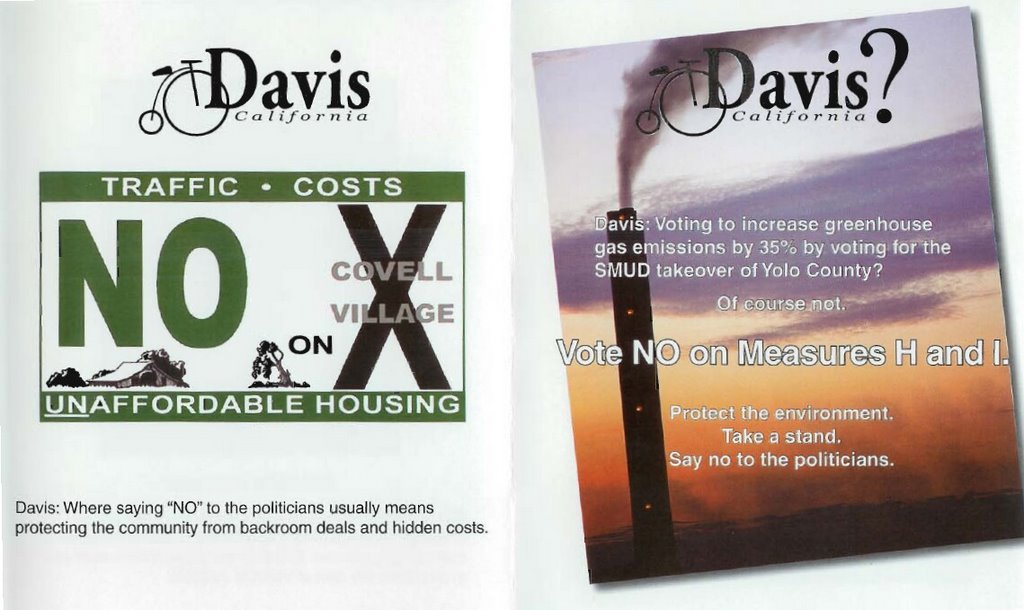
One of the more duplicitous tactics by PG&E and their campaign consultants was the mailer sent to Davis households that suggested that a vote for PG&E was equivalent to a vote against Covell Village.

In the end, the deck was stacked against a victory by SMUD. Measure H narrowly prevailed in Yolo County. Measure I narrowly was defeated in Yolo County. But Yolo County was irrelevant as Measure L was overwhelmingly defeated by a huge margin in Sacramento County.

As I wrote in the post mortem:
"Even granting the large defeat in Sacramento County, I'm a bit disappointed with the Yolo County results. Had Yolo solidly voted to support SMUD, it would have been a loud and clear signal. First, that PG&E could not buy our votes with their ten million dollar plus campaign, fraught with deception. Second, that we were not happy with our service from PG&E."
In the end, the process concerned me much more than the outcome. In politics you win or lose. But there is a bitter pill to be swallowed when you face a corporation with unlimited resources who unleashes their money and propaganda in ways designed to confuse the voters.

---Doug Paul Davis reporting

Wednesday, November 22, 2006

Dunning's Ridiculous Lampoon of Souza and Yamada

As far as letters to the editor go, it was pretty uneventful and unnewsworthy. Yet somehow it becomes fodder for the sardonic humor of Dunning.

On November 15, 2006 County Supervisor Mariko Yamada and Davis City Councilmember Stephen Souza wrote a rather ordinary and standard letter of thanks to the contributors and supporters of Measures H & I. Completely unremarkable unless you are Bob Dunning.


Public power quest is still alive

Davis voters sent an unmistakable Election Day message about public power — we want it! The twin SMUD annexation Measures H and I passed here by a nearly 62 percent margin despite PG&E's unprecedented $11 million disinformation campaign to defeat us. Unfortunately, their efforts to frighten and confuse Sacramento SMUD ratepayers and West Sacramento and Woodland residents were too great to overcome — this time.

On behalf of Yolo4SMUD, we wish to thank all of our contributors and supporters — including The Davis Enterprise — for advancing the dialogue on the clear benefits of municipal over investor-owned utilities. The quest for local power, which began nine years ago in Davis, is still alive, strong and well. Stay tuned, and thank you.

Mariko Yamada, chair

Stephen Souza, treasurer
Dunning writes:
let's correct that statement about a "62 percent margin" … there was no such thing … SMUD got 62 percent of the Davis vote … a 62 percent margin would be 81 percent "yes" and 19 percent "no." …
Okay, they misspoke or mistyped, they got 62 percent of the vote not a 62 percent margin. Let's haul off and write a column on it... oh yeah, he did. Must have been a slow news day.
You might want to read that last sentence again … Davis folks, you see, were too smart to be frightened or confused … but the lowlifes in those other cities we're forced to share a county with just couldn't put two and two together and were thus at the mercy of the merciless power company …
Yes this letter to the editor is a clear example of "our elitism shining through." I won't defend Souza on this score, but anyone who knows Mariko, knows she is anything but an elitist. If anything she's humble to a fault.

Moreover I just don't see any evidence of elitism in this letter. What I see is frustration and anger that PG&E spent $11 million plus on a campaign to distort the issues and their record on the environment. The only difference between Davis and Woodland and Sacramento is that Davis is a bit more liberal and it took more to convince them that PG&E was an environmentally friendly company than a fradulent "No on Measure X" flyer purporting that a vote for PG&E was a vote against Measure X (or something like that).

If Dunning wants to be outraged, how about being outraged at PG&E for dumping $11 million into a campaign to keep their services in Yolo County and using every trick in the book to try to confuse the issue.

And if we are to be outraged, perhaps we shoud be upset that Dunning is filling our newspaper space with such banalities. Oh yeah I forgot, he's funny. Can anyone explain to me the humor in this column, because the only one I'm laughing at is Dunning himself for writing about this.

---Doug Paul Davis reporting

Sunday, November 19, 2006

Souza's shot in the dark on PG&E

At Tuesday's City Council Meeting, Councilmember Stephen Souza got up before council to talk about the recent SMUD-PG&E election. Souza was a strong supporter of the SMUD annexation attempt in Yolo County.

One of the key parts of the election was the dispute between SMUD and PG&E over how much it would cost for SMUD to purchase PG&Es infrastructure. SMUD believed it was worth between $86 and $133 million while PG&E focused on the number $520 million.

Souza never really understood this point, he got burned by it at a Measure H & I debate by the PG&E spokes man. Here's my best understanding of the rule. For electricity infrastructure, fair market value is not determined by current worth. Rather it is determined by replacement value. Hence PG&E is claiming that the fair market value for their infrastructure is $520 million. SMUD was disputing that figure and placed it much lower at between $86 million and $133 million. I do not know enough to know which figure was accurate.

However, regardless of PG&E claims, they are not being assessed at replacement value but rather at actual value. The Board of Equalization is the one that assesses their value and the amount that they are paying taxes. The Board of Equalization is certainly going to be far better aware of the assessment laws than Councilmember Stephen Souza and it is unlikely that they have been assessing PG&E's current taxable value incorrectly.

Of course, Souza could have discovered most of this if he had asked questions in private about how taxes are assessed versus fair market value issues that arose during the campaign. Instead he has suggested that council agendize this. We see no purpose for this and believe it a waste of staff time and resources and that council should put its energies into other areas.

---Doug Paul Davis reporting

Tuesday, November 14, 2006

The PG&E Aftermath

I have delayed my writing of the PG&E decision until a week after the election (hard to believe it has only been a week). The problem with any analysis is that while H&I were extremely close elections, the fact that Sacramento had to approve it as well and it wasn't even close to passing in Sacramento, makes it difficult to do a true post mortem. It is disappointing though not surprising that it would fail by a large margin in Sacramento. After all, the benefits to Sacramento rate payers are not as immediately evident and it is far easier for PG&E to scare them.

Still I believe that had H & I passed in Yolo County it would have sent several loud and clear messages to PG&E. That message is mooted by a split decision. Dunning thought this was an odd outcome not understanding why someone would vote for one and not for the other. But in actuality it's not that odd with one passing by 400 or so votes and the other failing by a similar margin, as close as the two are to each other, this amounts to little more than random error by a small number of people not fully aware that these are two sides of the same coin, it's likely that 98 percent of the people voted the for both and only a tiny percent split their vote.

And yet, even granting the large defeat in Sacramento County, I'm a bit disappointed with the Yolo County results. Had Yolo solidly voted to support SMUD, it would have been a loud and clear signal. First, that PG&E could not buy our votes with their ten million dollar plus campaign, fraught with deception. Second, that we were not happy with our service from PG&E. (Obviously PG&E prevailed by casting doubt about the SMUD move more than by convincing us that we liked them).

This was a rare election in so many ways. There was near animous support among Yolo County Elected officials--every member of the three major city councils and all five members of the Board of Supervisors won. How is it then possible that PG&E wasn't soundly defeated in Yolo County?

The obvious answer was the slew of deceiving mailers and TV ads in Yolo County. PG&E managed to turn the strength of SMUD into an uncertainty by casting doubt on their ability to lower the bill for rate payers. This had to do with the costs of annexation. Watching the debate between SMUD and PG&E, it seemed that the pro-H & I side was ill-prepared for this argument even though they knew it was coming. Frankly after watching the debate, I had doubts myself about their plan even though I knew going in I was going to vote for SMUD regardless. The PG&E arguments were extremely effective unfortunately.

The second problem was that just like Target, PG&E tried to turn the issue of the environment--one of their weaknesses in their favor. So they launched a massive campaign to convince Yolo County voters that PG&E was environmentally friendly and perhaps as importantly that SMUD was not environmentally friendly (easier to convince people of negatives). They even went as far as to compare PG&E's effort to the No on X effort which we covered.

The bottom line of the PG&E effort was to convince the rate payers that they may not like the current system, but a new system may be worse, so stick with the devil you know. And when you have a resource advantage, it's easy to convince people to stick with the status quo by voting no. The no side almost always has the advantage in these types of races.

It is obviously difficult to fight back when you are facing a 10 million dollar plus campaign. But one way that might have been helpful would have been for each of the 20 officeholders to contact their core constituencies with a direct message of support for SMUD and an explanation of why it was important for them to support H & I. I'm not being critical of the SMUD effort, because they did very well facing overwhelming odds and an overwhelming resource disadvantage. At the end of the day, given that disparity, it was hard to win. I had hoped that the voters in Yolo County would see through the smoke and mirrors, but it seems very obvious that PG&E was able to obtain their by creating enough confusion and uncertainty to nudge a defeat on Measure I.

As I said previously, it was rendered moot by the large and overwhelming defeat in Sacramento County. This was a long and difficult process, so it is hard to know if this is the end of the fight or if they will try to revisit it. If they do wish to revisit it, they need to conduct a long and very concerted education campaign prior to the fact and they need to make it very clear exactly how much this will cost, so that PG&E has a more difficult time of mucking the waters.

---Doug Paul Davis reporting

Sunday, November 05, 2006

Chamber Clarifies Their Positions

Anyone see the letter to the editor in Thursday's paper, it was kind of buried but it was from Jeff Adamski and Sherry Puntillo:

Chamber reiterates its positions:
The board of directors of the Davis Chamber of Commerce wishes to reiterate its positions on Measures H, I and K. For Measures H and I, the SMUD annexation proposal, the Chamber has not taken any position and will not do so. With respect to Measure K, the Second Street Crossing development, while the Chamber supported the project through the planning process, we have updated our position to neutral.
Okay we're all clear now. Thanks for that.

Anyone wondering what that was all about?

On October 17, the People's Vanguard of Davis reported on the Chamber of Commerce's perplexing change from an endorsement of Target when it was a City Council issue, to no position once it became a ballot measure. The rationale behind that change is perplexing. Moreover, most of the key people in leadership positions are all personally supporting it and the change in position was never formally announced.

Meanwhile, a few days later we discovered that Bruce Gallaudet of University Honda, a board member on the Chamber of Commerce (and husband of Davis Enterprise Editor Debbie Davis) used the Chamber of Commerce attribution on the Sample Ballot Statement against Measure H.

It is nice that they clarify that they have no position on SMUD or Target, but that's all they tell us. There is no public announcement repudiating the use of the attribution by Gallaudet and there is no explanation as to why they would support Target in June but not November.

This seems standard policy by the Chamber to not publicly deal with issues of these sorts, but it's almost like there is a cloak of secrecy involving some of this stuff.

---Doug Paul Davis reporting

Friday, November 03, 2006

PG&E buys Target Votes

A few weeks ago I suggested that PG&E’s campaign against SMUD may actually be Target’s best friend. A few days before the November 7 election, I think that notion needs to be explored again, especially in the wake of the financial disclosures this week.

Recall back to a year ago—the Measure X campaign rubbed people the wrong way with the amount of money they spent but also the professional looking brochures that bombarded the public on a daily basis. Flash ahead a year later, and we see that the Measure K campaign has actually slightly outspent the Measure X campaign. However, they have toned down their assault on our mailboxes while assaulting us with a slew of cheaply produced TV commercials.

However, much of the scrutiny is off the Target campaign, because whatever excesses you can accuse the Target and the Yes on K campaign of, they pale in comparison to what PG&E is doing to us.

This Monday, and I know I’m not alone because I’ve read it elsewhere, I opened my mailbox to find not two but FIVE different mailers from PG&E in there. FIVE. And because they sent to my wife as well on some of them, there was a total 8 mailers in my mailbox on Monday. They were professionally produced, multicolor mailers. PG&E isn’t shy.

While Target has spent in excess of $200,000, PG&E has spent $10 million plus in fighting to keep its market-share in Yolo County. TEN MILLIION DOLLARS.

PG&E is obviously committed to staying in Yolo County. Target on the other hand, I guess just doesn’t want our business nearly as badly.

I’ve said this several times already, but it bears repeating. I have favored the SMUD annexation for quite some time, but the PG&E campaign has really raised the stakes on this election—but then again, I guess $10 million will do that for you. If they are willing to spend that on a campaign, you can wonder how much this County is worth to them—a fairly small county as California goes.

I think we all knew PG&E would fight to keep Yolo County, I’m not sure anyone expected it to this extent. You have to wonder if they aren’t trying to send a message for future reformers. I think we all need to send them a message on Tuesday—Yolo County cannot be bought.

---Doug Paul Davis reporting

Wednesday, November 01, 2006

PG&E Now Under Investigation for Campaign Activities

This morning's Sacramento Bee reports:

The increasingly aggressive election battle over electricity service in eastern Yolo County landed on the steps of the Capitol on Tuesday, with several lawmakers calling for an investigation into Pacific Gas and Electric Co.'s campaign tactics.

Assemblyman Dave Jones, D-Sacramento, and Sen. Deborah Ortiz, D-Sacramento, denounced PG&E for using a customer service telephone line and billing inserts to oppose ballot measures that would enable part of Yolo County to drop PG&E and buy power instead from the Sacramento Municipal Utility District.

Ortiz and Jones -- along with Assemblywoman Lois Wolk, D-Davis, who was not at the news event -- wrote a letter dated Tuesday to the Senate Energy, Utilities and Communications Committee and the Assembly Committee on Utilities and Commerce requesting that PG&E be asked to demonstrate that none of its inserts, telephone recordings or other political activities was paid for with ratepayer funds.
While we are certainly glad that people are starting to take notice about the campaign that PG&E has run against H&I, this issue only covers part of the story including the misuse of campaign and city logos for campaign purposes, the complaint filed by the No on Measure X campaign, the complaint filed by the City of Davis. The entire PG&E campaign has been misleading. The central issue in the campaign is over whether or not there will be savings for county ratepayers--the question I have to continually ask is whether you trust any claim that PG&E makes, because I sure don't. At this point, I would at least be inclined to investigate a claim that the sky was blue. That's how little credibility they have with me. I'll be honest, I was always going to vote for SMUD, but it wasn't an issue high on my radar until I watched the utterly contemptible campaign emerge.

---Doug Paul Davis reporting


Sunday, October 29, 2006

Davis Enterprise Reports on PG&E Using unauthorized logos


On October 20, we reported that the No on H & I campaign was trying to fool voters by using the No on X logo implying support by the No on X campaign for PG&E. A few days later we received a letter from the No on X campaign, demanding that PG&E retract "the implication that the No on X Committee has anything to do with your campaign against Measures H and I."

Finally, nine days after we first ran the article, the Davis Enterprise has run a story on the controversy. The main focus of the story is the unauthorized use of the City of Davis logo (see top right of the image above). Harriet Steiner wrote a letter to the FPPC and the Yolo County District Attorney's office. The City Council complained that they were not asked permission for the use of the logo and would not have granted permission had they been asked. You may recall that all of the members of the Davis City Council have endorsed the SMUD Annexation, along with the member of Woodland, West Sacramento, and the County Supervisors.

This follows another snafu from the PG&E backed group, where a ballot designation of the Davis Chamber of Commerce was used by Bruce Gallaudet, husband of Davis Enterprise Editor, Debbie Davis. Surprisingly that story has not been published by Davis Enterprise. Nor has the Davis Enterprise printed the complaint by the No on Measure X people, despite the fact that they sent the same letter to the Davis Enterprise that they sent to us.

---Doug Paul Davis Reporting

Saturday, October 28, 2006

PG&E Continues its "Green" Makeover


Some things in politics just take your breath away and leave you shaking your head. The PG&E campaign is one of them. Actually in some ways, Target and PG&E are using the same script. If these were candidates, you'd be thinking, that they suddenly found environmentalism.

Theresa Francis wrote to the Davis Enterprise:
I'm going to open a Hummer dealership in a giant LEED building; that way I can help save the environment.
Bob Dunning of all people writes:
would we allow a strip joint on the site just because it was housed in an award-winning building?
(Personally I think that Bob just wants a strip joint, but that's just me).

PG&E is using the same play book. First, they use the No on Measure X campaign to tell us that a vote for No on H & I is just like a vote for No on X. Now they are leafletting the town (or at least my residence) with a door hanger that pronounced them the guardians of the environmental order and SMUD as the evil polluters.

Look I can understand them wanting to hold onto their natural monopolistic market share and that they hate it when competition comes along, but good gosh, give us at least some credit for having some intelligence. Just because you call yourself environmentally friendly doesn't mean that you are.

This is a company that built a nuclear power plant on an earthquake fault and that has been cited for numerous unauthorized releases of radioactive waste.

"Pacific Gas and Electric Co. has agreed to pay $96,000 in penalties for losing track of radioactive spent fuel at its defunct Humboldt Bay nuclear power plant. (12/05)"

"Facing fines of $25 million per day for the last 15 years, PG&E, owner of Diablo Canyon, faces a make-or-break ruling in June when the Central Coast Regional Water Quality Control board decides whether to slap a cease-and-desist order on the plant for its thermal pollution and resultant marine environment kill-off -- allegations that PG&E denies. That could be on top of the $14 million PG&E was fined by the state and federal governments in a related case for withholding evidence of pollution. The utility is currently in negotiations with the board over the case that could include a potential trade of some of the 13,000 acres (including 10 miles of coastline) surrounding the plant. PG&E's customers, however, have paid for that land over the years and no one can explain how a trade of ratepayers-to-public ownership can work. (5/22/2000)"
The San Francisco Guardian reports:

In 1997 PG&E was tried and convicted in criminal court for endangering the lives and property of gold country residents by failing to trim tree branches near electrical wires frequently enough to prevent major fires. Evidence showed that PG&E executives had diverted tree-trimming money to fatten profits and salaries of top corporate executives.

The story of the company's poisoning of community water supplies in Hinkley became a major Hollywood movie called Erin Brockovich, and a similar environmental disaster is still underway just south of San Francisco. Meanwhile, residents of the Bayview-Hunters Point district in San Francisco are suffering from alarmingly high rates of asthma and other illnesses that they link to PG&E's dirty power plant in the neighborhood (see "Poison Power," 1/28/98). In addition, the nearby Potrero power plant, which PG&E sold to Mirant Corp. in 1998, is scheduled for expansion.

PG&E stole nearly $200,000 from San Francisco by illegally running its power lines to the Presidio, according to a 1995 lawsuit the city filed against the company. Indeed, PG&E's service to San Francisco residents is illegal, according to the terms of the 1913 Raker Act, which requires the city to operate a public power system. The company's monopoly has led to decades of structural corruption at City Hall (see "How PG&E Wires the City," page 26).

In 1998 a major blackout hit the city – leaving nearly half a million San Francisco residents without electricity (see "Still in the Dark," 12/16/98). Officials determined that a failure to make a key backup safety check at a San Mateo substation caused the outage. For several years the company had been cutting back on maintenance staff to fatten profits.

In 2001, after lobbying for the 1996 bill that deregulated part of the state's electricity industry, PG&E shuffled off more than $600 million in profits to its holding company, gave its top brass $50 million in bonuses and raises, and declared bankruptcy. Since spring 2001, rates have soared 40 percent and customer service for everything from hook-ups to billing problems has worsened (see "Feeling the Crunch," 9/4/02).

Under its proposed plan to get out of bankruptcy, PG&E wants to free itself of the last vestiges of state regulation while at the same time making a very anti-free market demand: ratepayers must protect its shareholders and CEOs from any potential future losses (see "Competing Energy Visions," page 30).

PG&E has a long record of harassing internal whistle-blowers and reporters who dare to take on the giant company.

Whistle Blowers Beware

Also from that article in the Guardian:

Silencing critics

Although PG&E likes to insist it is a tolerant and responsible company, it has a long history of retaliating against any employee who blows the whistle on its irresponsible practices.

In the 1997 Nevada County fire case, one of the prosecution's star witnesses was Jim Sprecher, a PG&E engineer who had written a report concluding that the company was letting trees go untrimmed for too long and jeopardizing public safety. Instead of heeding Sprecher's concerns, the company demoted him, relegating him to an unimportant job and ostracizing him socially, he testified.

He also testified that the report mysteriously disappeared from his unlocked filing cabinet at work at some point between 1993 and late 1996, when he was contacted by Nevada County prosecutors (see "Vanishing Report," 5/21/97). The report's recommendation to increase spending on tree trimming was ignored by PG&E higher-ups.

At PG&E's April 1998 shareholders meeting, Neil Aiken, a shift foreperson at the Diablo Canyon nuclear power plant, stood up and told shareholders about safety problems that came from cost cutting at the plant. He told the audience he came forward only in desperation, because he had exhausted all possible routes of solving the problem within the company. He also released a report detailing the safety issues called "Going Critical" (see "Nuclear Leak," 4/22/98).

That year PG&E executives forced Aiken to undergo psychiatric evaluation. He was locked out of the plant and forced off his job after 24 years (see "Plugging the Leak," 11/18/98). The Project on Liberty and the Workplace took up his case, and the U.S. Department of Labor found PG&E guilty of retaliation in November 1999 (see "PG&E Fires Whistleblower," 4/5/00).

PG&E also has a history of blackballing reporters who challenge the utility. Energy writer J.A. Savage sued PG&E in 1988, charging that the company had gotten her fired from two jobs because she had once worked for an antinuclear group and had written for the Bay Guardian. She settled the suit for an undisclosed sum in 1995 after the state Court of Appeals found that her allegations had enough merit to go to trial (see "Reporter Beats PG&E," 11/8/95).

"PG&E wields considerable power over the press covering its activities," Judge Williams Newsom wrote in a 1993 appeals court opinion dealing with the question of whether PG&E should be able to blacklist reporters who work for the Bay Guardian. "In the case of a public utility enjoying such extensive monopolistic authority ... there is an important public interest in assuring the freedom of the press in reporting on matters lying within the exercise of its franchise."

PG&E has used its formidable power to undermine that constitutionally protected freedom. The haze of P.R. the company generates regarding its operations has proved effective in protecting the utility's empire – at the direct expense of the public's financial interests, safety, and health.

Campaign manipulations are one thing, outrights lies are another. PG&E is about as environmentally friendly as the Bush administration. Yolo County voters should not get sold down the river on this.

---Doug Paul Davis reporting

Wednesday, October 25, 2006

The Real Environmental Record of PG&E: Manufactured Studies to Cover-up Environmental Crimes

For those who have seen the movie “Erin Brockovich” you know the story—residents of a small rural town in the Mojave Desert, Hinkley, California, alleged that PG&E contaminated drinking water with the carcinogen hexavalent chromium—chromium-6 and that this exposure led to widespread illness and disease. They used the chromium-infused water as a coolant at some of its natural gas compressor stations but the discharged water tainted local groundwater supplies. Earlier this year the company agreed to pay $315 million to settle the dispute, nearly a decade after agreeing to pay around $160 million.

Typical of settlements, the company refused to admit wrong doing however, PG&E spokesman Jon Tremayne issued a statement Friday saying, "Clearly this situation should never have happened, and we are sorry it did." (USA Today, 2-16-06).

Given that those practices go back to the 1950s and 1960s, it’s not clear that we should use this case to taint PG&E. More stunning however, is their recent attempts to manufacture a study that demonstrated no link between chromium-6 and cancer.

From the USA Today article:

In December, the Environmental Working Group published a detailed account of PG&E’s alleged attempts to corrupt a previous medical study on chromium-6’s carcinogenic effects.

Drawing on records obtained under California’s Public Records Act, the public interest group chronicled how shortly after the first Brockovich case resulted in the huge plaintiffs’ award, a PG&E-paid; environmental consultant persuaded a respected Chinese scientist to participate in an update of his 1987 study that found chromium-contaminated water in rural China was linked to an increase in villagers’ cancer.

The new study found no such link between chromium-6 and cancer. In its investigation, the Environmental Working Group alleged that the revised study, published in the influential Journal of Occupational and Environmental Medicine, was written by PG&E consultants rather than by the now-deceased JianDong Zhang, whose revised paper misspelled his name three times.

The public interest group obtained records from California’s Office of Environmental Health Hazard Assessment that supported its doubts about the revised study, including the sponsors’ alleged failure to disclose who actually wrote the manuscript and who paid for it, in addition to their allegedly incorrect use of several epidemiological terms, according to the Environmental Working Group.

Here’s the full report from the Environmental Working Group which documents how PG&E conspired to reverse findings of a cancer study.

The Wall Street Journal reported today that the San Francisco-based consultants, ChemRisk, "conceived, drafted, edited and submitted to medical journals" a "clarification" of the Chinese study, according to documents filed in another chromium lawsuit against PG&E. They did so despite a letter of objection from the Chinese scientist who led the original study, calling their reversal of his findings an "inappropriate inference."

Davis residents who listen to the rhetoric of PG&E may want to read through that report. It is very illustrative—first, PG&E is running on its green record and while the actual Hinkley case did occur decades ago, the attempts by PG&E to manufacture a study to exonerate their past behavior is utterly indefensible and is a matter of recent record and behavior. Of course these facts have not been brought up in the current campaign, but I think Davis residents need to know about it.

The issue here is about responsibility and this is how PG&E reacts when they have made a mistake, instead of making things whole and doing the right thing, they try to lie and connive their way out of responsibility.

---Doug Paul Davis reporting

Monday, October 23, 2006

No on Measure X Responds to PG&E

On Friday, we reported that PG&E was using the "No on X" visage to convince Davis voters that they were green. Yesterday, the People's Republic of Davis received a communication for the "No on X" group. It was a copy of a letter to the PG&E asking them to cease and desist from using their image in the No on H & I campaign and demanding that they retract the implication that "No on X" has anything to do with No on H & I.

No on X

xxxxx County Road 97, Davis CA 95616

October 20, 2006

Davis Enterprise
Woodland Daily Democrat

Sacramento Bee
Sacramento News and review
The Flatlander
People’s Vanguard of Davis

California Aggie

Editor,

We have sent the following letter to PG&E and to its campaign consultants:

Dear PG&E,

No on Measure X was the successful citizens’ campaign to stop the Covell Village residential development in Davis. PG&E has distributed a mailer to all Davis residents which uses an image identical to the No on X campaign sign.

We object to the use of the No on X campaign sign image. We demand that PG&E send a letter immediately to all Davis residents retracting the implication that the No on X Committee has anything to do with your campaign against Measures H and I—the proposals to replace PG&E with SMUD as the electrical provider for Davis.

The No on X Committee does not endorse PG&E’s position against Measures H and I. PG&E has no right to use our lawn sign image in your advertisements and thereby misrepresent our citizens’ group on this issue. We object to your implied message to Davis voters that if they voted No on X they should now vote no on H and I. Measure X had nothing to do with PG&E or SMUD.

We demand your immediate response to this letter.

Sincerely,

The No on X Committee:

Anne Driscoll (530) xxx-xxxx, Stan Forbes (530) xxx-xxxx, Carolyn Hinshaw (530) xxx-xxxx, Dick Livingston (530) xxx-xxxx, Pam Nieberg (530) xxx-xxxx, Bill Ritter (408) xxx-xxxx, Eileen Samitz (530) xxx-xxxx, Ken Wagstaff (530) xxx-xxxx

Sunday, October 22, 2006

Journalistic Ethical Lines that Should Not be Crossed

It was with some anticipation that I looked at the editorial section of the Davis Enterprise this morning. For on this Sunday morning it was quite likely that the Davis Enteprise would be offering their endorsement on Measure H & I (Smud Annexation). One has to wonder if this was appropriate at all given Debbie Davis' husband, Bruce Gallaudet's relationship to PG&E and the No on H & I campaign. Davis and the Enterprise probably save themselves serious allegations by taking the Yes on H & I position, against the stated position of Gallaudet, but the questions about the proper relationship between Journalism, Business, and Politics do not resolve themselves so easily.

The legal Definition of a conflict of interest:
A situation in which a person has a duty to more than one person or organization, but cannot do justice to the actual or potentially adverse interests of both parties. This includes when an individual's personal interests or concerns are inconsistent with the best for a customer, or when a public official's personal interests are contrary to his/her loyalty to public business.
As we reported earlier this week, Debbie Davis' husband signed two ballot statements in the sample ballot that oppose Measure H. First he signed the statement opposing Measure H and second he signed the Rebuttal to the argument for Measure H. In other words, the husband of the Editor of the Davis Enterprise, took a public position on an issue that Davis would have considerable power as to whether or not to endorse. It is inappropriate in our opinion, that Davis or her husband take public positions on political issues. If they do take public positions on political issues, Davis should recuse herself from being involved in the endorsement process. As far as we can tell, this did not happen.

The more serious issue involved a meeting in December 2005 for the Sacramento Local Agency Formation Commission. According to the minutes of the meeting, "Mr. Gallaudet stated he has partnered with P.G. & E." "If P.G. & E. leaves, it will be like losing a friend. This is a big gamble. I don't want to gamble, or to lose a friend, " concluded Mr. Gallaudet. It is unclear exactly what Gallaudet meant by "partnered." But it is pretty clear from his statement that he had rather strong business ties to PG&E, possibly had financial ties as well, and clearly retained strong political support for the electrical company.

A more general problem with the Davis Enterprise is the very strong ties Debbie Davis has to the business community. Debbie Davis is the immediate past chair of the Davis Chamber of Commerce. Bruce Gallaudet serves on the board of directors of the Chamber. In June of 2006, the Chamber of Commerce supported the Second Street Crossing project (popularly known as Target). Sherry Puntillo, who is the CEO of the Chamber, explained in the Davis Enterprise that the Chamber supported Target in June when it was before the council, but now is neutral.

Indeed, according to an email we received from a member of the Chamber, the Chamber had no notification to the public about their changed stance. Not on their website. No in their newsletter. Not in a press release. It is unclear when or how they changed their stance, but apparently they did. Meanwhile their members like Sherry Puntillo and her husband, former Council member Ted Puntillo continue to strongly support Target and Measure K. Puntillo is featured on the TV ad that has been bombarding Davis TV for the past few weeks.

Meanwhile not surprisingly last Sunday, the Davis Enterprise Endorsed Measure K in support of a Davis Target.

Debbie Davis and Bruce Gallaudet's leadership positions with the Chamber of Commerce seems to put her in conflict with her other duty to the public in the form of fair endorsements. Editorial boards of course are paid to give their opinion. However, there should be a reasonable expectation that the Editor does not have other commitments either political or business that would cloud her judgment.

Is Davis well-served by having an Editor with such strong ties to the business community? Recall that the Davis Enterprise endorsed Measure X, a measure that 60% of Davis Residents opposed. Recall that the Davis Enterprise endorsed Ruth Asmundson and Mike Levy. Davis residents supported Ruth Asmundson and Lamar Heystek. So it seems to a large degree that the Davis Enterprise is out of step with the Davis voter.

Those things happen in small towns, however, it seems inappropriate for the Davis Enterprise to be weighing in on issues when the commitments of the editor's husband or the editor herself overlap with the commitments of being an editor. Debbie Davis should have recused herself from endorsing on Measure H & I. And Debbie Davis and her husband should avoid taking public positions on policy issues that affect the City of Davis or the County of Yolo.

---Doug Paul Davis reporting

Saturday, October 21, 2006

PG&E's Dirty Campaign

The sentiment of many people I have talked to or received email from was basically that they supported SMUD over PG&E, but it was not an issue that they were passionate about. I guess I just can't get passionate about my electricity the way I do about a police officer violating someone's rights. One makes my blood boil, the other reminds me that I need to go see my accountant.

The People's Vanguard of Davis blog has been up since the end of July and yet the first article I wrote on Measure H & I was on October 11 when I noted that PG&E had spent over $9 million on the campaign against H & I. I've been around politics long enough that I knew PG&E would bring everything they had against this, but I never imagined $9 million, and frankly I looked at another figure--the endorsers of Measure H & I.

This all you really need to see:
Yolo County Supervisor Duane Chamberlain
Yolo County Supervisor Mike McGowan
Yolo County Supervisor Frank Sieferman
Yolo County Supervisor Helen Thomson
Yolo County Supervisor Mariko Yamada
Davis Mayor Ruth Asmundson
Davis City Council Member Sue Greenwald
Davis City Council Member Ted Puntillo
Davis City Council Member Don Saylor
Davis City Council Member Stephen Souza
And you can add newly elected Davis City Council Member Lamar Heystek to that list, not to mention an equally impressive list from West Sacramento and Woodland. You would be hard-pressed to find an elected official in Yolo County supporting PG&E, which is why Pollack a former County Supervisor is given such a prominent role with the PG&E side.

When do these guys agree on anything? And yet they are all supporters of SMUD (at least in name).

I'm a believer that with local candidates and local iniatives it is all about endorsements. Because people pay limited attention to these issues, if they see a person they normally like or are aligned with, they will tend to support it. And when you see Sue Greenwald and Don Saylor agreeing on something, you figure you have the gamut covered. I figured PG&E would outspend SMUD and the local officials, but it would be hard to get past the endorsements.

I've written more about this recently because I believe PG&E is running a deceptive and misleading campaign (shocking I know). They have attacked SMUD on their strengths--claiming that they overstate the savings that individuals will get from the switch while at the same time making the claim that they are more environmental friendly than SMUD.

They then take up the "No on Measure X" mantle by claiming it's not easy being green (see yesterday's entry for the picture). Legal analysts who have evaluated the misleading and unauthorized used of the "No on Measure X" concur that PG&E has in fact committed an actionable misuse of campaign logos. Unfortunately, PG&E is particularly vicious when they are litigated against, and will attack the litigants with a counter-suit--at the very least sapping the resources of the litigants and in some cases actually prevailing.

Folks, PG&E is a particularly vicious company that does not want their domain encroached upon. I know a lot of people are starting to see that they have underestimated the importance of this issue. Hopefully it is not too late to prevent PG&E from prevailing in H & I.

---Doug Paul Davis reporting

Friday, October 20, 2006

PG&E Who are you trying to fool?


Someone actually warned me that this was coming in the mail, and it's probably the only thing that saved me from dropping dead, because I've seen a lot of things in my time (and my time has not been that long), and yet, I really don't have good words to describe this. Recall back to last year when a bunch of developers supporting Measure X gathered around and sung "We Shall Overcome." That's the kind of moment that this campaign brochure evokes when you see it.

When I was growing up, PG&E built a nuclear powerplant in my backyard on an earthquake fault. Now PG&E claims to be green and suggests that it is not easy being green (cue up Kermit). And evokes the image of the "No on Measure X" as an argument to support PG&E. This is almost like shooting fish in a barrel. If I'm Dick Livingston, I'm suing.

YES ON K TV ADs and Rich Rifkin

I have to laugh everytime I see the "Yes on K" TV ADs and there is Ted Puntillo trying to sell us on Target. And at some point he talks about how he would like to do all his shopping in Davis and not have to go to Woodland and Sacramento. Do people see through this stuff? First of all, has Ted Puntillo ever gone to Target in his life? Second, even if he has, does all his shopping out of town entail going to Target? It's amazing suddenly if we have a Target in Davis we go from not being able to buy socks and underwear, to never having to shop out of town again. Wow! Target is not just a superstore, it's a miracle worker. And good grief--the very same people who are selling us on Target are the very same people who would never ever shop at Target.

And then you have Rich Rifkin. I will never forgive or forget Rich Rifkin who ripped the HRC for having too many periods in their report on racial profiling. It was embarrassing that the Davis Enterprise gave space to that drivel.

He may have topped that on Wednesday.
"I wouldn't suggest that all members of FETID are stinky, malodorous and in need of a bath. But if you get close enough, you'll find that most FETID don't buy deodorant or soap or undergarments. They never shop at Target. They despise "big box." They are enraged by the idea that the rest of the people in our fair city might actually want a store in town that sells ordinary consumer goods at a decent price, because FETID apparently aren't keen to be clean."
Darn it, he's found me out. He must have read my last blog entry and figured I was on a mission to deprive people of socks and underwear. That I even need to dignify this crap with a response is flat out insulting to me and you. So I'll just leave it up for posterity.

I guess a couple of "substantive" arguments need rebuttal.
"The planners exclaim, "It's four times larger than the permitted store size in the General Plan." That's true, too. It is a big store. But it's a ruse to lean on the General Plan to argue against Target. The General Plan was designed by the people of Davis to serve the needs of the people of Davis. The people, then, have every right to change their General Plan, if it is not serving their needs. That is why we are voting on this question."
Actually the General Plan was designed to protect us from large developments that might harm the character of the city. It was designed specifically to prevent this kind of growth. Now he's correct that people have the right to change the General Plan, but the opponents have the right to remind people that we have the General Plan for a reason.
Let me repeat what Paul Navazio, the finance director for the city of Davis, told me a few months ago: Target will generate $659,000 in new net revenues for our city government. That's a lot of cash. That money's now going to Woodland, Vacaville, West Sacramento and other surrounding cities.
I love this one--oh, he told you that Target will generate $659,000--that must make it so. In a previous blog entry, we cast doubt on that figure. Regardless, that figure is based on a comparison to an empty field rather than a comparison to an alternative development project there that doesn't involve a big-box corporation.
Unlike the geniuses on our Planning Commission, I think most people in Davis would like our city government to keep our sales tax monies. If we vote against Target, we know for certain that the city of Davis will lose $659,000 a year.
Now he insults the Planning Commission. This is flat-out insulting to the Planning Commission and the residents of Davis. They certainly spent a lot more time and energy researching this than he has. If he wants to disagree with them, fine. But be a little respectful of people who volunteer their time and energy.

That's perhaps the biggest beef I have with Rifkin--his irreverence. This type of column backfires because people in Davis are not stupid. They read this stuff as mean-spirited and over-the-top. It's not worth the paper it's written on.

Let's have an honest debate on Target and the future of the city. This is just a bunch of insults wrapped in psuedo-satire. The people of Davis deserve better than that.

---Doug Paul Davis reporting

Thursday, October 19, 2006

Davis Chamber of Commerce Attribution on Sample Ballot Unauthorized


Thanks to a tip, The People's Vanguard of Davis has learned that Bruce Gallaudet, a board member of the Davis Chamber of Commerce and husband of Davis Enterprise Editor Debbie Davis, signed the "Argument Against Measure H" and also the "Rebuttal to Argument in Favor of Measure H."

According to reliable sources, the Chamber has not taken a position on Measures H & I, which would authorize the Yolo County takeover of electrical services by SMUD replacing PG&E. Moreover, Gallaudet was not authorized by the Chamber to use its name as his attribution. This of course creates the mistaken perception that the Davis Chamber of Commerce opposes Measure H.

(Click on the image to the left for the full sized version)

---Doug Paul Davis reporting

Wednesday, October 18, 2006

Does Target Doom SMUD or PG&E ensure Target's Passage?

I found Richard Harris’ column in last night’s Davis Enterprise rather interesting, making the argument that Target is a “fight with no lasting significance to the life we live.” He describes us as “wrapped around the axle of NIMBYism fighting over where to buy underwear.”

On the other hand, we are missing out on the true issue of paramount importance.

There is a small and effective group of activists and local politicians putting together a pretty good campaign on behalf of Yes on H & I, Yolo Says SMUD Yes (to quote their signs), and I thank them for their efforts. But if you read the newspaper letters, look at lawn signs, run the gauntlet at the Farmers' Market or chat up neighbors, the talk of the town is Target. What a shame.

I guess I take some amusement in naked irony. If the SMUD campaign is indeed overlooked it is at least partly because some of the very same Davis officials pushing SMUD (Souza, Saylor, Asmundson) are some of the very same people who supported Target and put it on the ballot as well.

It is also naked irony in the blatant fact that Target may indeed pass on the back of the SMUD-PG&E mudfight. Recall the strategy of “Triangulation” developed by Dick Morris who was Karl Rove before we’d heard of Karl Rove. The idea was to have President Clinton position himself deftly between the “liberal” Democrats in Congress and the “radical conservative” Republican controlled congress. In that way, Clinton would seem not too liberal but as the alternative to the Republicans who were bent on turning off Sesame Street.

In other years, Target would be the poster-child for corporate excess and greed in Davis. The Target Corporation has outspent the “Don’t Big-Box Davis” opposition by a large margin. They have tried to convince the Davis electorate that they are “Green” and socially responsible. And they have not looked monstrous because of the campaign tactics of PG&E.

PG&E has spent over $9 million on a campaign to convince the people of Yolo County that however much you hate PG&E, SMUD will be worse. The PG&E counterattack is basically while it’s true that SMUD has been cheaper for ratepayers in Sacramento County and part of Placer County than PG&E is for Yolo customers, for Yolo County, SMUD’s underestimated annexation costs would keep that from being the case here. The proponents of the annexation have countered that SMUD is cheaper, greener, more reliable and locally controlled. But PG&E has controlled the terms of the debate through their enormous and unprecedented resource advantage.

Next to PG&E, Target looks downright green, mundane, and nice. Target can subtly point towards PG&E anytime its tactics are questioned.

It will be interesting to see how this ends up, but in many ways, we could end up with the worst of both worlds. The anti-Big Box campaign may end up being doomed because PG&E out-targeted Target. While the SMUD campaign might end up being doomed because Target for whatever reason is the sexier issue for Davis voters.

Harris suggests that SMUD is of much greater importance than Target. I both agree and disagree with that statement. SMUD would provide Yolo County with greener and more locally controlled energy. It remains to be seen at least in the short-term if that would be cheaper, I would guess immediately they might have to pass on the costs of annexation to the rate payer, but that seems a very short term expense.

However, Target would in many ways change the face of Davis. Harris mentioned we’d still shop in downtown if Target won and still shop in Woodland if it didn’t, but face of Davis would be inalterably changed with the building of a Target. And that’s something that we should not take lightly.

The charge of NIMBYism is a red-herring. Growth is inevitable. The U.S. population is now more than 300 million people, however, that does not mean that we have to grow through the construction of big business and corporate monstrosities. On the contrary, with the inevitable growth, it is incumbent upon cities to be even more meticulous in determining what types of business fits the image of the future of their cities.

When Target uses Chico as an example for what Target can do for us, we should shudder. There is a perfect example of how a city failed to annex land on its periphery and failed to protect its future. There are many other examples of Chico—where the character and nature of the town was altered by poorly planned and managed growth. So while I agree with Mr. Harris that SMUD is very important, I think Mr. Harris underestimates how big an undertaking building a Target is.

---Doug Paul Davis reporting

Wednesday, October 11, 2006

PG&E Spends $9 Million on anti-SMUD Campaign

The numbers are staggering… According to the Sacramento Bee:
“Pacific Gas and Electric Co. has poured $9.4 million into an aggressive campaign to retain Yolo County customers, spending $21 for every dollar spent by supporters of a Sacramento Municipal Utility District expansion.”
Yolo County officials who never agree on anything are near unanimous in their support for SMUD. That includes people like Mariko Yamada, County Supervisor, Sue Greenwald, Davis Mayor and on the other side Council members Don Saylor, Steve Souza, and Ruth Asmundson. All of these officials support SMUD.

The draw is that SMUD presents about 30 percent-lower average rates. These rates help the cities better maintain their budgets. It helps the school district’s lower costs. And it helps the consumer save on their electricity bill.

Everyone wins except for PG&E. How much are they set to lose? Well enough so that they can spend $9 million without blinking.

As many people in Yolo County have suggested—perhaps had PG&E put their money and efforts into improving their system and their customer service, the ratepayers in Yolo County would not be revolting.

I’m a strong supporter of local business. I’m a stronger supporter that small business provides better services. And finally, in this day and age, I’m a strong supporter of competition. When a company like PG&E operates with a natural monopoly, they have no competition.

This is probably the first time they’ve ever had to compete to keep customers. Because if “I” don’t like them, I can sit in the dark or install a windmill in my backyard and solar panels on the roof. Neither of which are really feasible options.

Now suddenly they have to fight for their customers. Instead of trying to win us over with promises of improvement and rate reduction, they are using their vast wealth that they’ve acquired from us to scare us into sticking with an inferior system. Unlike other political campaigns—everyone knows about PG&E, everyone knows about the services they provide, and they aren’t going to fool anyone with $9 million or even $90 million.

That said, I don’t think SMUD is running a very good campaign. I’ve heard complaints that the spokesperson was very bad at community forums and that Stephen Souza wasn’t very helpful. Why is Stephen Souza the point person on this? It should be someone like Mariko Yamada.

In the meantime, anyone driving by the PG&E plant on L and 2nd in Davis might notice the rather large NO on H and I signs, I could be wrong, but aren’t signs of that size, not allowed in the city limits? Why has no one challenged them?

As I said yesterday on Target, you have a choice. If you like your current rates and the current system, stick with PG&E. If you believe the scare tactics that SMUD is overreaching and this will cripple SMUD, then again, vote for PG&E. Personally, I can not think of many companies in this country that I dislike more than PG&E and I am willing to take the chance on SMUD.

Regardless of these issues, Yolo County deserves better than to be foisted a smear campaign that will cost well over $10 million by the time it is over.

---Doug Paul Davis reporting