The Vanguard has a new home, please update your bookmarks to davisvanguard.org
Showing posts with label Measure W. Show all posts

Saturday, February 28, 2009

Commentary: What Does Seven Million in Budget Cuts Look Like?

DJUSD knows what it is like to try to reduce a $4.5 million deficit because they attempted to do so last year. $4.5 million would have meant at least 114 teacher layoffs, possibly a closed school, definitely some ended programs like music, art, maybe da Vinci High as well--at least as they knew it. But while Davis experienced threats, they never had to go through with it. The May revise came in better than the midyear budget estimates. The Democratic legislature restored funding cuts. Davis used one-time monies from its reserves and got a $1.7 million gift and was able to escape last year largely unfazed.

I say all of that because at its core, $4.5 million in budget cuts would have been devastating. Now imagine $7 million in cuts. That is what Woodland is facing right now. That is what the Woodland School Board did on Thursday night, they voted to reduce expenses by $7 million. That is more than twice the deficit Davis is facing right now.

How does one cut $7 million? The Woodland Daily Democrat hardly gives a vivid description of this. Although apparently the public outcry got them to restore a number of programs including the elementary music program.
"Trustees also allotted $793,773 in funds to restore several programs and positions -- two high school vice principals, zero and seventh period, the Elementary Music Program, a high school librarian, an elementary school counselor and an extra teacher for Pioneer High School's Block Scheduling -- that were set to be cut."
It continues:
"While the elementary music program was restored, the board made several reductions to other programs, school budgets and at the district level.

School sites throughout the district froze open positions and cut 10 percent of discretionary funds, the enrollment center was restructured, elementary vice principal positions were cut, and teachers were reduced along with many other cuts. After much discussion, the board agreed to close both Grafton and Willow Spring Elementary schools."
That's right Woodland voted to close two elementary schools.
"Willow Spring and Grafton elementary schools were hotly debated reductions with many parents speaking in favor of leaving the schools open, to no success.

While Trustees Carol Souza Cole and Rosario Ruiz-Dark said they were not in favor of making these decisions without more information or more community input, other trustees said the schools were already set to be closed and students would get a good education no matter where they went. The board voted 5-2, with Trustees Souza Cole and Ruiz-Dark opposing the recommended cuts."
I will leave it to our friends at the Woodland Journal to work out the rest of the details. I have heard enough. This is not about picking on Woodland. Woodland is not alone. School districts all across the state are having to make veritable Sophie's choices between closing down programs and closing down schools. Many will have to do both.

Davis is quite fortunate in a lot of different ways. Some people have suggested in light of certain decisions that they regret voting for Measure W. Well let's do the math. Without Measure W just add another $2.5 million to the deficit that Davis has. That would put Davis' deficit for next year up over $5 million. Take out the generosity of the Davis residents and their $1.7 million in donations last year. We would be looking at the kind of cuts that Woodland is right now.

In other words, Davis is fortunate. A wealthy school district, in a wealthy community that is generous and supports its schools. That is a great thing.

The horrible thing is that across the state many students are not nearly so lucky. They do not live in communities that can dip into their bank accounts like Davis did last year. Heck, Davis probably could not do it so easily this year as they did last year. The economic crisis has hit home in this state. The unemployment rate is over 10%. Tax receipts are way down. The state is slashing billions from schools. That means millions slashed from local school districts, most of whom do not get parcel tax money to make up the difference.

The result of this is that the relatively wealthy and well off students in places like Davis will get by just fine. Their community will give just enough to avoid the kind of wholesale draconian cuts that Woodland is facing. We will tighten our belts. Our teachers may have to take pay cuts or face a small number of layoffs. But at the core our programs will survive and our students will thrive.

There are people on this blog who seem to take these things for granted. They seem to believe that schools have failed us. They seem to believe that there will be no consequences from cutting billions across the state from schools. I disagree with that assessment. I don't think schools have failed us. I think we've failed our schools. Not in Davis, but across the state of California.

California ranks in the middle of the country in per pupil spending, and that was data from a few years ago before the latest round of cuts. California was below the national average. And those are in absolute dollars, it does not account for the higher cost of living in California compared to many of the states below California in per pupil spending.

There was good breakdown last year in my other publication, the California Progress Report.
“The Census Bureau numbers show that California still spends $652 less per student than the national average, even though their figures on "student spending" include funds from outside the state that never make it into the classroom, which arguably inflate the figures. The Census Bureau estimates lump in payments made into the state retirement system, as well as federal funding beyond what the state spends. But even including those calculations, California's significantly below-average spending on students is abysmal. By comparison, the non-partisan national publication Education Week issued a report showing that California spends $1,900 less than the national average, because it only includes the actual funds spent by each state on each student.”
Also:
"even though we have extremely high costs, housing in particular, our teachers are still paid below the national average on a per pupil basis: $3,479 in California - compared to the national average of $3,811."
The bottom line is that we get what we pay for. If California were near the top of the barrel in terms of students scores, then maybe, just maybe we could justify our lack of spending. But it is not. It is towards the bottom.

For years we are told that the problem is just that we pay too much on administrators. Sorry folks, the district has laid the budget numbers bare. Only a tiny percentage of DJUSD's general fund budget goes to administrators. And that percentage has gone down. Davis has cut out it's Associate Superintendent of Education Position, it has cut to the bone its fiscal office. There is nowhere else to cut. The raised salaries that people are moaning about do not amount to a hill of beans in the scheme of things--and even they are probably coming off the books and then some.

Davis is not alone. Across the state, districts have done the same. This is not pork. Many of these are essential positions and their absence requires other people to do more work for no additional pay. A lot of additional work. For years, teachers have had to purchase educational supplies out of their own pockets. The same teachers who are paid below national average per pupil--which means that we are teaching to more kids than the national average. California teachers teach to about 22 kids whereas their counterparts teach to 15 kids. Think that might make a difference in the service they receive in return?

The sad thing is that all of the numbers I have just shared with you are numbers that existed before we cuts roughly $7 billion from the state's educational budget this year on top of whatever cuts were accrued last year and the lack of COLA for increased costs of living.

We indeed balanced our budget temporarily through huge real cuts (not simply slowing down the increases to programs, but actual cuts) and tax increases, but we did at a huge cost. Go to Woodland and you can see the very human cost it is going to take.

Remember that this is the childhood of those kids. This is their education. This is their future.

One final note: Somebody had the audacity of accusing me of being a Republican yesterday because I favor fiscal responsibility in the city of Davis and will not support new taxes without an assurance of accountability and responsible new contracts for upper level city employees. What these individual apparently do not get is that we do not have the money and resources anymore to be living the way we did in the 1990s or even the 2000s. We have to pick and choose what programs to support. For me, education has to be THE priority. Everything else has to come second.

The priorities in the city of Davis are out of whack. We are sitting on a $13 million deficit of unmet needs. That's road repairs and infrastructure upgrades. If we do not get our public employee compensation and pension system under control, we cannot keep up with the things that we really need to put money into.

Sorry but there is really not one pot of money for schools and one pot for the city. It is but one pot of money and we have to make tough choices.

A liberal in these times has to be fiscally responsible because there is no money to just throw around anymore.

---David M. Greenwald reporting

Thursday, January 29, 2009

District's Budget Workshop Shows Huge Deficits for Next Two Years

The Davis School Board met last night for a budget workshop. Given the fiscal situation and uncertainties in some ways the district stands in a much more challenging landscape than they did last year at this time. The chief reason for that is that while they are working off the governor's budget assumptions, we do not really know what the budget is going to look like if and when it is passed by the legislature.

As a result, the key objectives for the district are to look for ways to build capacity. There is an additional challenge of finding where the district can build in cuts outside of the categorical funds.

The district's priority is to find ways to reduce spending and get by through 2010-11 without taking money from educational programs. That is a tricky endeavor.

If there is good news, it is that despite the uncertainty, despite how bad the economic times are, right now it looks like the district if given flexibility by the governor and the legislature, a big if at the time this is written, the district can escape through 2010-11 without massive layoffs.

In part that is due to the district putting itself in viable fiscal position the last few years, in part that is due to a stabilized enrollment, and in part that is due to the generosity of the people of this district who came through with one-time money through the Davis School Foundation last year and through the passage of Measure Q in 2007 and Measure W in 2008.

Again, because there is no state budget, the district due to laws and regulations still has to adhere to a March 15 deadline for having an interim budget for 2009-10. Right now they are working off the Governor's budget assumptions until and unless there are changes and a more certain path.


The Governor's budget builds in cuts in the range of $2.5 million this year (as in 2008-09), another $3.3 million reduction next year with no funding for COLA, and right now no cuts for 2010 but minimal funding for inflation (COLA) and no funding restoration.


The Governor's budget does provide flexibility. Some of the key flexibility is that it allows districts to transfer money from their fund balance for categorical programs. This means that money that is normally restricted in use can be used for the general fund. For a district like Davis, this is a huge advantage. There is however considerable question as to whether this will hold. Democrats are opposed in general to this kind of flexibility for a variety of reasons.


In addition the Governor's budget also allows the district to reduce its reserve requirement. In essence this is one-time money that will quickly get depleted, but it will allow some districts to survive for a couple of years.

Finally, the Governor's budget, and again, this is subject to legislative approval, calls for the reduction of the school year by up to 5 days. More on this shortly.

The good news for the school district is that ADA is up, meaning there is no the problem we faced last year with declining enrollment. The bad news however is that our cash investments are earning less. In fact, we expect negative interests for the rest of the year. In a normal year these interests would yield around $750,000. Right now, Bruce Colby has this budgeted as zero income, it could in fact end up in the negative somewhat by up to $200,000.


Bruce Colby then showed where we currently stand. We are pretty much operating in the red, living off our fund balance and our reserves with no changes this year. And then we would end up in the hole $2.5 million for next year and $7.7 million for 2010-11.

In order for that not to happen, we are going to have to make cuts. The first set of assumptions are based on the ability to alter the student to teacher ratio from 20-1 to 22-1. That would save us $700,000 just for the K-3 and another $300,000 for the 9th and 10th grades. However, as Mr. Colby stated during his presentation, this is not likely to hold. The legislature of all the cuts and changes is most likely to keep the ratio. As you will see shortly, that will alter these assumption by quite a bit as the district will have to find another million.


How is the district going to make cuts with minimum impacts on education programs?

Well they are going to cut from the district office and not fill vacancies for risk manager, fiscal services, account tech, and board secretary. In essence, Bruce Colby will serve as risk manager and the fiscal services director ends up requiring additional work for him as well. That cuts about $200,000 from 2009-10 and 10-11.

Other cuts will include to counseling services and classified staff reduction. Both of those are simply through attrition. They will simply not fill vacancies. It will not require layoffs.

They will have some spending reductions, we're talking about $100,000 there. They think there is some flexibility in unused parcel tax funds where they can shift around for $200,000.
Finally the issue of the reduction of the work calendar. Right now they are discussing two days which would be $500,000. Every day they do not work, it is $250,000. One of the questions is how much of that has to come from instructional days. The board seems willing to double that to four days given the amount of money this would save. Part of this depends on the legislature approving the reduction of school days.

Those cuts still only save about $2.3 million for 2009-10 and $1.8 million for 10-11. The remainder of the money will come this year from the transfer of categorical fund balance. The next two years they will transfer $1.1 million from categorical allocations. They think reductions in restricted funds can give them $400,000 and for this year there was a $200,000 Adult Education Fund Balance that the adult school director volunteered to give back to the district.


With those cuts, you can see that we remain in deficit spending but we remain in the black across this period in terms of ending fund balance. Notice that the reserve is gone though by 2010-11 which means we could be facing problems for 11-12 if the state budget situation does not improve and it is not expected to.

So if the district gets class size reduction flexibility, we are in decent shape.


Without that flexibility, we are still okay but we have $1 million less next year and $2 million less in 2010-11. That means that our fund balance will be almost gone by then and we will really face potential problems in 2010-11.


The bottom line is that we are most likely going to be okay through 2010-11 given current assumptions and hoping that the state budget picture does not get much worse.

From my perspective it is not clear that we will have that categorical flexibility that the governor has built into the budget. But we'll have to see what the legislature and governor eventually decide when they finally agree on a budget.

Of course all bets are off if the state actually starts running out of money has to default on payments to local schools.

---David M. Greenwald reporting

Monday, January 26, 2009

Policies Implemented Last Year and Passage of Measure W Put Davis in Good Position Relative to Neighbors

One of the constant refrains posted on the Vanguard for much of the last year, has been the consistent comparison between the Davis school situation and that of Woodland.

That refrain is typified by this question posted on September 22, 2008:
"Why were Woodland schools able to weather the storm, w[ith] no teacher layoffs, yet we were going to lay off nearly 100 teachers in Davis? That is a huge discrepancy that has not been answered satisfactorily for me."
The implication of the question was that the problems that Davis faced last spring and that necessitated Measure W were based on local problems rather than statewide revenue shortfalls.

The answer generally given to that question was that Woodland was able to survive in part on reserves and one-time money and that their problems were going to come in future years.

It is very unfortunate that those answers have largely been proven right. Davis stands in relatively good position to whether at least the first year and a half of the financial storm based in part on the passage of Measures Q and W, and a good job of managing its carryover funds.

Woodland, unfortunately, on the other hand, is facing what Davis faced last spring.

In article published on Saturday, entitled, "Deep cuts are near for WJUSD," Woodland Daily Democrat reported:
"With no solution in sight to the state's financial problems, Woodland Unified School District staff are bracing for future lost revenue by planning staff reductions and putting cost-saving measures in place."
Oh but there is more:
"But that's just one of the financial hurdles the district faces. Not only are they expecting close to $6 million in cuts in the next 18 months -- about $300 less per student -- but declining enrollment is producing a nearly $700,000 loss."
Wait a second, I could not have read this right. Did they say not only do they face, $6 million in cuts, but are facing $700,000 from declining enrollment. I thought Woodland had a lot of development recently and development helps ensure there is no declining enrollment? I thought Davis needed to develop more so that we did not suffer from declining enrollment. I am very confused.
The district must start making hard budgetary decisions even without a clear plan from the state, interim superintendent Carmella Franco said.

"The problem is that we have to have a plan to the board by February so we can't wait for the legislature," Franco said. "We know they're going to be horrible cuts but we can't wait."

Harsh cuts in personnel and teachers will need to be made by March 15 so that employees will know whether they will continue to work next year.

"We're operating with no guidance," Interim Assistant Superintendent of Business Services Paul Disario said.
Davis is in a similar situation in terms of not knowing what the budget is going to look like, but having been through this last year, Davis is now in far better shape to get by than Woodland.

Woodland is now looking to approve an Energy Saving Program--something DJUSD already has done. They are looking at an across the board reduction of all district department budgets, 10% reduction in discretionary budgets, and a 10 percent freeze in the school categorical funds. Finally they are talking about an early retirement incentive plan with about 120 eligible employees.

The bottom line is that these are tough times for education, the state is going to make deep cuts no matter whose budget plan we look at. Davis is in far better shape now as opposed to last year because of the steps already taken and because of public generosity.

---David M. Greenwald reporting

Friday, January 09, 2009

What Happens to the District if the State Runs Out of Cash on February 1?

For those who are hulled up somewhere away from media communications, perhaps Antarctica or the Serengeti, the state is facing a budget crisis the likes of which we have not seen before. This is not simply business as usual. To make matters worse, there seems to be no willingness for the “leaders” in Sacramento to come together on a budget that will inevitably contain bad news, decisions people do not want to make, they will have to do things that will anger their constituencies.

Just yesterday the State Controller John Chiang said that the things are on a “downward spiral.” Every day of inaction is making matters worse and no one expects an agreement any time soon.
So with that good news out of the way, here is how this mess in Sacramento will effect this community and your children.

Associate Superintendent Bruce Colby presented his non-budget budget talks. No PowerPoint slides this time because, well, we don’t have actual numbers because there is no real proposal to work with. And as was made clear by Linda Legnitto from the Yolo County Office of Education, the district is going to have to come up with a budget by March 15, 2009 regardless of whether there are actually real numbers to work with. People are going to be given pink slips. Students are going to protest. 2008 is going to repeat itself.

The district because of strong fiscal management and the passage of Measures Q and W is in better shape than it was in 2008, but not by as much as we would hope.

Mr. Colby told the district:
“The biggest thing to note and the big headlines out there is that the state is running out of cash. If they don’t do anything and get a budget for this year, they are out of cash on February 1. After February 1, they start issuing IOUs to state employees, to vendors, and people they send checks to.

There is a question as to whether they have to legally fund and give apportionments to schools. The apportionments for revenue are actually in the constitution so there is a question with the constitution if they have to pay us in cash, the question if they don’t have the cash, do they not have to pay the cash?

So the big question is what’s going to happen on February 1 when they run out of cash?
And this is the real problem—no matter how good a job the District has done managing its money, if the state ends up defaulting on its commitments to school districts we are in a world of hurt.

Mr. Colby continued:
“So we’re back to not just deficits and fund balance and all this accounting, we’re now in the cash mode for the state level and the district level.”
Ms. Legnitto however held out the hope that due to Title 16, the schools would get their money.

She told the board:
“Hopefully Title 16 will protect the ongoing apportionment and we’ll be able to squeak through… There is at least some law on our side to get that apportionment. My recommendation is for people to conserve as much cash and be as conservative as possible in the event that the state really does default on that.”
Title 16 is the statute that makes the apportionment of money to schools a priority for the state. That statutory requirement occurs whether there is a budget or not. So if there is money, schools would get it first. But is there money? That is the open question that is going to keep many people up all night as February 1 marches upon us. More on Ms. Legnitto’s comments shortly.

Assuming we have cash, what is our cash position?

Bruce Colby projects that in the current year the state funding will fall somewhere between $2 and $2.5 million short of that which was budgeted. It gets worse. Next year we will face a $2 million ongoing deficit plus an additional $1 million to $1.5 according to governor’s proposal.
“That we do know, we’re going to have that kind of range. It gets bigger every time they look at it.”
He continued:

“The real question is not really how much at this point; it’s really where the cuts are going to come from. There are big philosophical differences with the Democrats wanting to be more controlled on the categorical side. The Governor’s plan wants to be more flexible and takes away the wall between categorical and restrictions… He threw a volley about taking away all state mandates… He is actually volleying out there saying that we don’t have to do that any more.”

In previous discussions, Bruce Colby indicated that from the district’s perspective, more flexibility was better.

As mentioned previously, the prognosticators believe that the budget situation will not be resolved any time soon.
“Talking to those in the know… the feeling in Sacramento was that he doesn’t see a short-term closure on this where people come together. In fact what he sees is that there will be just as prolonged a budget process this year as last year. So we’re probably sitting at the same place we were last year with the January revise that we have to then march through all the progressions and deadlines for that. We don’t know how that’s going to come together.”
The uncertainty makes it even more difficult to plan for next year. Mr. Colby said that he will be at a workshop next week and will understand the Governor’s plan at that point, but the problem is that it’s the governor’s plan and who knows exactly what the actual plan will look like. There is quite a distance between the governor’s plan, the Democrat’s plan, and the Republican’s plan.

The bottom line is that the district knows that we have to plan for cuts from the general fund and get ready for what comes down the pike.

Bruce Colby then addressed the end year fund balance of $10.8 million—a figure unfortunately that is quite misleading in terms of the actual district’s position.
“When we closed out the year last year, we had $10.8 million of fund balance. That’s an accounting fund balance. It’s not necessarily cash in the bank. That was split between categorical and unrestricted account ledger. $5 million was restricted categorical.”
How much of this would be available if there were additional flexibility in the budget from the governor?
“The numbers are down to about $4.4 million of that would be available at the end of this year. So there’s not $10.8 million available. Some of that has already been spent because we are deficit spending. We already had plans for some of that money and it has been spent already. When we did the budget, only $4.4 million of that is available. We don’t have $10.8 million to play with, we have what’s ever left at the end of this year’s budget. The midyear cuts in the $2 to $2.5 million range will come out of that.”
The $4.4 million includes categorical—so the district would need to gain the categorical flexibility in order to even use this.

However as Mr. Colby cautioned, the categoricals have been built up over years of legislation that has set aside money for specific purposes. Full flexibility means wiping out years of legislation and programs.
“We’d like to have as much flexibility as possible; the question is how much that’s going to happen.”
Also these bad numbers are reliant on the eventual agreement by the state to raise tax.
“The other thing I forgot to put on here is that all of these plans are dependent on new taxes. The Republicans who are the minority, but hold the swing vote, their stance is no new taxes.”
One proposal is to cut the school year by five days. Right now the requirement is for 180 days, this would cut it to 175 days. According to Mr. Colby, that would save the district around $1 million for the five days in staff compensation alone.

Linda Legnitto of Yolo County Office of Education was asked about the County’s fiscal condition.
“We are as dependent on the state revenue as the districts. In fact, I put a spending freeze in place a month ago to try to conserve our cash, in a worst case scenario, just in case the state defaults on their apportionments that we could possibly make it through the year. I’ve also had some preliminary discussions with the County of Yolo, but if you’ve read anything about their budget it’s unlikely that they are going to have sufficient revenue to really make loans either.
Once again, she laid out how bad things look:
“The state budget crisis is very real. A $40 billion deficit is nothing to take lightly. Traditionally schools base their budget projections on the Governor’s January proposal. In this his may be the best case scenario. If in fact no revenue is included in the budget solution the cuts would be greater than what he has proposed. You have to prepare for that. And unless they actually give zero COLA, you have to reach that March 15 deadline. Traditionally they give the COLA and then deficit it back to zero. That is to your benefit because when they do that, that COLA is eventually restored. It’s an obligation for the state to bring Prop. 98 back up to that at some point. If they actually give zero, it’s never restored.”
The bottom line here appears to be as follows. First, the uncertainty of the budget situation is probably worse than the actual budget. But if the current proposal is the best case scenario, we are not going to have a good time this spring.

Second, the district is in far better shape than last year. I will say that members of the Davis Schools Foundation were at the meeting. They will be working hard again to raise money, but it is a very different economic climate than a year ago.

Bottom line, it looks like no matter what, the district will be fine this year as long as the state does not start giving schools IOUs. If they do, I do not know what happens. It would be devastating. Hopefully we do not find out what happens. Next year, it looks like if the state gives the districts categorical flexibility, and if the state perhaps cuts the number of school days by five (which is not a good thing but perhaps necessary), the district should be able to use that $4.4 million to soft land us. If that scenario pans out, then we can plan for another $2 million for 2010-11 and hopefully get us through this crisis relatively unscathed.

However, that rosy scenario depends heavily on the state getting a budget passed and fixing the $40 billion hole before it gets worse and it depends on them not defaulting on money to schools.

---David M. Greenwald reporting

Tuesday, November 11, 2008

OPEN LETTER TO THE DAVIS JOINT UNIFIED SCHOOL DISTRICT

Congratulations for your important and impressive victory in Measure W. The people of Davis, as they did last spring with their donations to the Davis Schools Foundation, have affirmed their support for education. It is a resounding victory that carries with it a good deal of responsibility.

The people have entrusted to you the education of their children. You do not need me to tell you how big a responsibility that entails.

During the course of the campaign, I had the chance to speak with many, many people in the community about the schools. I would like to share some of my thoughts with you in a moment.

But first I would like to say I worked so hard to get the facts out for this measure because I believe in education. As I have said so many times on the blog, I sat up in the audience all too many nights last spring until all too late into the evening. I talked with parents and students and shared their anxieties and concerns. I supported Measure W first and foremost for them, never again did I want students to worry about the possibility of their schools closing and their teachers fired.

I have heard concerns about fiscal mismanagement, transparency, and accountability from many quarters in the community—including from people that it might surprise you to learn shared this concern. However, I believe that I have thoroughly reviewed and observed district practices. I believe that the district has gone to great lengths to be both transparent and accountable. I look forward to working in the future toward both of those goals.

Now however I offer some critiques and hopefully constructive criticism.

First, this has to be the last parcel tax until Measures Q and W expire in three years. The community was willing to back this one, but they were getting a bit leery. I support education strongly, the state budget is going to be a huge challenge, I can only hope that given a year at least where the district is assured that they will have the necessary funding, that the district finds ways to keep afloat in tough economic times. The taxpayers of Davis face all sorts of potentially new taxes, fees for service, and water rate increases in the coming years. I worry about their ability to make ends meet in these tough economic times. As such, I will state plainly right now, I will not support another parcel tax before these two parcel taxes expire. Furthermore, I urge the district to find a way to renew only Measure Q when the time comes, that means find a way to account for the $120 per year that Measure W provides even if the state does not.

Second, there needs to be community outreach on Valley Oak. There is still a lot of bitterness out there. I understand that Measure Q and Measure W passed despite the closure of Valley Oak and at times it passed with the support of many of those same parents, but there are two groups that you need to focus on. First, those parents and community members who fought so hard for to keep Valley Oak open. And second those in the community that really believed it was a special and unique school and who believe that there were racial elements that came into play.

I spoke with so many this year and many of them told me this fall that they were torn. They had always supported education, always voted for whatever measures were on the ballot to support education, but they were angry about Valley Oak. Those people in the end voted for W as they voted for Q, but do not let this fact mask a very serious animosity that has developed out there. A number of very prominent people did not endorse Measure W because of Valley Oak and they only in the last week and through great effort of many decided to hold their nose and vote for it.

I will never forget right before the election going on a police ride along of all things, and as we drove past Korematsu, the police officer told me that he had mixed feeling about that school. He described to me how he had worked at Valley Oak in his capacity as a police officer as he had several other schools over his lengthy career. But he said Valley Oak was different. They made him feel like he was part of the school itself. He did not feel like a visitor there. At one point, there was a troubled student without male role models in his life and they asked just to talk to him about ten minutes at recess.

To me this story reinforces to me that yes you can duplicate programs but a school is more than a sum of its programs. That is not to take away from the great things that this district does at every school. But I, like so many others believe that Valley Oak was special and unique that the district did this community and that neighborhood a great disservice by closing the school. The district and the board have not made amends for that or acknowledged that to the citizens of the community. And yet, the devoted parents and community leaders there remained loyal to this district and supported Measure W even as their hearts were breaking over the loss of their school. Talk to them, and you will see, the hurt feelings and raw emotions still. You will also see the love for schools and the commitment to education.

Third, again along the same lines, during the course of the budget struggle, there was another struggle that lost attention. In 2007, there was a serious push for stronger work toward closing the achievement gap. There were period but persistent concerns about race relations on the high school campus and elsewhere in the district. There was the controversy about the STAR testing. There were concerns raised by longtime and prominent members of the community that issues that were addressed in a 1990 report laid on the shelf for years, un-acted upon. These issues came back up in 2007. They have disappeared during the struggle for the budget. These are serious issues and they need to have renewed focus. The problem is no less real in 2008 going into 2009. The fact that the district will have fewer resources to deal with this problem means that we must be that much more aggressive at addressing it.

Fourth, there are serious issues of mistrust regarding Emerson Junior High. These are not merely manifested on the blog, but also in emails on several email lists developed to mobilize people to fight to keep Emerson open. Interestingly, not one email went out on that list urging people to vote Yes on W prior to the vote. There are people in this part of Davis that really believe that Emerson’s closure is fait accompli. I do not believe that is the case at all. From every conversation I have had with the district or board members, while they cannot promise that Measure W’s passage means Emerson stays open, I believe it would be logistically infeasible to close it.

However, I would suggest that there needs to be more communication between the school board, the district, and West Davis about the exact concerns about Emerson and the real prospects for it closing. Level with the public in advance if there is reason for concern and reassure them if there is not. Communication and trust are the keys. I understand that in the rush of the spring budget crisis, these discussions could not happen, but they can happen now and they need to.

Finally, Bruce Colby a couple of weeks ago suggested a Vanguard sponsored Q & A session. I hope to work with Mr. Colby and Dr. Hammond to facilitate something along those lines. We can think about how to structure it.

I am pleased with the transparency and accountability of this district, but I do believe that the district can do even better. Opening lines of communication are important. The new district website is better, but it could be better still.

In this day and age of instant communications, there is no excuse to have a communications gap with the community. I would look as a district toward finding ways to enact better communication tools. The Davis Enterprise is only read by less than one-third of the households in the city. The Vanguard is one alternative means to communicate more directly to the public, but not the only way.

The district has come a long way in the last four years in terms of public trust and accountability, but there is much that still needs to be done.

---David M. Greenwald

Friday, November 07, 2008

Analysis: A look back at Measure N at Why It Was Defeated

The results for Measure N can be looked at in two ways. On the one hand, the measure failed by just 2000 votes despite large amounts of public confusion about what the measure would do and why it was needed.

On the other hand, opponents of Measure N point out that Davis rarely opposes such measures, that there was only late organized opposition, no ballot argument against the measure, and yet it lost.

Both in a way are probably correct.

The Davis Enterprise in a rare moment of editorializing by city beat writer Claire St. John suggests:
"The death knell probably rang when Mayor Ruth Asmundson, who voted in favor of putting Measure N on the ballot, encouraged voters to turn it down."
I would tend to agree with that analysis. But this article will look further and argue that this was a much broader and deeper defeat than the surface numbers might suggest.

Councilmember Lamar Heystek along with his colleague Stephen Souza was the strongest supporter of the measure. The Vanguard is awaiting his exclusive statement, in the meantime, we post his statement as printed in the Davis Enterprise.
"I have learned much from those who were most vocal in their opposition to Measure N... I hope the community at large, especially those who campaigned actively against Measure N, will continue to provide guidance to the City Council on the issues that are related to the charter.

And I think that people who did not support Measure N would like to have greater engagement with the community, and I think that is something we've learned from the process.

Anything the city would want to pursue as a result of a charter will require much more discussion and a much better understanding on everyone's part."
Mayor Pro Tem Don Saylor has at times called the measure "a solution in search of a problem."
"I think this vote indicates that any future consideration of change to our city's governance structure must be clear and specific and based on deep community engagement."
In my own view, I think Councilmember Heystek has indeed learned from this setback for his cause of home rule and eventually choice voting.

Commentary

There were two critical errors along the way. One was the separate the issue of choice voting from the issue of the charter city in order to gain the support of Mayor Ruth Asmundson, a gesture that was already futile even before she changed her vote.

The other error was to bring about this process without more community involvement and buy-in. The result of both of these was a confusing and sterile measure that many did not understand more still failed to appreciate any sense of its necessity.

In the final analysis then, Don Saylor's view is right, there must be clear and specific changes to the city and it must be based on deep community engagement. The irony is that they had the latter back in 2006, but it got lost along the way.

Vanguard Analysis

The Vanguard analysis paints a far grimmer view of the measure that goes well beyond the narrow 2000 point defeat which marked a 54-45 verdict.

Looking at the city precincts only, we see that there was a considerable undervote when compared to its companion Measure W.

In the city of Davis, 28,105 people cast their ballots for the Presidential Election--of which 22,653 voted for President Elect Obama (80% if you are scoring at home).

Measure W in the city of Davis received around 26,263 votes of which The fall of which just under 20,000 were Yes votes. From the Presidential election at the top of the ballot to Measure W was a decline of just 2000 votes. That means there was only 6.6% drop off from the Presidential Election at the top to Measure W--a remarkable feat given the length of the ballot and the fact that Measure W was on the second side of the ballot and past all of the propositions.

However, Measure N received just 22,760 or 3503 less than W and 5,659 less than the Presidential election. That is a drop of nearly 20%. One in five people did not cast their ballots for Measure N.

Even the Los Rios Bond which was on the ballot in Davis and never even discussed among most people either in the papers or on the Vanguard only had 12% who did not vote for it.

The comparison is probably most striking with Los Rios because there was a measure that was never discussed and yet it was very clear what it was about and what it would do.

We can go back to the Davis Enterprise editorial a month ago, the people of Davis simply do not know what the measure was about and therefore a large number either voted against it or did not for it at all. Only 10,395 of 28,105 (about 37%) of those who cast their ballots on November 4, 2008 voted yes on Measure N.

The bottom line here is that we see the perils of putting a measure on the ballot during this type of election that is complicated. Measure W and Measure M were both straightforward. Voters knew a yes vote generally meant money for education and that a N vote would deny that money. People did not have that easy frame for Measure N and as a result uncertainty about what the measure did caused some people to vote No and others to simply not vote at all.

The future of a charter city, choice voting, and home rule will depend on this community. The perils of a council driven initiative were well-demonstrated this week. Now we will see what the people of Davis want and if this effort dies here or continues on.

---David M. Greenwald reporting

Wednesday, November 05, 2008

Measure W Wins with an Overwhelming 75% of the Vote; Measure N Goes Down

Measure W needed two-thirds majority to pass, instead it got three-quarters majority. All along, I thought it was headed to a very narrow win, instead it won by an overwhelming majority. With 100% of the precincts reporting, Measure W received just under 22,000 votes on the yes side compared to just 7000 votes on the No side. It is an overwhelming mandate for continued high quality education in Davis.

In the coming days, I will speak to what this means and what it does not mean. Right now, let us just say that the people of Davis have spoken in a way that the few on the blog who have been dissenters all along cannot speak. Just as the people stepped up last spring to prevent disaster, the voters have stepped up to do the same. There will not be teacher layoffs, not this year, not in this school district.

Meanwhile, I would be loathe to mention that the Charter City concept rightly went down to defeat and back to the drawing board. The solace that backers of a better charter might take is that it was a narrow defeat, at least in comparison to the victory of W. Just 2000 votes separated yay from nay. And so, if Councilmember Lamar Heystek and Stephen Souza are so inclined, we can have a real public process this time and put a good measure on the ballot, that all of us can get behind. Measure N was not that measure.

But this morning belongs to Measure W and its backers. The Vanguard spoke by phone last night when it was not certain that W had passed, but it looked like it would.

Janet Berry has twice saved this schools district. First as the head of the Davis Schools Foundation and then as the Co-Chair of the Yes on Measure W committee.
"I am encouraged by the early returns and the fact that the community is really coming together and showing that it values education."
School board member Gina Daleiden who called me around 5 pm to tell me that they had won this election, but she did not want that said at the time with three hours to go before the ballots even closed. She told me at midnight last night:

"I'm thankful that we live in a community that truly values education. When times are difficult our community steps up and supports our children and our schools. "

She then added:
"This one of the broadest coalitions I've ever seen behind a campaign. I think that that's quite a testament to the school support that our community gives to education and our schools. "
She pointed out the support of the Chamber of Commerce, Downtown Business, Yolo Taxpayers Association, all of the PTAs, the Realitors, the Aggie, the Sacramento Bee, the Enterprise, the Vanguard, you name it.

Finally after 1 pm last night, the Vanguard spoke with District Superintendent James Hammond.

First, the Vanguard asked the Superintendent how he felt at this time:
"With the preliminary numbers, I'm obviously encouraged. I am definitely feeling good about our ability to weather the financial instability of the state and try to at least protect certain programs and protect any significant cuts that would affect the district in the future. Obviously there are no guarantees, because we now have to wait to see what the January budget from the governor states. But we're definitely in the position to take local control of the programs that our community is accustomed to having. "
The Vanguard then asked him what the future held with the prospects for the state budget looking very bleak in the foreseeable future:
"We obviously are going to have to keep a very close eye on how the state's budget is going to create a local impact for us here in the district. We definitely want to make sure that we have a good understanding of the revenues that the state is following short on in its projections if any midyear cuts are forced upon us. Also at the same time, try to build a reserve to try to be able to spread it over a multiyear budget we are required to submit."
Finally, the Vanguard asked him if there was a possibility with a bad budget forecast of future parcel taxes, a possibility he immediately and clear discounted.
"You know, I don't see that being a realistic meaneuver any time in the very near future. We've already gone to our community two years in a row , but obviously that's ultimately a board decision. In the near foreseeable future, I don't see that being a consideration."
The people of the district have shown overwhelming support once again for the district and for education. However, it should not be viewed as any kind of blank check. More than a year ago, many people eventually voted for this measure because they believe in education and have always voted to support education. But there seemed from so many I talked to, mixed feelings about a number of topics.

We will talk about this later in the week. In the meantime, the district deserves not so much to celebrate but to take a collective breath. It has indeed been a very long year for the district and the district with this vote survives though it will not prosper, not with the governor already threatening additional cuts and the people of Davis about tapped out.

---David M. Greenwald reporting

Monday, November 03, 2008

Election Wrap Up and Prediction

Tomorrow we actually have some important local news that we have to cover, so today is going to be our wrap up of the election coverage from the past few days.

So here's what we want to know today, predictions, post them in the comments section and then debate them out.

Electoral college: Does anyone think that McCain will win tomorrow? How many electoral votes do you think that Obama will get? Does he get over 350 electoral votes?

Senate: Do the Democrats get to 60?

Measure W: Does it get to the 66.7% it needs to pass?

Measure N: Does it get 40% of the vote?

Statewide:

Really just going to focus on two...

Proposition 8, Same Sex Marriage: Does it pass?

Proposition 4, Abortion, Parental Consent: Does it pass?

That should keep people busy.

In case you missed it, here is our wrap up coverage.
Measure W

There is really no issue that the Vanguard has covered more than Measure W, here is the latest coverage that we have had on that issue.

Last we argued that if Measure W fails, Emerson closes. We also argued that if Measure W passes, Emerson likely but not certainly stays open. The basic reason for this is logistics. The logistics for closing Emerson are just too tricky.
On Friday, we covered a story on the Measure Q oversight committee, interviewing Bob Schelen, who argued pretty convincingly that the district has been very transparent in their process to the oversight committee. Moreover individuals can come in and ask questions of the district as well.

We also found out from Bruce Colby that the district does pay for cooking lessons to their staff. The only cost to the district is the employees who take the lessons. He calls it a low cost employee professional development program. And of course the main goal is to provide more healthy food choices for the students that they will eat.

He suggested that he would sit down with anyone who is interested and go over the budget.

Finally, he suggested that after the election there could be a Vanguard sponsored Q and A with him and the Superintendent.

The big news for the week came from Dweezil. Dweezil came out and endorsed Measure W yesterday.

And if you missed it, the Vanguard posted a late update with the full letter she submitted to the Enterprise.
Measure N

As many know, the Vanguard has come out against Measure N. Our view is simple. I would be supportive of a city charter that is properly written and narrow, but I think this charter is too broad. It would allow too much power to future city councils. I would like to see this charter get voted down and a committee formed to draft a new one that is much more specific.

We have also provided somewhat balanced coverage on the issue alloting space to both sides.

I accidentally omitted Rick Entrikin's name yesterday when I was mentioning this piece, so my apologies...

The big news on this yesterday was Mayor Asmundson's short letter to the editor changing her position:
"On further consideration, I now believe that Measure N is not in the best interest of Davis voters. Please vote no."
In addition, we posted from Nancy Price's letter to the editor, also in opposition.
"My objection to Measure N is that there has been virtually no communitywide presentation and discussion of what is allowed under a general law city or a charter city. Yet, we are asked to vote on a fundamental change in governance that will have far-reaching consequences."
Proposition 8

I was not originally going to talk about this Proposition today. The Field Poll released last week showed it failing by a very small plurality 49-44. This is getting particularly nasty with ads going back and forth, including some pretty nasty ones on both sides. We were watching the TV coverage in Roseville where street protestors have lined the streets with signs--because that is going to matter for a statewide iniative. I have no idea which side is going to win, but I suspect it will depend on who turns out to vote.

Polling in 2008

In fact, all of the polling in general is going to depend on this. This is an interesting year if you like to watch polling as I do. This year more than any, the model for voting matters.

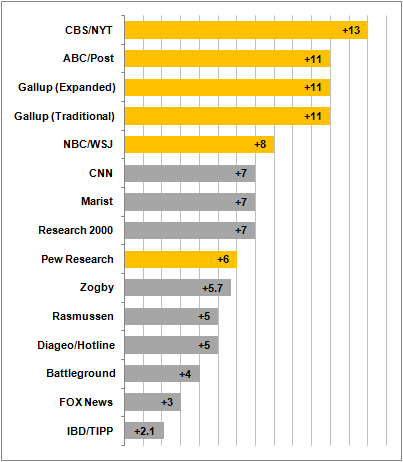
There has been a systematic difference in the polling for the Presidential race based on assumptions. Those polls that have shown the narrowest leads are the ones that have most closely adhered to a traditional voting model resembling 2000 and 2004. But will the electorate look like that where Democrats and Republicans were even in 2004?

I doubt it. Gallup has tried to bridge the gap by having two likely voting models, one based merely on past behavior, the other based on voting intentions.

But there is something else going on and the polling site FiveThirtyEight.com has captured some of it. How many African-Americans who have been apathetic in recent years will come out to vote for the first African-American President? And how many young people.

Looking at youth dominated sites, one example is Facebook where Obama has like a 70%-24% lead among those who have mobilized to get out the vote. If you do not use Facebook, you may not understand what this means, but there is an application that allows people to set their "status" to get out the vote, and by a huge margin most have mobilized for Obama rather than McCain. That is a snap shot, but a telling one.

Here is what FiveThirtyEight.com has shown, there is a gap between those polls that poll cellphone-only voters, who are most likely to be younger voters and those who do not. Those in bright contact cellphone-only voters and there is a noticeable gap there.


What does this mean? Depending on youth turn out, the Obama lead could be understated even in the more generous models.

We just do not know. And that's why they vote.

So we'll find out tomorrow. In the meantime, tell us what you think.

---David M. Greenwald reporting

Sunday, November 02, 2008

Measure W Gains Most Powerful Endorsement to Date: Dweezel the Dragon (Update)

I hope my friend Julie Cuetara forgives me for relaying this story. There are just moments in your life you do not forget. And one of the most vivid moments I remember in my over two years of coverage of Davis events was the night that they closed Valley Oak. Hundreds of students under the direction of Dweezel the Dragon marched from Valley Oak to the Community Chambers. Late into the night the meeting went and it became very clear that the verdict on Valley Oak was in and it would be closing. There in the back of the room was the image of Dweezel in tears. I will never forget that.

Dweezel is not one to give up easily however and she continued to fight for Valley Oak, through the charter process, through school board elections, until the very day they had to stop fighting when it became clear that it just was not going to happen.

I pass this on because there is no one more committed to Valley Oak than Julie Cuetara. She not only was Dweezel the Dragon, she was a member of Davis OPEN, a group organized to keep Valley Oak open.

This morning in the a letter to the Davis Enterprise, Dweezel (and Julie Cuetara) have endorsed Measure W.

She begins:
"Measure W is not about Valley Oak Elementary and Davis Joint Unified School District - It's about California's budget, California's state of affairs, and securing, through hard times, our children's future."
She continues:
"Some people are saying $120 is a lot of money on top of what we currently spend in our classrooms. I'm saying $120 per year is not much to secure what we have - a good district, good programs, (more) stable home value, a wonderful place to raise children and to grow old.

Think about our schools losing nearly $3 million for even one year and how it would trickle down through our community. We could never get back what we would lose! And I can guarantee you, with the loss of teachers, programs and the trickle-down effects that would occur, this measure would come up again next year and we would pass it."
And then finally, the message she closes with:
"I have been proud to be Dweezel, proud of supporting children and the Davis community for over 15 years. Through my endeavors, I've learned a lot about our district, its finances, policies, programs, schools and the people behind them. I have lost a lot due to decisions made and through all my sadness and upset with our district, I am proud to say, we do have a good district that deserves our support."
Frankly, I cannot think of a more powerful spokesperson or a more powerful statement than that. Anyone who is still on the fence because of Valley Oak just remember, no one lived and breathed Valley Oak more than this individual. She sees the big picture here and knows what needs to be done.

UPDATE:


Julie Cuetara has sent the Vanguard the full version of the letter, the Davis Enterprise could not print the whole thing today. I think it is important that everyone here reads the entire letter because it addresses a key concern about Measure W and Valley Oak.

Click to enlarge.


---David M. Greenwald reporting

Thursday, October 30, 2008

Down the Homestretch for Measure W: Multiple Views on the Ballot Measure

If Measure W passes, the good news is that Vanguard readers will have plenty of other things to read about and this blogger who sometimes acts as a reporter will not have to stay up until 1 or 2 in the morning to watch school board meetings.

Yesterday someone in the comment section asked me how much I was getting paid by the district, implying that I was a shill for them. I can understand how someone would feel that way. I have spent many many hours in the last year working on this blog and elsewhere to get Measure W passed.

Granted I have been talking about a parcel tax for far longer, but the first mention of Measure W was August 3, 2008 on this blog. Since then this will be the 17th article I have done mentioning Measure W.

Tomorrow, we will have a very special report on the Measure Q oversight committee. I encourage everyone skeptical of that process to read what Bob Schelen has to say.

Today, we are going to take a look at what a number of people and others are saying about Measure W.

The Davis Enterprise has letters from four of the five school board members supporting Measure W. I am not certain if Susan Lovenburg has already submitted a letter, but if she has not, do not read anything into it. She was out at the MU on Monday working hard trying to tell students about Measure W.

Board President Sheila Allen actually posted this on the Vanguard as well, yesterday.

I am going to post her entire post here for those who do not read the comment section.

She directed people to note that she is a strong supporter of neighborhood schools:
"Note especially the last paragraph. I am a firm supporter of neighborhood schools for many reasons that I have publicly presented during School Board meetings for the Valley Oak and the Emerson discussions. Please show your support by Voting Yes on W."
Here's the body of her letter:
"We moved to Davis because of the great schools. This is true for our family. I have received many emails from concerned citizens that begin with that very sentence. But, because of an on-going decline in state funding for public education the ability to continue our great programs is at stake.

This year the district cut $1.1 million dollars from the budget and still faced the specter of cutting an additional $2 million in program. With a budget that is over 80% direct student-related personnel, these dollars mean teacher jobs. Last spring hundreds of students, teachers, parents and community members lined up to ask that their program or position would not be cut. Luckily, the Davis Schools Foundation was able to rally the community to temporarily fill the gap for this school year only. Measure W will mean the teachers and our programs will continue for the next 3 years. Measure W means the Davis public schools will continue to be a great place to learn for all of our students.

On November 4 you have the opportunity to provide a solution. Coming to protest in March will not be a solution. The solution to save the teachers and program is now--and it is Measure W! Please vote yes on W."
Then Gina Daleiden and Tim Taylor:
"Clear and straightforward, if you support science, math, English, foreign language, music, social studies, librarians, athletics, debate, journalism and the teachers who enliven the minds of our next generation, then you support Measure W. The choice is clear.

We are all too aware of the state budget crisis and the impact that has on school funding. Local dollars are needed to maintain our quality programs here in Davis - among the best in the state - because state dollars simply do not.

You may find yourself asking, is the school district running leaner in these trying economic times? Absolutely. DJUSD spends more than 80 percent of our discretionary budget on expenses directly related to classroom instruction - teachers, counselors, principals and para-educators. Of the remaining percentage, we've cut $1.1 million, including eliminating one of the top three administrative positions, squeezing site budgets to levels difficult to sustain, and cutting operating costs. Our administrative budget falls in the lowest tier in the state, lower than most school districts, and even lower than many nonprofit organizations.

Despite all of this, the shortfall in funding is over $2 million annually. It is simply not possible to cut these funds without severely impacting the classroom and our kids. Vital programs and teachers will be lost. Our school system, our community and, most importantly, our children will lose."
Boardmember Richard Harris makes a plea that they need a two-thirds vote:
"To succeed, we need two votes in favor of Measure W for every one vote against it. Unlike the presidential race, where a candidate can win without gaining the most votes nationwide, or the local bond measure for community college facilities that can pass with only 55 percent of the vote, we need a super-majority of two-thirds support to pass Measure W. A simple majority will not be enough to save our schools.

Measure W is a true test of this community's willingness to take local responsibility in these uncertain economic times for key education programs like science, math, music and libraries.

We've reached out to voters during this campaign and we know a majority of voters, and overwhelmingly parents, support investing $10 a month in their community. A clear majority of voters definitely agrees with The Enterprise, the Chamber of Commerce and the Yolo County Taxpayers Association that Measure W is good for the schools and the community.

But there are many more potential voters in households without students attending Davis schools than households with children in the schools.

So parents, now is the time to get out of your comfort zone and go talk to your neighbors who don't have school-age kids. Tell them about Measure W, emphasize that strong Davis schools make our community strong and Davis a better place to live. Earn their support and then make sure they vote."
Do not take the word just for the elected members of the school board. A few weeks ago, the Sacramento Bee Endorsed a Yes on Measure W vote, citing: "APPROVING PARCEL TAX WILL PRESERVE A TRADITION OF GOOD SCHOOLS"

They write:
"Voters approved the last four-year parcel tax in November 2007, for $200 per parcel.

Since that 2007 parcel tax passed, however, the state's budget situation has worsened, and with it the situation in local school districts. The Davis school district faced $2.8 million in cuts this last year. A one-time fundraising effort by the Davis Schools Foundation staved off $1.77 million in cuts, but the district still had to chop $1 million out of the budget.

So now the Davis school board is back, asking voters to add $120 a year to the 2007 parcel tax to avoid program cuts. Measure W would raise $2.4 million a year for the next three years."
They continue:
"The additional $2.4 million a year would allow the Davis schools to preserve elementary science and music programs; preserve librarians at elementary and secondary schools; preserve class-size reductions for ninth- and 10th-grade English and math; preserve class periods for foreign language, music and physical education; and preserve extracurricular drama, debate, journalism and sports programs.

Measure W does not fund new programs.

If voters do not pass the parcel tax, the school district will have to cut $2.4 million from its budget."
They discuss a criticism of the parcel tax:
"The main criticism of parcel taxes in general is that because they are a flat fee on every parcel, lower-income households bear a disproportionate share of the burden. Davis mitigates that by making the parcel tax lower on apartments ($50, instead of $120 in Measure W) and by exempting property owners age 65 and older, who fill out a form and return it to the school district."
Finally:
"Davis residents have a long history of extraordinary support for their schools, and every school in the district performs above state goals on the Academic Performance Index. To continue the tradition of excellence, Davis voters should vote "yes" on Measure W."
Here are a couple of fliers, in case you have not seen them. The first, is a flier sent out by the Davis Teachers' Association and I'm not sure where the other one comes from.


---David Greenwald reporting

Wednesday, October 29, 2008

Rumors About Emerson Continue, Irrational as They May Be

No, it is not just on this blog. I hear and get asked about whether Emerson is going to close wherever I go. There is a persistent rumor that the closure of Emerson is fait accompli regardless of the outcome of Measure W.

As I have argued this is completely illogical. I will break down that illogic shortly. I would submit to the readers of this, that if you want Emerson to close, then you should vote against Measure W, because voting against Measure W will almost surely lead to the closure of the school. If you want to strongly increase the likelihood of Emerson remaining open, and these are the words of Superintendent James Hammond whom I will quote fully below, then you should vote for the Parcel Tax.

I will get to those words of the Superintendent in a moment. First we need to logic through this argument.

Why Emerson Closes if Measure W Fails

The school district last spring estimated that the closure of Measure W would save the district roughly $600,000 in site specific operating expenses. That is largely without the lay off of teachers.

That is the biggest single chunk of money that can be saved with terminating or eliminating teacher positions. In fact, that represents around a quarter of the money that they would need to cut if Measure W fails.

If given the choice between teachers and a facility, they are going to pick the facility every time. (I will get to why they eliminated Emerson for this list last spring below).

The problem that you face when you have a number like $2.4 million is that you really cannot nickel and dime your way to budget cuts. They have already trimmed two major positions from the district's administration including an Assistant Superintendent whose contract was not renewed and whose position was not replaced.

The good news for the district is that 82% of the district's discretionary general fund budget goes directly to the classroom, but the bad news is the same. It means to get meaningful cuts, you have to cut from the classroom. Of the remaining 18% of the budget that does not directly go to the classroom, 9% of the budget goes to ground operations such as custodians and only 7% of the budget goes to administration.

That means you are either cutting teachers or you cutting facilities. Again, that means if you have to cut $2.4 million and can get a quarter of that without laying off a single teacher, guess what they do?

So by all means, if you want to have Emerson close, vote no on W. The illogic of people who say because they won't guarantee Emerson stays open if W passes, they will therefore vote against W and ensure that Emerson closes, is mindboggling.

Why Emerson Stays Open if Measure W Passes

There are issues of the facility that will prevent the guarantee of Emerson staying open. But, most available rationale indicates that it most likely has to stay open if the general fund is not in deficit.

People try to link Emerson and Valley Oak. But Emerson has advantages (many of them) that Valley Oak never had.

As Superintendent James Hammond said on the Vanguard Radio show in mid-October:
"It's not like the closure of an elementary school where you have eight or nine sites, you have three junior high sites spread across town, so you have logistical concerns to evaluate."
This is not a defense of closing Valley Oak, but when they had to close Valley Oak, you have at least three schools within close proximity to Valley Oak. North Davis Elementary and Birch Lane are both within nine-tenths of a mile and Korematsu is just one and a half miles. That means that you are generally redirecting students within a relative close proximity. Now as we know from the Valley Oak issue that arose last year, you are still putting a burden on parents and making it more difficult for young children to walk and bike to school. Nevertheless, it is not a logistical nightmare for the district.

On the other hand, the Junior High scenario is much more tricky. You have Holmes Junior High a full 3.3 miles from Emerson. That is a logistical nightmare in a school district that does not have district busing transportation. That reason alone is why the district held off on closing Emerson as a possibility last spring and why it will likely not close it in the future if there are funds.

And remember they cannot simply move all of the Emerson students to Holmes, they would have to move a good portion of Holmes students to Harper, another two miles away.

So unlike having a simple situation where a few relatively close elementary schools can absorb additional students, you have a tough scenario where you are moving a large amount of students a good distance away.

These logistical problems relegate Emerson to a worst-case scenario closure rather than a likely closure if the general fund is in relatively good condition.

I pressed Superintendent Hammond on this issue during the October 15 radio show. Here's what he told me.
"The status on Emerson, to be quite honest, right now there is no decision. I mean we are status quo. There has been no formal discussion about Emerson between the staff and the board since last spring... Emerson has challenges but it doesn't mean there's an imminent closure waiting for it. There's facility concerns. It's not like the closure of an elementary school where you have eight or nine sites, you have three junior high sites spread across town, so you have logistical concerns to evaluate, facility concerns to evaluate. But by no means is there any type of hidden agenda to close the school. I think that that is one of the things even after passing the budget that we still deal with today."
Thus he completely denies that there is any kind of hidden agenda. On the other hand he cannot make promises.
"I can't make any promises as a superintendent particularly when it comes to the instability of the state budget and the inadequacy of how schools are funded."
He lays it out pretty clearly here, he believes that if we get the funding, the "likelihood" of Emerson staying open increases. And if we do not get the funding, the "likelihood" of closure increases.
"I would like to think, and what I say with my own words without representing anyone else, that with additional revenue in this case from Measure W, probably increases, and I use this word intentionally, the likelihood, the likelihood of things staying status quo, the lack of funds that we get if we're not successful with the parcel tax or we have to re-run a parcel in '09 at a lesser amount and we get a very bad January revise like we're expecting, the likelihood of being back where we were last spring increases. And as you know David, everything is back on the table and being evaluated and discussed. And that is my fear, that being in a place early in our school year where our fiscal indicates that we have to make some cuts and that's where I don't want to be."
Again, Measure W's passage will not guarantee that Emerson stays open. It will not. What Measure W does is take all of the position that Measure W funds, all of the teaching positions and it guarantees them for the next three years. Those positions by law cannot be eliminated. That frees up other money to go to keep Emerson open.

If the district does not have that money from Measure W then they have a choice, they can either terminate the positions that W would have funded or they can try to save money by closing schools. My guess is that they are going to close at least one school if they do not get Measure W or if they have to pass a smaller parcel tax in the spring.

Again, if you want to insure that Emerson closes, vote against the parcel tax. Because if the parcel tax fails and they have to come with a smaller amount in the spring, Emerson is likely gone. If you want Emerson to have a possibility to remain open, you have to vote for Measure W.

With $2.4 million, you are not going to nickel and dime your way to a balanced budget. If it were $0.24 million you might have a chance to. But with it at $2.4 million you have to cut from that 82% of the budget, and that is classroom money.

Again, the illogic of the position, they won't guarantee Emerson so I'll vote against Measure W is breathtaking. The reverse is most likely true.

---David M. Greenwald reporting

Monday, October 27, 2008

Vanguard Ballot Initiative Recommendations

While the Vanguard does not endorse candidates, we do make recommendations on issues. Many of these you can of course glean simply by reading the articles on this site. But since I have had a number of calls and emails over the last wee asking how I would vote and a number of issues, I thought I would put this in one place.

I also attach a sheet at the bottom with a link to the Courage Campaign who have compiled a list of 10 progressive organizations and how they are voting. Although other than on Prop 11 there are no disputes on which way to vote, some groups do not recommend on some of the propositions.

I will start with the local measures and then deal with the statewide issues.

DAVIS BALLOT MEASURES

MEASURE N: CHARTER CITY: NO. This measure would determine whether or not Davis would have a charter city enacted. In theory, I would be supportive of such a concept, but I think this charter is too broad. It would allow too much power to future city councils. I would like to see this charter get voted down and a committee formed to draft a new one that is much more specific.

MEASURE W: DJUSD PARCEL TAX: YES. For $120 per parcel voters of the city of Davis can ensure that core programs and teachers remain in tact. We are talking about elementary science, music, some HS athletic programs, as well as keeping class size down. If this does not pass, the district faces a $2.4 million deficit which means that teachers and programs get cut.

STATEWIDE BALLOT

PROP 1A: HIGH SPEED RAIL: YES. This would begin construction of a train that connects San Francisco to Los Angeles via San Jose and Fresno. This is a project I have been wanting for at least 15 years. Create a fast and convenient alternative transportation system to get people out of their cars. This is the most important project that we can fund this year.

PROP 2: STOP ANIMAL CRUELTY: YES. Goes without saying humane treatment for farm animals. We're not talking a lot--enough space for animals to beable to move around, stand up and sit down. This seems like a no brainer to me and the arguments against about costs and competitiveness do not make a whole lot of sense.

PROP 3: CHILDREN'S HOSPITAL BONDS: YES. I see no reason not to expand children's hospital facilities around the state.

PROP 4: PARENTAL CONSENT FOR ABORTION: NO. Proponents argue that this will get teens to talk their parents about sex. I do not believe that you mandate parent-teen communications. I think it places teens at risk who fear the response of their parents more than they fear other things. It is just not a good idea. One thing I never see in these proposals is how big a problem this actually is. If it is a problem, I think there are other approaches that would be more effective and starting well before pregnancy and abortion issues arise.

PROP 5: NONVIOLENT OFFENDER REHABILITATION: YES. I am a strong proponet of alternative forms of punishment. I think we put way too much emphasis on incarceration and our prisons are being overwhelmed with non-violent sex offenders. The program has the possibility of saving the state between $1 billion and $2.5 billion per year.

PROP 6: SAFE NEIGHBORHOODS ACT: NO. This basically does the opposite of Prop 5--it extends and expands mandatory sentencing and it also takes money from the rest of the state's beleagured budget and puts it into more prisons and correction spending. This may be the worst initiative on the ballot in my opinion and that includes 4 and 8.

PROP 7: RENEWABLE POWER STANDARD: NO. This bill may be well intentioned putting more resources to solar and wind projects by mandating that we get 50% of our power from renwable sources by 2025. The problem is that opponents believe that the measure is poorly written and would cause more harm than good. When the opponents include Sierra Club and Conservation league, then I tend to believe that statement.

PROP 8: ELIMINATES SAME-SEX MARRIAGE: NO. I believe that consenting adults should have the right to marry the person that they love regardless of gender. To me this is a no-brainer and almost every argument against it is based on fear. For those who suggest that same-sex marriage is a threat to traditional marriage, look at the divorce rate, it seems that marriage is under fire much more by people who do not respect marriage rather than people who desperately want to wed.

PROP 9: Victims' Rights and Protection Act of 2008: NO. Some of these provisions are not bad including notification and participation of victims in criminal justice proceedings. However, opponents argue that these are already in law. They also believe that these provisions would end up costing the taxpayer hundreds of millions. I am not nearly as opposed to this one as the Prop 6, but it does not seem the type of reform we really need.

Prop 10: California Alternative Fuels Act: NO. This is another one of those bills that look good until you realize who is supporting it and what it would actually do. One the plus side: The funding it provides will allow the generation of electricity from renewable sources, and provide consumer rebates for the purchase or lease of "clean alternative fuel vehicles". Th bill is sponsored by Boone Pickens, many have derided Pickens and Clean Energy Fuels for sponsoring this initiative because it may set up the company and Pickens for a financial windfall. Again, League of Conservation Voters and Sierra Club support it. This would take $10 billion out of the state's general fund over 30 years. The proposition was initiated by one person/interest group and as such lacks the vetting that would have come had it gained input from a wider variety of sources.

PROP 11: REDISTRICTING: NO. This sets up an appointed bipartisan commission to handle state redistricting. We already have a bipartisan commission that handles redistricting, it's called the state legislature, they are elected by the voters in California. From what I have seen, voting reforms generally create more harm than good. The system we have now has been in place for over 100 years.

PROP 12: VETERANS' HOMES BOND: YES. Basically renews a home loan program for veterans that dates back to 1922. The bond must be periodically renewed--this would be the 12th renewal. Enables veterans of current wars to get affordable loans and the bonds are repaid by the veterans themselves. Do not see a downside to this one.


---David M. Greenwald reporting

Sunday, October 26, 2008

Measure W Campaign Ad

Check it out, the thirty second spot airing on Comcast Cable in Davis.

Saturday, October 18, 2008

Vanguard Radio Interview with James Hammond

We had a tough time slot this past Wednesday, up against the third Presidential debate. But for Davis voters, Measure W may be the most important issue on the ballot next to the Presidential Election.

On Wednesday, the Vanguard sat down with Davis Joint Unified Superintendent James Hammond and pressed him on the key issues of the day.

Monday, October 13, 2008

Endorsement Watch: 5th Senate and Measure W

'Tis the season to watch Sunday newspaper endorsements. For those who have been reading this blog for awhile, you know that for some reason I love to read and critique newspaper endorsements. For me, it gives us an insight into what the media think and to a lesser degree what issues they think are important and how we can evaluate the news overall.

Newspapers will argue that there is a separation of the the news and editorial function, but in my former profession as a social scientist, there has been some interesting empirical studies that argue otherwise.

Besides, at the end of the day, this blog was largely developed to respond to what the mainstream news was reporting and in general to criticize it.

We begin then with two newspaper endorsements that came down yesterday--one involving the 5th Senate District and the other involving Measure W.

STOCKTON RECORD ENDORSES AGHAZARIAN

There is one main reason why the Stockton Record endorses Aghazarian. It is not partisan. In fact, they have endorsed Barack Obama for President and Jerry McNerney for Congress--both of them Democrats. Granted the endorsement of Barack Obama was a very big deal. It was the first time since 1936 that the Stockton Record Endorsed a Democrat.

The reason the Stockon Record endorsed Aghazarian is that he's from Stockton.
"And that brings us to one of the most important reasons Aghazarian should be sent to the Senate: He lives here. He understands the district and its needs. He will be here.

Because of the loony way legislative districts have been carved out - with the express purpose of making them safe for incumbents - it is possible San Joaquin County could end up with no representatives in Sacramento who live in the county. That's unacceptable no matter the sincerity of an out-of-area politician's vow to be in the county often."
Are you kidding me? First of all, the current State Senator is from Linden which is essentially Stockton, so it is not as though there was a long history of Stockton being shutout of the Senate Seat. Second, it's a big district. It goes from San Joaquin County to Yolo and Solano Counties. Why does Stockton deserve a representative more than Yolo County or Solano County?

I am sorry but that is just selfish. There are many cities in this district, Stockton is the largest one but it's also on one end of the district, the majority of the district would be left high dry by such a move--if we are merely looking at geography.

Can we draw districts more compactly? Certainly, but I am not going to selected my representative based on geography.

A couple of other points that they argue.
"Aghazarian, who used to brag about his ascension through the Republican Party ranks, has reinvented himself for this campaign. His advertisements paint him as the candidate of "independent leadership," never mentioning his party affiliation."
The Record is for some reason buying into Aghazarian's non-partisan rhetoric. The reason he is arguing this is that he is running for election in a Democratic year in a district that has a 15 percent Democratic registration. He has not changed his tune or if he has, make him prove it in the legislature not as part of his campaign rhetoric. In short, his record as an Assemblyman shows nothing to lead one to believe he independent. Nothing.

Finally, I take issue with this:
"Wolk claims she is more effective than Aghazarian at working across the aisle, claiming she has had more bills signed by the Republican governor than any other legislator. In truth, however, most of the bills have been relatively insignificant."
In truth probably most legislation in the California Legislature, is insignificant. However, she did sponsor several key pieces of legislation dealing with flood control, delta protection, and elder protection. Somehow I doubt that Aghazarian has such a legislative record. They certainly do not cite it in the endorsement article.

However, this is really the most illogical of the Record's arguments. Democrats will control roughly 60% of the seats in the State Senate regardless of who wins this seat. Who is going to be the most effective legislator the majority party member or the minority party member? The answer is the majority party member who will pass a much higher percentage of legislation. It is not even close. The Stockton Record does even think about this contradiction with their argument. Aghazarian is not going to as effective as a minority party member as Wolk will as a majority party member, so if that is you rationale for voting, it makes no sense to vote for Aghazarian over Wolk.

In short, the Stockton Record probably has many good reasons to support Aghazarian, but they really do a poor job of selecting three that make no sense. I am sure they really do want Stockton to be Represented, but it's not like Stockton has not been Represented the past eight years. The rest of the District is just as deserving of representation as the City of Stockton.

In my opinion people should vote based on who they most agree with on the issues and who they think will be a better legislator. I cannot answer that question for my readers, but I can say that the Stockton Record falls woefully short in its endorsement criteria, at least the ones it states.

DAVIS ENTERPRISE ENDORSES MEASURE W

This is really not a surprise at all. Let us face it, the Davis Enterprise since 2005 has endorsed the wrong way from my perspective on every single issue except Measures P, Q, and W--the Parcel Taxes. They endorsed Covell Village. They endorsed Target. They endorsed Jeff Reisig for District Attorney. They endorsed Ruth Asmundson and Mike Levy in 2006 for Davis City Council. They endorsed Souza, Saylor and Sydney Vergis this year.

In other words, given that record, it is hard for me to use their endorsement of Measure W for much of anything other than to say that a broken clock is right twice a day--if it is an old fashioned, analog clock. And the Davis Enterprise is certainly that.

And frankly, I think the Stockton Record makes a stronger argument for Aghazarian than the Davis Enterprise does for Measure W.

The argument is this:
"Without the $2.4 million in extra funding per year, we face the same severe cuts and massive teacher layoffs that were threatened last spring. That's when the community came together - led by the Davis Schools Foundation - to raise $1.77 million. That one-time effort, along with more than $1 million in district budget cuts, plugged the hole for this school year only."
What happens if it fails:
"IF MEASURE W FAILS, the community faces another massive fundraising drive to save teachers and programs. Or worse, we face their loss due to budget cuts."
This is a point that has be driven home to voters. The $1.77 million raised by the schools foundation was one-time money the result of a hard drive in the community with the issue firmly in the minds of voters.

However, some need to recognize that that money is one-time money and it is not sustainable.
"But community philanthropy can't always be the answer, said Alan Anderson, the new president of the Davis Schools Foundation. 'Ongoing support is the best way to solve chronic under-funding from the state and to restore confidence in the future of our public schools for families, teachers and, of course, our students.'"
We had Alan Anderson on our radio show last spring, he is exactly right here as he was back then. The support by the Davis Schools Foundation was amazing and it saved programs and teachers but it was a one-time bridge loan, not a means by which to provide ongoing support. The voters need to decide if the programs funded by the $2.4 million and the teachers funded by that money are necessary for the Davis Schools to remain at the top of the state scale.

There are so many more factors that needed to be addressed in this editorial. We have mentioned them in this space time and again, so for now we are just thankful that at the very least the Davis Enterprise has the commitment to provide schools with the necessary funding to continue to function at a high level.

---Doug Paul Davis reporting