The Vanguard has a new home, please update your bookmarks to davisvanguard.org
Showing posts with label blogging. Show all posts

Saturday, December 27, 2008

The Rise of New Investigative Reporting

Back in November the New York Times had an interesting article, the focus was on a San Diego blog--Voice of San Diego.

Writes the New York Times:
"Over the last two years, some of this city’s darkest secrets have been dragged into the light — city officials with conflicts of interest and hidden pay raises, affordable housing that was not affordable, misleading crime statistics.

Investigations ensued. The chiefs of two redevelopment agencies were forced out. One of them faces criminal charges. Yet the main revelations came not from any of San Diego’s television and radio stations or its dominant newspaper, The San Diego Union-Tribune, but from a handful of young journalists at a nonprofit Web site run out of a converted military base far from downtown’s glass towers — a site that did not exist four years ago."
Indeed in this country we have seen a trend of local newspapers going out of business, struggling financially, cutting their staffs, etc. The result has been that there are fewer and fewer investigative reports from mainstream newspapers. This has led to a huge hole in local coverage, a hole filled now by the rise of "a new kind of Web-based news operation" which is now forcing the local papers to follow the stories that they uncover.

Sound familiar?

The New York Times reports that similar operations have cropped up in New Haven, the Twin Cities, Seattle, St. Louis, and Chicago. In fact, there are many more in big and small towns.

Where this movement perhaps differs from the Vanguard is that it is being led by professional journalists rather than citizen journalism posted by unpaid amateurs.
The fledgling movement has reached a sufficient critical mass, its founders think, so they plan to form an association, angling for national advertising and foundation grants that they could not compete for singly. And hardly a week goes by without a call from journalists around the country seeking advice about starting their own online news outlets.

“Voice is doing really significant work, driving the agenda on redevelopment and some other areas, putting local politicians and businesses on the hot seat,” said Dean Nelson, director of the journalism program at Point Loma Nazarene University in San Diego. “I have them come into my classes, and I introduce them as, ‘This is the future of journalism.’ ”
All around the country, newspapers are struggling to survive. We learned recently that the owners of some of the largest papers in the country the Los Angeles Times and Chicago Tribune are declaring bankruptcy. Locally reporters are being laid off because of struggling times.

The death of newspapers does not have to come, what needs to happen is that newspapers change the way they operate.
"That is a subject of hot debate among people who closely follow the newspaper industry. Publishing online means operating at half the cost of a comparable printed paper, but online advertising is not robust enough to sustain a newsroom.

And so financially, VoiceofSan Diego and its peers mimic public broadcasting, not newspapers. They are nonprofit corporations supported by foundations, wealthy donors, audience contributions and a little advertising."
This is a model that the Vanguard is likely to follow in the coming year.
But some experts question whether a large part of the news business can survive on what is essentially charity, and whether it is wise to lean too heavily on the whims of a few moneyed benefactors.

“These are some of the big questions about the future of the business,” said Robert H. Giles, curator of the Nieman Foundation for Journalism at Harvard. Nonprofit news online “has to be explored and experimented with, but it has to overcome the hurdle of proving it can support a big news staff. Even the most well-funded of these sites are a far cry in resources from a city newspaper.”

The people who run the local news sites see themselves as one future among many, and they have a complex relationship with traditional media. The say that the deterioration of those media has created an opening for new sources of news, as well as a surplus of unemployed journalists for them to hire.

“No one here welcomes the decline of newspapers,” said Andrew Donohue, one of two executive editors at VoiceofSanDiego. “We can’t be the main news source for this city, not for the foreseeable future. We only have 11 people.”
I think what we will see are more of these kinds of operations. The question is whether these kinds of entities are providing the kind of coverage that people seek.

It is worth reading the full New York Times article from November.

From a local level, one of the things the Vanguard has done in the last year has been to move to more investigative and more watch dog reporting. The local newspaper offers people a better guide to community events, but the Vanguard has the luxury of being able to focus on a single story or two a day and going much further in depth than the local paper. Thus the Vanguard was able to delve deeply into the operations of a Tahir Ahad where the local paper never really covered the story.

Investigative reporting is an issue that many local papers have gone away from. The result is that most stories scratch the surface and rely heavily on official sources. The EPA story from earlier this week represents an interesting case in point. The local activists are concerned about developments on the Superfund Site which will house the new Target. The EPA writes a letter laying out their position that the site does not pose a health risk. However, the local group is skeptical of these claims. The Vanguard actually reports the issue first and takes the side of the local group. The Enterprise reports the next day but takes the side of the EPA. That will likely be the last article you see on this subject by the Enterprise, meanwhile the Vanguard has already written a follow up.

But there is more going on in this story, and probably as soon as next week, we will have further information as the Vanguard continues to dig to get to the bottom of what is going on while the Enterprise has long since moved on and declared there is nothing to see. Perhaps the Vanguard will find something out that changes the course of the story, perhaps it won't. But the fact that the Vanguard keeps looking beyond the official word sets it apart from the rest.

Recently the New York Times had a Q&A with a numbers of their reporters and editors on their internet site. So I asked a question of Walt Bogdanich assistant editor at the New York Times Investigative desk (must be nice to work for a large paper).
In 2008, Mr. Bogdanich won the Pulitzer Prize for Investigative Reporting for the series "A Toxic Pipeline," which tracked how dangerous and poisonous pharmaceutical ingredients from China have flowed into the global market. In 2005, Mr. Bogdanich won the Pulitzer Prize for National Reporting for his series "Death on the Tracks," which examined the safety record of the United States railroad industry. And in 1988, he won the Pulitzer Prize for Specialized Reporting, for his articles in The Wall Street Journal on substandard medical laboratories.
So I ask how local papers can continue investigative reporting given their limited budgets.
"There seems to be a vicious circle now in the media. Primarily that investigative reporting is not funded in all but a few papers because of the loss of revenue and profit that newspapers have brought in. But in part that is due to the declining dedication and quality of the product. How can local newspapers re-commit themselves to investigative reporting?"
Unfortunately his response missed the point:
"Yes, many newspapers have less money to spend on investigative reporting. But it is also true that investigative reporting costs less today than 20 years ago because of the Internet. Case in point: while sitting at our desks in New York, reporters were able to analyze the types of pharmaceutical ingredients that Chinese chemical companies were selling on the open market. Having a great cash flow is not a prerequisite for investigative reporting. It helps, of course. But remember, back in the days when newspapers were flush with cash, most of them did very little of it."
The point is that local newspapers are not doing investigative reporting. It may be cheaper than it used to be, but newspapers are cutting back staff.

The future of local newspapers in part will depend on their ability to figure out a way to restructure in a different economic environment. They will need to find a way to make money and provide a service that people want.

The Vanguard on a good day probably has about a quarter of the readers that the Enterprise gets on a daily basis. (The Enterprise itself only gains access into roughly one-third of the households in the city of Davis with its regular circulation.) There is a niche here to be exploited. The Vanguard has been able to do this with hardly any money used to promote itself. There is obviously a yearning in the populace for more than the bare bones news coverage that most local papers offer while at the same time the local papers provide vital information on an array of topics that the Vanguard could never even hope to try to cover.

The bottom line here is that newspapers are going to have to change if they want to survive. So far they seem reluctant to do so.

---David M. Greenwald reporting

Monday, May 14, 2007

Monday Midday Briefs

Psuedonymity on the Internet

I guess to the surprise of few I come down strongly in favor of psuedonymity.

But there as an interesting piece in the Washington Post today on the subject:

These days we want "transparency" in all institutions, even private ones. There's one massive exception -- the Internet. It is, we are told, a giant town hall. Indeed, it has millions of people speaking out in millions of online forums. But most of them are wearing the equivalent of paper bags over their heads. We know them only by their Internet "handles" -- gotalife, runningwithscissors, stoptheplanet and myriad other inventive names.

Imagine going to a meeting about school overcrowding in your community. Everybody at the meeting is wearing nametags. You approach a cluster of people where one man is loudly complaining about waste in school spending. "Get rid of the bureaucrats, and then you'll have money to expand the school," he says, shaking his finger at the surrounding faces.

You notice his nametag -- "anticrat424." Between his sentences, you interject, "Excuse me, who are you?"

He gives you a narrowing look. "Taking names, huh? Going to sic the superintendent's police on me? Hah!"

In any community in America, if Mr. anticrat424 refused to identify himself, he would be ignored and frozen out of the civic problem-solving process. But on the Internet, Mr. anticrat424 is continually elevated to the podium, where he can have his angriest thoughts amplified through cyberspace as often as he wishes. He can call people the vilest names and that hate-mongering, too, will be amplified for all the world to see.

I guess in some ways I am an internet romantic, believing that the goal of the internet is to divorce ideas from the physical appearance of individuals who utter them, so that we might judge an idea by the internal logic of that idea rather than automatically accept or dismiss it on the basis of whether or not you like the individual who happens to utter it.

Then again, psuedonymity also creates a protection, and so you see on a lot of anonymous blogs and bulletin boards people saying things to other people behind not only the mask of their identity but also the distance that a keyboard lends over a person to person encounter.

The downside of this is a story from back in March where a 400 pound woman gave birth to a child a few days after finding out she was pregnant.
When a California woman recently gave birth to a healthy baby just two days after learning she was pregnant, the sudden change to her life was challenging enough. What April Branum definitely didn't need was a deluge of nasty Internet comments.

Postings on message boards made cracks about Branum's weight (about 400 pounds — one reason she says didn't realize sooner she was pregnant). They also analyzed her housekeeping ability, based on a photo of her home. And they called her names. "A pig is a pig," one person wrote. Another suggested that she "go on the show 'The Biggest Loser.'"

"The thing that bothered me most was, people assumed because I am overweight, I'm going to be a bad mom," Branum says. "And that is not one little bit true."

Still I think the upside outweighs the downside. The downside can be mitigated through moderators and rules and a basic culture created on a blog. One of the things that moderates my own writings is having to look people in the eye and receive emails and occasionally angry phone calls after I write about them. The same does not hold for the hundreds of people who post comments, usually with either a psuedonym or as "anonymous."

At times I have thought about required registration, but I always come back to the same problem. Many people have good things to say, accurate things to say, important things that need to be heard but cannot do so because they are afraid. I encounter it all the time when I get a person who comes forward with a horrific story about the police or another situation, but are too afraid to come forward. They are too afraid to press a complaint. They are too afraid to even tell their story. This is a small community still where people either know each other or know someone who does and there is a legitimate fear factor about coming forward and reporting the truth. But sometimes they can say it with their names protected and that makes all the difference. I know a lot of people will view that as illegitimate, but I don't think it is. I have personally received enough threats to understand people's fear.

Just some thoughts for today...

---Doug Paul Davis reporting

Wednesday, May 09, 2007

Commentary: When "Fair and Balanced" is Less Accurate

The other week at a school board meeting, Jeff Hudson, the Davis Enterprise beat reporter who covers the school district made the casual remark to me that it must be nice not to have space limitations for my stories. It was a factor that I had not given a lot thought to previously--however, as I have become aware of it, it has given great advantage to the ability of covering stories with tremendous detail that cannot be otherwise provided in newspapers due to space limitations that I simply do no have to deal with.

What I had given considerably more thought to is the ability to write stories as I view the facts rather than at times artificially attempting to create balance out of the express need to adhere to the principle of "fair and balance." Unfortunately, I would suggest that such approaches at times lead one to actually bias the coverage. The freedom to write as one sees it, has a great deal of benefit at times--while at the same time running the risk of falling prey to criticism of bias. What I would suggest here is that bias can at times be a good thing, so long as you are willing to be upfront about it (and this blog certainly has been pretty open about its political bent).

All of this came to mind last night as I read Claire St. John's story in the Davis Enterprise, "Fewer council meetings but longer nights." Those who are regulars to this blog will recall my story from April 26, 2007 entitled, "Analysis: Asmundson's Attack on the Mayor Unfounded."

From the titles alone you can see that my story has a definite slant, whereas the Enterprise story obtains a more balanced approach. (I would be remiss if I did not point out here that there have been examples in the Enterprise where the title is less than fair and impartial, and that almost invariably those titles are negative towards the more progressive side of politics in Davis).

Remember that the usual assumption is that fair and balanced is more accurate. That is the mantra that mainstream reporting generally follows and what it affords is protection for the news agent against the charge of bias. (Although I suspect every reporter reading this will be screaming bs, and I understand.)

Let's delve into the story a bit to illustrate that this widely championed but rarely practiced principle can be misleading.

St. John reports on the exchange that we dealt with in our story from two weeks ago:
At the last three council meetings, Greenwald has asked her colleagues to keep comments succinct, avoid repetition and ask their questions of city staff members ahead of time.

"The public does not like it when our meetings go this late, and I am trying as mayor to do a reasonable job in pacing our meetings so they can be over by 11:30," Greenwald said, at the April 17 meeting.

The council has a policy that at 11:30 p.m., a motion must be passed to continue the meeting. Each time, the meeting has carried on by at least a 4-1 vote, but never without commentary.

On April 17, Mayor Pro Tem Ruth Asmundson responded to Greenwald's comments with a barb.

"It is just unfortunate that the mayor cannot run a meeting," Asmundson said. "If we have a more efficient meeting, we can finish these things. We can be more efficient if the mayor could just run this meeting more efficiently."

"I talked less than anybody at this meeting," Greenwald replied. "I would challenge anybody out there to take a stopwatch ..."

"You're still talking," Asmundson snapped. "Let's go."
What St. John does not do at this point, which I was able to do, was take Mayor Greenwald's challenge of keeping track of the time used by each member and chronicle how long each councilmember took when they spoke at the meeting.

That's precisely what I did in the April 26 piece and found that indeed, Greenwald spoke far less than any other councilmember and that Asmundson along with her ally Saylor had taken up the most amount of time. That was a lengthy endeavor that had me sitting down for a couple of hours and tallying up how long each member spoke.

Here were the findings:

Saylor

39

Asmundson

35

Souza

26

Heystek

25

Greenwald

18


That leads us to the very natural question of why is it that a Davis Enterprise reporter cannot report on the actual time used by each member?

The simple answer appears to be that such reporting may impart bias if their findings were as skewed and one-sided as the ones I found (and anyone watching that meeting probably would not have to use a stop-watch to figure out that Mayor Greenwald was speaking far less than her colleagues). It would take a side in the story. In short, it would not be "fair and balanced."

Now we can argue that perhaps the Davis Enterprise does pick sides at times, but let's assume at this time that they do not. Let's assume that they adhere to this principle consistently. What do we take away from it?

For me it demonstrates that fair and balanced is not necessarily more accurate. And that sometimes you need to be able to take sides to accurately report a story. The moment you accept even the possibility that there may be validity to this point, you have to look at media such as blogs in an entirely different fashion because the assumption has always been that bias equals less accuracy, but perhaps the truth is that sometimes bias gives you more information than artificial attempts to maintain the journalistic ethos of fair and impartial reporting. Sometimes, we need to get to the truth and the only way to do that is to take sides.

To me it would certainly be defensible to take the time to report on how much each city councilmember spoke if you are going to report on the broader issue of why the meetings are last as long as they are. Perhaps it is too much to ask a reporter to referee in a fight between elected officials, but perhaps that is something that the public ought to know as they weigh in on the accuracy of the claims made by each side in an attempt to come up with their own opinion.

To me giving facts is always in the realm of reporting and we should not shy away from reporting unfortunate and at times one-sided facts. After all, is it not still news if a given office holder makes a charge that turns out to be not backed up by the available facts?

---Doug Paul Davis reporting

Sunday, March 11, 2007

Awards Ceremony Presents Us with a Time for Reflection

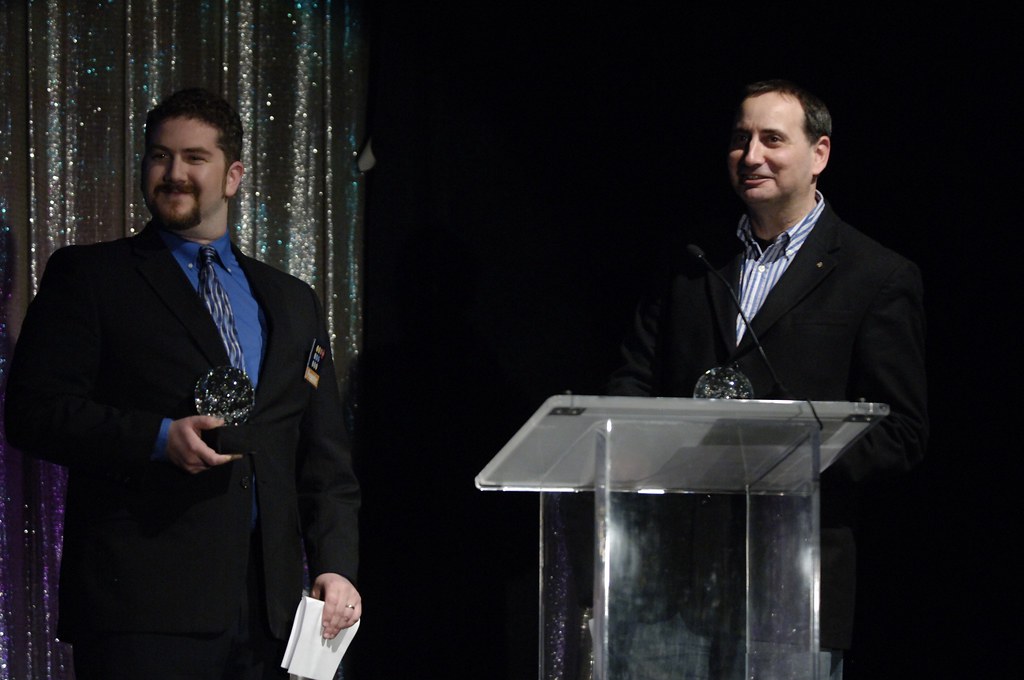
Several weeks ago I received an email from a group called the Dotties. It turned out that for ten years now this group has met and given out awards to the best websites in the Sacramento Northern California area. Recently with the rise of blogs, they have added blogs to their awards ceremonies. So on Thursday, I threw on a suit and gave out an award (those things by the way, weigh a ton and would serve as a good weapon against a mugging if you are an Olympic shotputter).

Mark S. Allen from Good Sacramento was the master of ceremonies. He did a very good job with a small and at times indifferent crowd. When he introduced me, he cited the blog as "bringing law enforcement together with the community." An amusing line that indicated to me that he has read the People's Vanguard.

The category I gave an award for--or at least was supposed to as the winner in my category did not show up to the event--was "Blogs and Online Categories." If there was one criticism, it would be that some of the groups were overly broad. For example, "Health Care, Biotech, Agriculture and Engineering." So we were sitting at a table with Mandarin Orange Growers who were competing against the ultimate winner, Sutter Health.

In the "Blogs" categories, MX Sponsor a site devoted to motocross sports. Highly technical in its design, and yet this would be the category that this blog might potentially compete against in the future. In fact, as they described the judging criteria--and its good criteria--they are looking at technical innovation, they are also looking as usability, and content.

The Dotties Awards Ceremony also presents us with an opportunity for reflection and to look toward the future.

This past week, the People's Vanguard of Davis passed the 50,000 hit mark since October 10, 2006 when I finally realized enough people were on the site to install a hit counter. One of the lessons I have learned is that you do not need a flashy site to get readers, in fact, this site is just a "blogger" site that I enter my writings directly into a template. It is as non-technical as it comes.

And yet as they discussed on Thursday, it meets the key threshold of a successful marketing endeavor--this blog found a niche that was badly needed by a segment of the community. I cannot go to a public event without people telling me that they read the blog--even in Sacramento. People were disparately looking for an alternative source of information and I have staked this blog's reputation on content rather than bells and whistles.

I hope as time goes on, the Dotties can begin to recognize blogs in their own right and judge them based on the information that they provide rather than the technical aspects. Blogging has become a valued addition to the fourth estate. It is a means by which to level the playing field. No longer is information confined to those with the money and resources to own a printing press. Knowledge and reporting has become unlocked. And in some cases for the good, and like all technologies, there is the potential for bad as well. The power of blogging is a constant reminder that we all must be vigilant and yet responsible.

That is not to say that this will also be just a "blogger" blog. As much as that format serves my short-term needs, I have already seen the limitations of the format. The future shall be interesting to say the least. This blog started as an outlet for my frustrations following the June 2006 primary in which it became clear that there was no accurate and reliable means to get information out to the public.

However, although this blog's growth and direction--in terms of popularity and perhaps importance--was always part of my "vision," I am not sure I ever really anticipated that it would end up being as successful as it has so far.

So the Dotties' awards gives me a good opportunity to look back at the past and thank the people who have been readers from beginning and thank those of you who will be logging on for the very first time in the coming days. It also gives me a chance to look into the future and there will be some changes coming down the pike. I will not be changing the content of this site or the information I provide. But there will be changes nonetheless and hopefully these changes allow us to continue to grow and prosper into the future.

Thank you and good day.

---Doug Paul Davis reporting

Wednesday, January 24, 2007

Free Speech and Blogging

Last night I found myself once again the target of Davis Columnist Bob Dunning's sardonic humor. Oh he did not mention me or this blog by name, but it was pretty clear who he was referring to. (Davis has few other blogs and this is the only one that routinely discusses Dunning). However, he brought up some points I think that call for addressing, including what might be construed by some as a legal threat.

It is no secret that Bob Dunning's column has been a frequent subject of this blog and in a very critical manner. However, we have always done our best to merely make factual corrections of Dunning's assertions rather than attempt to deride his character. Nevertheless, a man who has made his living for the last 30 years by sarcastically deriding public figures, has little tolerance when the shoe is on the other foot.

Last night Dunning wrote:
"given that various bloggers in town continue to pump out actionable libel and defamation nearly every day of the week, perhaps under the mistaken impression that "anonymous" blogs are no-holds barred free-for-alls where the usual rules of law are suspended . . . they aren't, which is a lesson some of them will no doubt learn in the near future . . ."
As a public figure, there is a great deal higher burden to prove libel and defamation than a private citizen would have. A private citizen, would only have to prove negligence--that a reasonable person would not have published a given defamatory statement.

However, a public figure would have to demonstrate "actual malice"--that something was published that was knowingly false or in reckless disregard for the truth.

Dunning falls at the very least into the category of a "limited-purpose public figure" one who "has access to the media to get his or her own view across" and also one who "voluntarily participates in a discussion about a public controversy." Dunning fits both of those definitions.

What might Dunning be referring to?

The only public charge he has made was this one from January 12, 2007:
"Twice on this blog I've seen truly ugly references to Catholicism as it pertains to the Above-Pictured Columnist made by anonymous cowards … if this ugliness had involved any other faith, it would be condemned by this town's alleged civil rights activists as "hate speech," but it's apparently open season on Catholics … yes indeed, real life hate-mongers right here in the Most Relevant City in America …"
Following the January 12, 2007 column I did a search on the blog to see if I even mentioned the word "Catholic" or "Catholics" and in fact I did not.

Upon further scrutiny a person who made comments did in fact reference Dunning and Catholic although I would hardly categorize it in the light that Dunning did.

Furthermore the California Supreme Court has specifically protected bloggers from libel suits for "posting defamatory statements made by others."

The California Supreme Court on November 20, 2006 wrote:
"Subjecting Internet service providers and users to defamation liability would tend to chill online speech... Until Congress chooses to revise the settled law in this area" people who contend they were defamed on the Internet can seek recovery only from the original source of the statement, not from those who re-post it."
In other words, I am not responsible for the content posted by others on this blog.

At this point it seems that Dunning merely dislikes being the focus of scrutiny by this blog in much the same way as the rest of the community is the focus of scrutiny and ridicule by Dunning. However, as far as I can tell, none of this rises even remotely to the level of libel and every statement made by this blog that is not immediately provable through the public record, I can back up with multiple witnesses testifying to the accuracy of my statements. Therefore, Dunning's charge of libel and defamation is patently false and ultimately unprovable.

---Doug Paul Davis reporting

Saturday, January 06, 2007

Score one for the blogosphere... on the bad side

It is a lesson that as a blogger, every blogger must inherently worry about. What you report affects people's lives, even as you are typing from the sanctity of your personal home and looking up information on the internet. This is the lesson we bloggers must take to heart.

On December 20, 2006 a conservative blogger Michelle Malkin reported that a source used by the Associated Press in Iraq, a Jamil Hussein did not exist.

This was used to show that the AP was making up false anti-war stories.

Well yesterday the AP reports:
Iraq's Interior Ministry acknowledged today "that an Iraqi police officer whose existence had been denied by the Iraqis and the U.S. military is in fact an active member of the force, and said he now faces arrest for speaking to the media..."
As these things go this ranks up there as an absolute disaster. You have an irresponsible blogger, making irresponsible claims that end up getting someone fired.

The upside about blogging is that it keeps the mainstream media on their toes and ensures better reporting. The downside is the you have untrained amateurs or in this case a political pundit with power and influence and a political shtick carelessly or maliciously harms another person.

As a blogger I am a strong supporter of the medium. I think that locally and nationally we need voices who can call it as it is. I have in a very short time, I believe made an impact in the community. I note that County Supervisor Helen Thomson read from this blog. That the Woodland Daily Democrat used a blog entry on their editorial page. That the Senior Citizen's Commission will have an agenda item this Thursday related to this blog. So there is a tremendous amount of interest and impact already for this new blog. This is a note of caution, with power and influence comes responsibility. But this is a note of caution to all of us to remember that what we say does impact lives.

---Doug Paul Davis reporting

Friday, December 22, 2006

The death of blogging?

It only makes sense that we started this week with a story about the death of newspapers and now apparently the newspapers have fought back with their own story about the death of blogging.

Marc Fisher of the Washington Post writes in yesterday citing a British firm Gartner which does a study and prediction based on statistics that purportedly show that some 200 million people worldwide who had started blogs have already given them up.

Those who predict a quick end for blogging have missed essential points about blogging in general. First of all, blogging has evolved over time to the current form. The internet was immediately a source of information and also interactive information. The rise of blogging has actually occurred over the entire lifespan of the web (and the mass web).

Blogging fills several fundamental niches (holes if you will) in the reporting/ news industry. First, it gives people a source for unfiltered information. We no longer have to rely on large corporations to purchase printing presses in order to be able to quickly and easily disseminate information. Am I overstating it to say that blogging is as revolutionary a concept as Guttenberg's printing press and the ability to mass produce written information? If so, not by much.

Second, in a conversation yesterday I had about blogging, the idea came up that newspapers are general interest papers--they have to cover everything. The Davis Enterprise has to cover the city council meeting but also Davis-fest. The Sacramento Bee covers Davis, but also Sacramento and many over communities in their media market. Blogs can cover very specific topics. No newspaper could focus solely on Davis politics and survive. But a blog for the most part can.

Third, blogs provide the public with an outlet for interactive communication. The difference between a newspaper and a blog is amazing in terms of the ability of blogs to interact with their readers. My readers can respond immediately and for the most part without fear of censorship. Newspapers require letters to the editor, separated by time and restricted by editorial decisions.

Fourth, the ability to get news that no one else covers. The ability for Senator Allen's comments about "Macaca" and Senator Burn's comments about firefighters were able to bypass traditional media censors and be halfway across the cyber-world before the traditional media sources even knew what was happening.

All of these point to an evolution in the way that blogging happens. Those who practice blogging as a hobby may indeed drop off. But think about this for a second--the Daily Kos gets millions of hits a day. Clearly, they are feeding a niche and a market that the current media do not tap. That is not to say the process will not continue to evolve. The most striking thing is that Marc Fisher writes about the end of blogging on a Washington Post blog.

Blogging is here to stay. Mass media will continue to develop and the process will be better for it.

---Doug Paul Davis reporting

Monday, December 18, 2006

Thinking outloud: The Death of Newspapers?

It's worth reading the December 14, 2006 edition of the Sacramento News and Review. Jeff vonKaenel, owner and CEO of the News and Review, writes about "why corporate management of daily newspapers spells disaster for the news business, community debate and our way of government."

I'm kind of ambivalent about his point. Unlike a lot of bloggers, the first paper I read in the morning is the New York Times, followed by the Washington Post, and then the National Journal's Hotline (which as a political junkie, is my bread and butter). It is only after reading those traditional news sources, that I start looking at blogs and other new sources of information.

"People may be getting their news from various sources today: radio, television, online. But most of the original reporting--even that which ends up on radio, TV and the Internet--is done by daily newspapers. Daily newspapers also do nearly all of the investigative reporting that monitors how government spends its citizens’ money and watch over how the government works to protect its citizens’ interests."

I have to wonder about print elitism (the reverse of print envy), and it brings me back to the point that I made in response to Davis Enterprise Columnist Richard Harris a couple of months ago--is the daily newspaper really on the cutting edge anymore? Many of the biggest political stories of 2006 came not from daily newspapers, but from bloggers and other independent sources that then filtered up to the mainstream press.

The control of the US Senate came down to a couple of Senate races that hinged on blogger and youtube reporting. Webb does not win in Virginia without "Makaka." George Allen was a sure-bet until a kid following Incumbent George Allen around with a hand-held uploads a video onto youtube and suddenly Allen is in hot water.

And maybe this is part of the point that vonKaenel is trying to make by looking at the impact of corporate ownership.

But I think it is something much bigger and it goes the heart of the problem that we have in Davis. How do people get access to information about local politics? They read about it in the Davis Enterprise. That is largely the only source for information. If they do not cover it, people do not know about it.

The Davis Enterprise, their editor Debbie Davis, and their staff are the gatekeepers of information that affects the people of Davis. And that gatekeeping power is tremendous.

This blog has broken what a number of people who I have spoken to believe to be, major stories. Are they being reported? Not really. If the Davis Enterprise does not consider it news, it does not get reported. And that's the problem that we are seeking to breakdown.

The other factor is that daily newspapers are passive. Now they are learning to adapt. The major papers now have blogs to give their readers more interaction. People do not want to passive absorbers of information, they want to react it to and participate.

This is a new technology, but as more and more people start participating through blogging, they will become more comfortable with the process.

So while I disagree with vonKaenel, I also sympathize with his vision and his beliefs.

But at the end of the day, I just think he's wrong when he says:

"The cost is more than the thousands of jobs lost in the newspaper business in just a couple of years. It’s more than the future value shareholders will never receive. It’s the price we’ll all pay for losing the institution that represents a major foundation of a working democracy that really scares me."

Democracy will survive without the daily paper. News sources will evolve and adapt. The news business will adjust. And I think we'll be better for it, because no longer will corporations and editors and people with the resources to print have a monopoly on the gatekeeping of information.

That's a strength for democracy, not a weakness.

---Doug Paul Davis reporting

Thursday, November 02, 2006

Printing versus Blogging

I started this blog during the summer and the rate of growth has been quite surprising and pleasing as thousands each week log onto this site. Hopefully over time that number will grow so that there can continue to be dialogue in our community on a variety of local, regional, and national issues.

Tuesday marked a couple of firsts; Matt Rexroad mentioned The People's Vanguard of Davis in his blog after responding to a piece that I wrote in which he was mentioned, and Richard Harris referenced this blog in his column in Tuesday's Davis Enterprise.

In his column, Harris writes:

The Halloween View From South Davis is across the digital divide instead of the great Interstate 80 concrete divide.I don't blog. Read them but don't write them.

I put my picture, real name and e-mail address on anything I write for public consumption. Straight up and simple. Shake your hand, look you in the eye and tell you what I think.

Call me old school or label me a Luddite but if you're going to opine, criticize, whine or aggrandize, you should not hide behind the electronic curtain of anonymous pseudonyms in today's blog eat blog world.

But the times are a changin,' Bob, and today's Thomas Paine-lite pamphleteers use blogs as the new water cooler, phone call, rumor mill and leaflet. Frankly, I think many bloggers suffer from print envy.

One presumably local blogger takes "Davis" as his (or her) own nom de plume and recently used his Internet curtain cover to disagree with me about Target and SMUD. He made some interesting arguments but it's hard to take anonymous critiques seriously.

"Davis" usually uses Enterprise columns, editorials or news stories as the foundation for his screeds. Serious envy. One day Mr. Pseudonym picked on Rich Rifkin for "pseudo-satire." The next day he tore into the paper's editor (curiously also named Davis) because her husband took a public position on an issue. Stop the presses on that one. Quit your job because your spouse has an opinion? "Davis" needs to get married.

At least the former "Yolo Blogger," a UC Davis employee who was busted for using school computers to blog, was funny. I hope he buys a home computer and starts it again. As for "Davis," it's a small town. Face your neighbors at the grocery store. Write a letter to the editor. Come out, come out whoever you are. Olly Olly oxen free.
Harris states that I have a serious print envy. I do have a serious gripe--it's not an envy--with the media monopoly in the city of Davis and the lack of reporting on a lot of key issues, the one-sided reporting on many more, etc. So when I go after the Davis Enterprise, it is not because I envy them, it is because I fear them. And I think they do not serve the majority in this community well in the service that they provide.

Now allow me to make a secondary point. Richard Harris gets a full column every other week to say basically whatever he wants. And that's fine, I don't begrudge him of that. However, in order for us to respond to Harris publicly, we'd have to write a letter to the editor, that Debbie Davis may or may not print several days later (and she's generally printed my letters, so I cannot complain there). They are limited to 350 words and they are a one-shot deal.

Harris points out my criticism of Rich Rifkin. I'll use this as an example to demonstrate why I prefer blogging to newspapers. Rifkin's column on Target, which I responded to on October 20, 2006, generated quite a bit of controversy within the No on K community, and people emailed me and asked me to respond. Now the policy of the Davis Enterprise is that you can only have one letter pertaining to a campaign. That is a very stringent policy and it means that you basically get 350 words, whereas Rich Rifkin or Richard Harris could get roughly 700 words or so every week--or twice the size--and again he can write on whatever he wants presumably.

Now let's compare the situation of the Davis Enterprise to this blog. When I wrote the blog on Rifkin's column, Mr. Rifkin was able to come over here and respond. And if he had chosen to, he could have repeatedly responded. I've never edited someone's comment, I've never deleted someone's comment, and as long as they aren't threatening people, breaking laws, or using profanity, I never will edit someone's comment. This is a space where there can be free discussion. You can choose to use your real name, put your home phone number as Matt Rexroad did, or post anonymously or psuedononymously in my case.

Blogs are the wave of the future, because the confines of communication are now open and not owned by a corporate and monopolistic entity. I make no profit on this forum. I charge no fee to access it. The public is free to come on here and respond. That's the way it should be.

So I don't envy print. I think it is limited and its exlusiveness is a thing of the past. In fact, if you look at most of the major newspapers, they have gone to blogging as well and you can log onto the Washington Post, read a column and post a comment. You can log onto the SacBee.com and post a comment to the news stories. Notice that the Davis Enterprise--large portions of their website is basically inaccesible because you have to pay to access a lot of the text and there is no blogging. Blogging is the wave of the future. Decentralized communication is on the rise. And print no longer exclusively meets the needs of the populace who no longer wants to sit by passively and accept what is written at face value.

---Doug Paul Davis reporting