
The Vanguard has a new home, please update your bookmarks to davisvanguard.org

Friday, October 20, 2006

PG&E Who are you trying to fool?


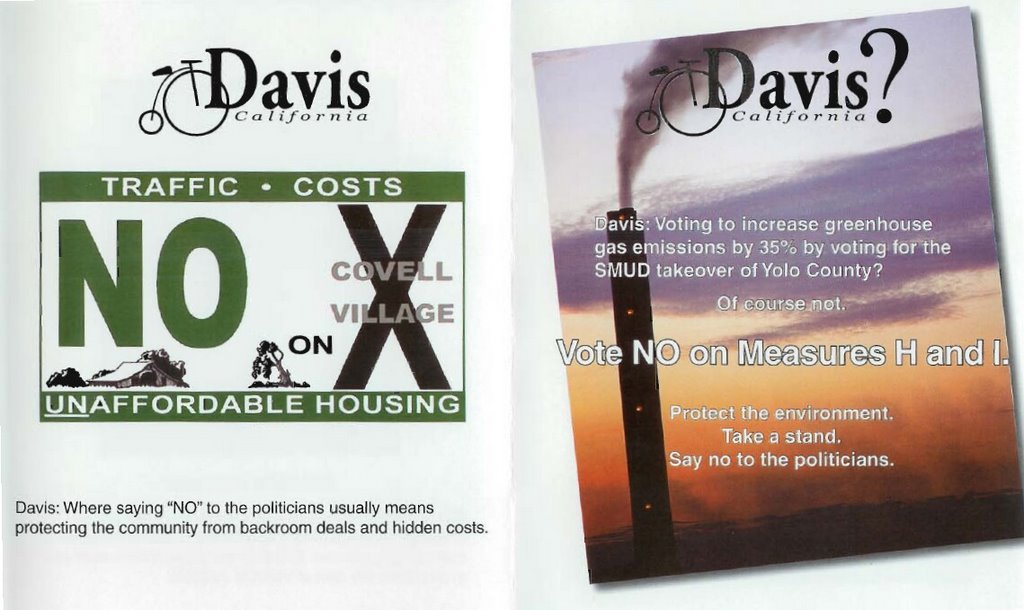
Someone actually warned me that this was coming in the mail, and it's probably the only thing that saved me from dropping dead, because I've seen a lot of things in my time (and my time has not been that long), and yet, I really don't have good words to describe this. Recall back to last year when a bunch of developers supporting Measure X gathered around and sung "We Shall Overcome." That's the kind of moment that this campaign brochure evokes when you see it.

When I was growing up, PG&E built a nuclear powerplant in my backyard on an earthquake fault. Now PG&E claims to be green and suggests that it is not easy being green (cue up Kermit). And evokes the image of the "No on Measure X" as an argument to support PG&E. This is almost like shooting fish in a barrel. If I'm Dick Livingston, I'm suing.

YES ON K TV ADs and Rich Rifkin

I have to laugh everytime I see the "Yes on K" TV ADs and there is Ted Puntillo trying to sell us on Target. And at some point he talks about how he would like to do all his shopping in Davis and not have to go to Woodland and Sacramento. Do people see through this stuff? First of all, has Ted Puntillo ever gone to Target in his life? Second, even if he has, does all his shopping out of town entail going to Target? It's amazing suddenly if we have a Target in Davis we go from not being able to buy socks and underwear, to never having to shop out of town again. Wow! Target is not just a superstore, it's a miracle worker. And good grief--the very same people who are selling us on Target are the very same people who would never ever shop at Target.

And then you have Rich Rifkin. I will never forgive or forget Rich Rifkin who ripped the HRC for having too many periods in their report on racial profiling. It was embarrassing that the Davis Enterprise gave space to that drivel.

He may have topped that on Wednesday.
"I wouldn't suggest that all members of FETID are stinky, malodorous and in need of a bath. But if you get close enough, you'll find that most FETID don't buy deodorant or soap or undergarments. They never shop at Target. They despise "big box." They are enraged by the idea that the rest of the people in our fair city might actually want a store in town that sells ordinary consumer goods at a decent price, because FETID apparently aren't keen to be clean."
Darn it, he's found me out. He must have read my last blog entry and figured I was on a mission to deprive people of socks and underwear. That I even need to dignify this crap with a response is flat out insulting to me and you. So I'll just leave it up for posterity.

I guess a couple of "substantive" arguments need rebuttal.
"The planners exclaim, "It's four times larger than the permitted store size in the General Plan." That's true, too. It is a big store. But it's a ruse to lean on the General Plan to argue against Target. The General Plan was designed by the people of Davis to serve the needs of the people of Davis. The people, then, have every right to change their General Plan, if it is not serving their needs. That is why we are voting on this question."
Actually the General Plan was designed to protect us from large developments that might harm the character of the city. It was designed specifically to prevent this kind of growth. Now he's correct that people have the right to change the General Plan, but the opponents have the right to remind people that we have the General Plan for a reason.
Let me repeat what Paul Navazio, the finance director for the city of Davis, told me a few months ago: Target will generate $659,000 in new net revenues for our city government. That's a lot of cash. That money's now going to Woodland, Vacaville, West Sacramento and other surrounding cities.
I love this one--oh, he told you that Target will generate $659,000--that must make it so. In a previous blog entry, we cast doubt on that figure. Regardless, that figure is based on a comparison to an empty field rather than a comparison to an alternative development project there that doesn't involve a big-box corporation.
Unlike the geniuses on our Planning Commission, I think most people in Davis would like our city government to keep our sales tax monies. If we vote against Target, we know for certain that the city of Davis will lose $659,000 a year.
Now he insults the Planning Commission. This is flat-out insulting to the Planning Commission and the residents of Davis. They certainly spent a lot more time and energy researching this than he has. If he wants to disagree with them, fine. But be a little respectful of people who volunteer their time and energy.

That's perhaps the biggest beef I have with Rifkin--his irreverence. This type of column backfires because people in Davis are not stupid. They read this stuff as mean-spirited and over-the-top. It's not worth the paper it's written on.

Let's have an honest debate on Target and the future of the city. This is just a bunch of insults wrapped in psuedo-satire. The people of Davis deserve better than that.

---Doug Paul Davis reporting

Thursday, October 19, 2006

Davis Chamber of Commerce Attribution on Sample Ballot Unauthorized


Thanks to a tip, The People's Vanguard of Davis has learned that Bruce Gallaudet, a board member of the Davis Chamber of Commerce and husband of Davis Enterprise Editor Debbie Davis, signed the "Argument Against Measure H" and also the "Rebuttal to Argument in Favor of Measure H."

According to reliable sources, the Chamber has not taken a position on Measures H & I, which would authorize the Yolo County takeover of electrical services by SMUD replacing PG&E. Moreover, Gallaudet was not authorized by the Chamber to use its name as his attribution. This of course creates the mistaken perception that the Davis Chamber of Commerce opposes Measure H.

(Click on the image to the left for the full sized version)

---Doug Paul Davis reporting

Assessing the New Human Relations Commission


It's been a week since the Human Relations Commission met for the first time since council dissolved the former group. There have been many charges levied toward the group and there have been many changes designed to prevent what happened last year from happening again. Many in the public feel that the previous Human Relations Commission overstepped their authority.

Councilmember Stephen Souza would agree with that take. In the Davis Enterprise last Friday:
Council member Stephen Souza stressed to new commissioners that their job is to work to bring community members together through education, not by investigating alleged cases of discrimination. "Your role is to educate, not to adjudicate," Souza said.
In Monday's blog entry however, we saw that in fact, according to the Davis Anti-Discrimination ordinance, the Human Relations Commission's role was to do both. The Ordinance authorizes the HRC to "investigate and mediate" complaints of violations of the Davis Anti-Discrimination ordinance. When Jamal Buzayan came before the Commission last summer and complained that the Davis Police Department violated his daughter's rights, the commission was fully within their authority to investigate his complaint and make recommendations to the City Council to address the problems that they found. They did so in their final report on February 21, 2006.

Now the council wants to essentially do away with the power that the ordinance grants the Human Relations Commission.

The California Aggie yesterday ran an article on the new Human Relations Commission. In it they quote John Pamperin, a longtime member of the commission.
"As we progressed in dealing with the political issues I felt some of our constructiveness got caught up in the campaigns for City Council and district attorney," Pamperin said. "It makes it difficult to look at the civil rights concerns when the issues are one candidate's or another's."
Unfortunately, the Aggie does not attempt to contact any of the former members to respond to this article. Nor does the Aggie respond to inquiries from this blog as to why they presented such a one-sided view of things. The quote from Pamperin is accurate, but it is also misleading. The politicizing of the process as Pamperin puts it came after the City Council rebuffed the HRC's attempts to forge a solution within the process. Moreover, it came after threats from the council following a February 7, 2006 meeting to examine the membership of the HRC and possibly make changes to it at that point. While the council would not act until late June to finally disband the commission, the atmosphere was poisoned and the membership within the HRC realized that working with this current City Council was impossible. Even then, the politicizing of the process came from outside of the HRC meetings and only by members of the HRC as private citizens.

Looking ahead

The City Council may have disbanded the former HRC and filled it with new members that it probably hopes will be closer to their own viewpoints, the problems that erupted last spring will not go away. In many ways, the police issue itself which served as the flashpoint for dissension, is only the tip of the iceberg of larger problems that have been ongoing within this community for over 20 years. Indeed past members of the HRC going back to 1986 have noted that the police issue is not new, it came up in the mid 1980s, it came up in the early 1990s, and it has come up again, because no one has done anything about it. If there is one small victory for the past HRC, it is that they forced City Council to start to address the problem of police oversight.

While the Council did not implement the recommended policy of the HRC, they did hire a police ombudsman who for the first time offers independent eyes to investigate the police. Unfortunately, at the same time, the council has made the process less rather than more transparent. There is no public body aside from the council themselves, with the power or authority to listen and act on public complaints about the police. There is no public body that can handle and discuss publicly police issues and complaints.

Furthermore, there is a huge divide within our community on the issue of race. Again, the police issue serves as an illustrater of this divide. When the issue of police came up last spring, the vast majority of people in Davis came out in support of the police--even liberals and progressives. Why? Because most people in Davis have had positive dealings with the police and rely on the police to protect their property and persons from harm. However, there is a sizeable segment of the population--African-Americans, Hispanics, Muslim-Americans and others that have had very different relations with the police department. It is here, where the complaints about not only racial profiling but also violations of civil liberties and rights have emanated from.

The role of the Human Relations Commission needs to be to bridge that gap between white and brown, white and black, so that they can work together to solve these kinds of problems. Unfortunately, this may be the one job that the new Human Relations Commission is least capable of doing.

At Tuesday's City Council Meeting, Stephen Souza praised the new Human Relations Commission as a "very diverse group of people." Unfortunately, I think that assessment is wrong. The Davis Human Relations Commission has traditionally been the most diverse group in the city. On the last commission, there were five or six different ethnicities on the commission, and in fact, it was a minority-majority group. That is no longer true. It is now a largely white body.

Why? Unfortunately, people of color did not apply to the commission. This fact will unfortunately hinder the commission's ability to bring diverse groups together. Many in the minority community were outraged that the commission that advocated on their behalf was disbanded. There was a fundamental distrust of the City Council and City Government to begin with and that has been exacerbated by the disbanding of the past commission.

Moreover, the problems faced by those in the minority community as not always readily apparent to the rest of the city. I'll use myself as an example because if I did not follow the Human Relations Commission and get to know people who were coming forward with complaints against the police, I would never have known there was a problem in this city. I've never been pulled over by the police or had any sort of negative interaction with them. It is only through my acquaintances and friends that I have learned of the true nature of what is going on in our otherwise great city.

Without first hand knowledge and without community trust, the task ahead for the HRC appears doomed. The new chair John Dixon and much of the membership are people of good intentions. But at least right now, none of them seem to have the fire and drive of the former chair to make the kinds of changes that are needed. The minority community lost a great friend when the HRC was disbanded. The progressive community now needs to come together to ensure that this type of thing never happens again.

---Doug Paul Davis reporting

Wednesday, October 18, 2006

Does Target Doom SMUD or PG&E ensure Target's Passage?

I found Richard Harris’ column in last night’s Davis Enterprise rather interesting, making the argument that Target is a “fight with no lasting significance to the life we live.” He describes us as “wrapped around the axle of NIMBYism fighting over where to buy underwear.”

On the other hand, we are missing out on the true issue of paramount importance.

There is a small and effective group of activists and local politicians putting together a pretty good campaign on behalf of Yes on H & I, Yolo Says SMUD Yes (to quote their signs), and I thank them for their efforts. But if you read the newspaper letters, look at lawn signs, run the gauntlet at the Farmers' Market or chat up neighbors, the talk of the town is Target. What a shame.

I guess I take some amusement in naked irony. If the SMUD campaign is indeed overlooked it is at least partly because some of the very same Davis officials pushing SMUD (Souza, Saylor, Asmundson) are some of the very same people who supported Target and put it on the ballot as well.

It is also naked irony in the blatant fact that Target may indeed pass on the back of the SMUD-PG&E mudfight. Recall the strategy of “Triangulation” developed by Dick Morris who was Karl Rove before we’d heard of Karl Rove. The idea was to have President Clinton position himself deftly between the “liberal” Democrats in Congress and the “radical conservative” Republican controlled congress. In that way, Clinton would seem not too liberal but as the alternative to the Republicans who were bent on turning off Sesame Street.

In other years, Target would be the poster-child for corporate excess and greed in Davis. The Target Corporation has outspent the “Don’t Big-Box Davis” opposition by a large margin. They have tried to convince the Davis electorate that they are “Green” and socially responsible. And they have not looked monstrous because of the campaign tactics of PG&E.

PG&E has spent over $9 million on a campaign to convince the people of Yolo County that however much you hate PG&E, SMUD will be worse. The PG&E counterattack is basically while it’s true that SMUD has been cheaper for ratepayers in Sacramento County and part of Placer County than PG&E is for Yolo customers, for Yolo County, SMUD’s underestimated annexation costs would keep that from being the case here. The proponents of the annexation have countered that SMUD is cheaper, greener, more reliable and locally controlled. But PG&E has controlled the terms of the debate through their enormous and unprecedented resource advantage.

Next to PG&E, Target looks downright green, mundane, and nice. Target can subtly point towards PG&E anytime its tactics are questioned.

It will be interesting to see how this ends up, but in many ways, we could end up with the worst of both worlds. The anti-Big Box campaign may end up being doomed because PG&E out-targeted Target. While the SMUD campaign might end up being doomed because Target for whatever reason is the sexier issue for Davis voters.

Harris suggests that SMUD is of much greater importance than Target. I both agree and disagree with that statement. SMUD would provide Yolo County with greener and more locally controlled energy. It remains to be seen at least in the short-term if that would be cheaper, I would guess immediately they might have to pass on the costs of annexation to the rate payer, but that seems a very short term expense.

However, Target would in many ways change the face of Davis. Harris mentioned we’d still shop in downtown if Target won and still shop in Woodland if it didn’t, but face of Davis would be inalterably changed with the building of a Target. And that’s something that we should not take lightly.

The charge of NIMBYism is a red-herring. Growth is inevitable. The U.S. population is now more than 300 million people, however, that does not mean that we have to grow through the construction of big business and corporate monstrosities. On the contrary, with the inevitable growth, it is incumbent upon cities to be even more meticulous in determining what types of business fits the image of the future of their cities.

When Target uses Chico as an example for what Target can do for us, we should shudder. There is a perfect example of how a city failed to annex land on its periphery and failed to protect its future. There are many other examples of Chico—where the character and nature of the town was altered by poorly planned and managed growth. So while I agree with Mr. Harris that SMUD is very important, I think Mr. Harris underestimates how big an undertaking building a Target is.

---Doug Paul Davis reporting

Tuesday, October 17, 2006

Davis Chamber of Commerce is Neutral on Target “After” they Supported It

Forgive me, as a Bush-hater I don’t like to use this reference, but after reading Sherry Puntillo’s response to a criticism of the Davis Chamber of Commerce, I had myself a John Kerry Flashback. (Recall that Kerry in the 2004 Election defended his vote against funding the war in Iraq by clumsily stating: “I actually did vote for the 87 billion dollars before I voted against it.”)

Don Shor wrote a letter to the editor criticizing the Davis Chamber of Commerce for their position on Target.
I have always appreciated the excellent service that Chamber staff provides. I have been a member of the Chamber nearly every year since 1981. But I regret that I will not be renewing my membership now, or likely in the future, because of the Chamber's position on the Second Street Crossing (Target) project… It is bad enough that the Chamber chose to take a position on Second Street Crossing at all. A neutral position would have been more appropriate. But for me, the final straw was when two Chamber representatives spoke in favor of Target at the June City Council meeting. This public support was directly harmful to the interests of many Chamber members.

Debbie Davis then gives her close friend Sherry Puntillo (didn’t we just criticize this in Sunday’s Entry?) the unusual opportunity to respond:

* Editor's note: Chamber CEO Sherry Puntillo clarifies, "When the Davis Chamber of Commerce's position regarding the proposed Second Street Crossing was presented to the Davis City Council, it was in the context of a pending council decision on the project. However, with the council's decision to place the issue on the ballot, the Chamber board decided to take a neutral position on the project."

Yes thank you Mrs. Puntillo for clarifying that—so what you are saying is that you were for Target before you were neutral on it? Yes, that sets everything straight. I’m crystal clear on the chamber position now.

Can someone please explain to me why the Chamber could/ would support the Second Street Crossing when it was a council decision but take no position on it as a ballot measure? That makes absolutely no sense to me.

While I’m at it, it strikes me as very odd that Sherry Puntillo is allowed to respond to this criticism in the same issue, immediately below Mr. Shor’s letter. Of course, it is probably no coincidence that Debbie Davis, Editor of the Davis Enterprise is also a member of the Chamber’s board and furthermore is the very “bestest” friend of one Sherry Puntillo. No, I’m certain that there must be a coincidence because otherwise that might appear to be unethical. I do not recall other members of the public being given a courtesy call and allowed to “clarify” when someone writes a letter to the editor of criticism.

You know I’m sure if someone were to say, criticize the former Chair of the Davis Human Relations Commission inaccurately, Debbie would call up Ms. Escamilla Greenwald and allow her to clarify her actions and position. Oh wait, that didn’t happen.

It is pretty clear who Debbie Davis panders to. Fortunately for us, Puntillo’s clarification makes about as much sense as John Kerry’s and we all know what happened to John Kerry.

---Doug Paul Davis reporting

Monday, October 16, 2006

WILL CITY COUNCIL ALTER DAVIS ANTI-DISCRIMINATION LAW?

Those who only read about the Davis Human Relations Meeting in the newspaper last week may have missed the big story buried under the lead.
"[T]he commission has been charged with reviewing the city’s anti-discrimination ordinance, created in 1986. Dixon appointed a subcommittee to look at the ordinance to see if any changes are necessary."
The article does not mention why they are reviewing the city's seminal ordinance that incorporates one of the most sweeping anti-discrimination laws in the nation into the Davis Municipal code.

At issue is Section 7A-15(C):
"Any person who believes he or she has been discriminated against in violation of the provisions of this ordinance may file a request to have the Human Relations Commission investigate and mediate his or her complaint. The Commission may adopt rules of procedure to accomodate the needs of such investigation mediation. A complaint to the Commission shall not be a prerequisite to filing a civil action under this section, and the findings and conclusions of the commission issued in response to such proceedings shall not be admissable in a civil action."
Councilmember Lamar Heystek brought this section of the anti-discrimination code to the attention of the HRC and Councilmember Souza (a former chair of the HRC himself) who recently helped re-write the commission's charge, was completely unaware of this section of the city's Anti-discrimination Ordinance. The commission sub-committee is charged with determining whether the city council should alter the anti-discrimination ordinance adopted into law by the City Council on Feberary 26, 1986 and approved by Nichols-Poulos, Rosenberg, Tomasi and Mayor Ann M. Evans and opposed by Jerry Adler.

Now recent history of the HRC begs the question--why was the City Council seemingly completely unaware of this section of the ordinance? This is not a mere academic question, one of the reasons that the City Council disbanded the HRC in June was the claim that they overstepped their bounds. When in fact, according to the Anti-discrimination Ordinance, the former HRC not only had the authority but were in fact mandated to investigate the charges of racial bias in the police department by members of the public. Far from exceeding their authority, they were acting within the direct letter of the law. And for doing that, they were disbanded.

The more pressing question now is will the HRC recommend to abrogate their own authority and duties that are authorized under the Davis Anti-Discrimination Ordinance? And will this community allow the City Council to weaken perhaps the most seminal piece of legislation in our city's municipal code?

---Doug Paul Davis Reporting


Sunday, October 15, 2006

Davis Enterprise Endorses Target

It's Sunday, a low traffic day on the People's Vanguard. I save the hot and juicy stuff for Monday, so I went into this entry without much of an idea of what I was going to wite about. The Enterprise today is dominated by SMUD, Choice Voting, and Target.

Let me say something quickly on SMUD since I saw a letter that suggests uncertainty means a "No Vote." I do not know exactly what SMUD will mean other than it will mean NO PG&E. I know PG&E is bad in so many different ways. That's enough for me. I'd vote for Bob's electrical outlet over PG&E. Think about that for awhile...

It is of course of no surprise that the Davis Enterprise would endorse Target. I'm not sure they've seen a development or a pro-developer candidate that they do not like. They endorsed Covell Village and Mike Levy for crying outloud. I could have forgiven them had they endorsed Asmundson and Forbes and opted for experience, but Levy? Good gosh, that's hard to stomach. And it's all too telling about where Debbie Davis' loyalties lie (a close ally of the Puntillos). Given that backdrop, it would have been stunning had they not endorsed Target.

But I'd like this blog to be about ideas rather than ad hominen attacks, so let's look at the arguments the Davis Enterprise puts forth in support of Target.

"The 137,000-square-foot Target store proposed for Davis will generate an estimated $659,000 per year in sales taxes for the city of Davis." That was the rationale used by the Council's majority when they heard the issue of Target back in June. They completely ignored the point that now Mayor Sue Greenwald made in opposition to that figure and it was dead on. If you compare the amount of revenue from Target compared to the current vacant field, it is a good producer for city revenue. However, this is a Hobson's Choice argument. The alternative that council and the pro-Target people present is--Target or vacant field. There is a third option--a development that does not include a big-box retailer.

And what happens if you compare the revenue of Target to alternative developments?

The City Council attacked Sue Greenwald but never answered that question. City Staff disagreed with Greenwald but never addressed that question. And the Davis Enterprise never once offers up an argument against that point. Instead they create a Strawman argument in support of Target: "Target critics... argument presumes a high-value auto dealership occupying the site, which cannot be counted on." The argument that Greenwald made had nothing to do with an auto dealership, it was merely offering an alternative development plan.

Now let us suppose that we develop that property with a number of smaller scale stores and shops. It might not generate the same amount of tax revenue as Target will--I'll grant that point. But it won't be a $659,000 difference either.

Moreover, that projected revenue fails to take into account severe potential opportunity costs. First, while it may generate revenue, it may also cause a number of locally owned or smaller businesses to go under. So while you may generate revenue, the question is are you expanding the revenue base or merely transferring it from one business to another?

There are two consideration--first, how much business from Davis leaves town because there is no Target? Do we have an estimate of that? And second, how much business will come from out of town? Do we have an estimate of that? I would guess that there would be a number of out-of-town customers who would stop and shop at Target for convenience while passing through town. After all, the adjacent cities, all have similar shopping opportunities. A good amount of people from Davis go to Target in Woodland and would be more likely to shop at Target in Davis, so from that perspective some of the business would stay in town.

However, there is a fundamental cost that is not economic. We all live in Davis for a reason--whether it is to grow up in a small and safe community with a unique flavor or to attend or work at the university, there is a unique quality about Davis. It cannot be quantified. Bringing in Big-Box retailers like Target will act to change the nature of this city.

The Davis Enterprise closes with:
"Davis' Target store will be an environmental showplace as well--one of only 10 retail stores worldwide... that have achieved LEED (Leadership in Energy and Environmental Deisgn) certification."
Isn't that special. Davis' Target will be "Green." But will corporate Target also change their practices to fit the sensibilities of Davis? Answer: not bloody likely.

From Co-op America:
"While Target is a partner in the EPA Waste Wise program to reduce municipal solid waste, the company has yet to show significant signs of reducing its overall environmental impact."
Moreover are you concerned about sweat shops?
Target has not escaped the heat altogether as fair labor advocates and big box opponents keep a watchful eye on the company. Conditions at some of Target's supplier factories have included up to 180 hours of unpaid monthly overtime and the failure to provide legal minimum wages to 40 percent of workers.
In our discussion on the living wage proposal by Councilmember Heystek and our article on a "Green Target," we pointed out that a person who makes Target wages was unlikely to be able to even live in Davis. Even with Heystek's modest proposal of $10/ hour, it would be a tight budget. So while we may add jobs, there is a good chance that those will not be jobs for Davis residents. A fact that likely did not escape the Davis Enterprise, as they did not mention it in their article.

And this discussion has not even begun to touch on the anti-Union and Union-busting activities that Target has engaged in. While Wal-Mart is more notorious on this front, Target may be just as bad. There is a reason the Sacramento Labor Council (CLC) strongly opposes the building of Target in Davis.

So yes, this Davis Target story may be "environmentally friendly"... in Davis. But the overall environmental record of Target leaves much to be desired, and if you have concerns about the treatment of third world workers and first world minimum wage employees, then the Davis Enterprise really did nothing to allay those broader concerns with their subterfuge about the Davis Target achieving LEED. The marketing technique is actually quite insulting to the collective intelligence of this community. It takes a very quick Google search to uncover some serious concerns about the business practices of the Target corporation. But then again, most of you probably knew that already.

Unlike the Davis Enterprise, the People's Vanguard of Davis does not endorse. Take all of these factors and arguments and make up your own mind.

---Doug Paul Davis Reporting

Saturday, October 14, 2006

More on Racial Profiling

I had originally put this in a comment, I'll throw it as it's own entry and follow-up with some thoughts on it...

One thing that the Davis Police recognize is that the majority of the crime committed in Davis is from people outside of the city and it generally comes in the form of property theft. The police also understand the key access points to the city and they basically watch those access points and look for anyone "who doesn't belong." And then they look for a second reason to pull them over and ask them questions--that could be a minor violation such as failure to use a signal or it could be an expired license plate or broken headlights.

Part of this is good police work--understanding where the crime is going to come from is very important. On the other hand, the people who may "look like they don't belong here" simply because they are not in the majority are most often minorities who live in Davis and end up being pulled over multiple times in short periods of time. This is more common than not.

The key questions that are asked during the stops are things such as, "are you from Sacramento?" Or, "Are you from Oakland?" Which may tell them they are gang members. They also ask if someone is on probation because that allows them to conduct a search without permission or a warrant.

In the end, profiling is hard to prove. There are some aspects of good police work here, but the practice ends up angering many people who fall into the target group that the police believe may not belong. In the end, they are looking for reasons to pull over minorities and question them. It may or may not be an effective crime fighting technique, but it also serves to drive a wedge into the minority community.

The rest of the community really has no conception for the amount of anger that is out there. Last May, I attended a march at the police station with a number of students--almost all of them were minority students and the vast majority of those were African-American. I've followed this issue for quite some time and yet I was caught off guard by the sheer number of students who stepped forward and the level of anger that they had at how they were treated.

I would say more than 20 students spoke about personal experiences with the police and racial profiling and some of them had more than a handful of these experiences. It was shocking to listen to this, because it was clearly a very different world that they inhabit from those of us who are white. So when I heard comments from people in this community last spring talking about the fact that they’ve never had a negative experience with the police, the first thought that jumps into my head is that they are older and white rather than younger and a minority. That gulf made it very difficult for much of the community who has undoubtedly had good experiences with the police to understand where this anger was coming from. That polarization led to many of the problems that occurred in the past year.

The number of times many of these students had been pulled over leads one to the stark conclusion that this is not merely the enforcement of minor violations as some police officers claim. It is systematic and it is very intrusive.

But the issue of racial profiling itself remains a very tricky situation to try to deal with. It is difficult to prove because the encounters are often ambiguous and it is only in the broader context that it becomes apparent that there is a problem. That's been the problem all along--the City Council and the previous police chief denied that there was any problem whatsoever (while at the same time they implemented tremendous amounts of change by creating the position of ombudsman) and the majority of the community agreed with them because they never experienced the problems that some of our residents and our students have had to experience.

There is little that the Ombudsman can do about racial profiling--most cases will be murky at best. A police officer pulls over an African-American UC Davis student, says that he has failed to signal--how is even a video going to demonstrate conclusively otherwise? We would need data on traffic stops and that data would have to somehow demonstrate that a disproportionate amount of African American students were getting pulled over for minor incidents with no citation given.

Amazingly enough there was some data collected at one point by the police department. However, last year Steve Pierce, then Assistant Chief, admitted that they didn't know what to do with it and they threw it out when they moved to the new police station. He admitted this at a public meeting and wrote it in an email to Chief Hyde.

Unfortunately, while I have hope for the new ombudsman and his ability to investigate some of the complaints into the police department, racial profiling is going to be a tough nut to crack. I just don't see that issue getting resolved anytime soon. Clearly the community needs to see what is going on before they are going to be willing to act and I don’t see how that’s going to happen either.

---Doug Paul Davis reporting

Friday, October 13, 2006

CAB Meetings to Stay out of Public Light

The majority City Council moved to change the purview of the Davis Human Relations Commission (HRC) citing that the HRC no longer needs to concern themselves with police issues since council has created a Community Advisory Board (among other bodies such as the Police Advisory Committee and the Ombudsman) to serve that purpose.

The following is the description from the city website on the CAB functions:
An advisory board of 12 people representing a cross-section of the community based on neighborhoods, businesses, schools, religion, race, gender, and other factors was formed the last quarter of 2005. The members are selected by the Police Chief with the City Manager’s approval. This board meets with the Chief on a monthly basis to provide input to the department regarding constituent concerns. Additionally, the CAB members will take information away from the police department back into the community. This Board has broad public representation and input into the police department. Most importantly, CAB opens and sustains on-going dialogue with key members of the community on issues of mutual concern.
While the board may have "broad public representation" and it may open and sustain "on-going dialogue," it also meets in private. There has been increasing discussion that with the removal of the police issue from the HRC, the CAB needs to take on a more public role. Councilmember Heystek raised this issue at the September 19, 2006 Council Meeting.

And according to the posting by Chair Steven Worker on the Davis Wiki, this was an item of discussion at the last CAB meeting.
The CAB process was discussed and there was agreement that meetings needed agendas (pre-meeting) and notes (post-meeting). There was discussion that these might be posted on the DPD website. It was felt that guests could be invited by CAB members, but the CAB would not be a place to hear complaints about specific incidents , but rather discuss overall themes and issues.
This is a troubling policy statement for two reasons. First of all, you have a body that is meeting and advising on policy decisions that is not open to the public except by invitation.

Second, the public once again has no public venue in which to air their concerns about police practices except for the City Council Meetings. The Police Chief has suggested that that is the role of the ombudsman, but that forces people to take formal action every time they need to air their grievances. Moreover and troubling is the fact that without public scrutiny there can be no public pressure to change policies. John Burris in his book, "Black and White," cites the fact that even when Police Departments are found to have committed acts of misconduct, the lack of public scrutiny often means that the practices continue and policies remain unchanged. This occurs despite millions of dollars in settlements paid in civil lawsuits and sustained complaints against specific officers. Lack of public awareness means that poor training and other factors can continue despite lawsuits and complaints.

This current arrangement with lack of public hearings is clearly by design. The City Council was not happy with the way things went last year with the Davis Human Relations Commission and they somehow believe that they can handle this problem better by removing it from the public realm.

This approach seems problematic at best. There remains a sizable number of people within this community who are very concerned about the police issue and the conduct of the Davis police department. By forcing this issue largely out of the public realm, these problems will not go away and in fact they may fester beneath the surface. If anything the situation could become more volatile without any sort of pressure release valve provided by bodies such as the Davis Human Relations Commission over the last 20 years.

The Police Ombudsman Robert Aaronson is a good hire and a good person, but most of his duties and reports will be not made public (and there are good reasons for this). It is very concerning that there is no public access now on this issue.

(For further information on the CAB I recommend you read the segment in our Police Oversight Series on the CAB)


---Doug Paul Davis reporting

Thursday, October 12, 2006

Video Shows Case of Alleged Racial Profiling

The People's Vanguard of Davis has acquired this footage taken in January of 2006. It shows an area couple who witnessed a police officer pulling over an African-American UC Davis student. They then talk to the student who is unhappy at being pulled over.

As with most cases of alleged racial profiling, the evidence is unclear. We do not have access to the interaction between the police officer and the student. And even if we did, we would see the police officer ask a couple of questions, check the car's paperwork and let the student go. There was no citation given. The charge of racial profiling is difficult to sustain and often explained either by citing a minor vehicle violation or the claim that the person fit the profile of someone sought by the police for the commission of another crime.

The reason that he was allegedly pulled over was failure to signal, however, the student claims that that was untrue and the officer never cites him for it or even gives him a warning. This is a similar story that is told over and over again amongst minority students in this community. A student is pulled over, asked what they are doing, asked where they are from, the license and registration are processed, and then more often than not the person is let go without a citation or even a warning.

I like this clip because the student is clearly well-spoken and someone that most in the community can relate to. He is on his way to a job interview, well-dressed, and driving a nice rental car.

The sad part about this interaction is that these types of interactions between minorities in Davis and the police happen frequently, there is little that can be documented about them and in the end, the only thing this clip can do is raise community awareness about the problem.


---Doug Paul Davis reporting

Wednesday, October 11, 2006

PG&E Spends $9 Million on anti-SMUD Campaign

The numbers are staggering… According to the Sacramento Bee:
“Pacific Gas and Electric Co. has poured $9.4 million into an aggressive campaign to retain Yolo County customers, spending $21 for every dollar spent by supporters of a Sacramento Municipal Utility District expansion.”
Yolo County officials who never agree on anything are near unanimous in their support for SMUD. That includes people like Mariko Yamada, County Supervisor, Sue Greenwald, Davis Mayor and on the other side Council members Don Saylor, Steve Souza, and Ruth Asmundson. All of these officials support SMUD.

The draw is that SMUD presents about 30 percent-lower average rates. These rates help the cities better maintain their budgets. It helps the school district’s lower costs. And it helps the consumer save on their electricity bill.

Everyone wins except for PG&E. How much are they set to lose? Well enough so that they can spend $9 million without blinking.

As many people in Yolo County have suggested—perhaps had PG&E put their money and efforts into improving their system and their customer service, the ratepayers in Yolo County would not be revolting.

I’m a strong supporter of local business. I’m a stronger supporter that small business provides better services. And finally, in this day and age, I’m a strong supporter of competition. When a company like PG&E operates with a natural monopoly, they have no competition.

This is probably the first time they’ve ever had to compete to keep customers. Because if “I” don’t like them, I can sit in the dark or install a windmill in my backyard and solar panels on the roof. Neither of which are really feasible options.

Now suddenly they have to fight for their customers. Instead of trying to win us over with promises of improvement and rate reduction, they are using their vast wealth that they’ve acquired from us to scare us into sticking with an inferior system. Unlike other political campaigns—everyone knows about PG&E, everyone knows about the services they provide, and they aren’t going to fool anyone with $9 million or even $90 million.

That said, I don’t think SMUD is running a very good campaign. I’ve heard complaints that the spokesperson was very bad at community forums and that Stephen Souza wasn’t very helpful. Why is Stephen Souza the point person on this? It should be someone like Mariko Yamada.

In the meantime, anyone driving by the PG&E plant on L and 2nd in Davis might notice the rather large NO on H and I signs, I could be wrong, but aren’t signs of that size, not allowed in the city limits? Why has no one challenged them?

As I said yesterday on Target, you have a choice. If you like your current rates and the current system, stick with PG&E. If you believe the scare tactics that SMUD is overreaching and this will cripple SMUD, then again, vote for PG&E. Personally, I can not think of many companies in this country that I dislike more than PG&E and I am willing to take the chance on SMUD.

Regardless of these issues, Yolo County deserves better than to be foisted a smear campaign that will cost well over $10 million by the time it is over.

---Doug Paul Davis reporting

Tuesday, October 10, 2006

Souza Encourages Heystek to Bring up Living Wage Item on His Own

In what follows is the exchange from the August 1, 2006 Meeting where Heystek first requestioned that council agendize the living wage ordinance. Note that he clearly states he would like it on the September 12 agenda. This is important because when Council votes against agendizing the item by a 3-2 vote, Souza specifically encourages Heystek to prepare the item on his own for discussion. Because he has to prepare the item himself, it takes until the September 19 Meeting to bring it forward, which was the last possible date it could have a first reading and still apply to Measure K. Heystek is then chatised by Souza and Saylor both at the meeting and in the press for politicking and throwing this item on them at the least meeting. In light of this video clip, this attack is shown completely unfounded and the council majority is in fact responsible for the late date by failing to allow staff to prepare this item.

Bottom line here--the video at the end of this clip clearly shows Souza encourage Heystek to bring this proposal forward on his own and later both he and Saylor attack Heystek for bringing it forward at the last minute (he did not) and for politicking. This is duplicitous on the part of council at best.


---Doug Paul Davis reporting

Dreaming of a Green Target?

In Sunday’s paper we were told that a “green Target” not only “provides affordable shopping” but it “fits Davis’ values.”

I read through the entire column written by a large number of individuals, and I did not see much that would sway my view of Target as a large business that would put local owners out of business, would bring in a number of jobs to people who could not afford to live in our community on the Target salary, who practices union-busting behavior, and I could go on.

In fact, I came away rather insulted that they thought, “The use of wood, stone and other design features to make the store unique to Davis” would make me believe that Target supported my values. My values are not based on exterior aesthetics.

The big story from last weekend is the closing of an icon in Sacramento and Davis: Tower Records. From the Sacramento Bee:

“The Tower Records legacy began on Watt Avenue in 1960, where Russ Solomon opened his first store. A store still exists on Watt Avenue, above, but not for long. Tower served as a point of pride for capital-area residents. But competition from big-box discounters and the Internet began eroding music retailers like Tower in the mid- and late 1990s.”

Tower is obviously not a locally owned business, but it was started in Sacramento. Moreover, it demonstrates once again that big-box retailers have the capability to put others out of business.

Meanwhile, we can do some math. Target brings in about 200 jobs (150-250 is the estimate). Most of those will receive Minimum wage which is currently $6.75 per hour. Even if they work a full 160 hours in a month, that is $1080. And that’s before taxes. So we’re talking about $900. No one can reasonably live in Davis on $900 per month. So we would not be bringing in 200 jobs into Davis, we would be bringing them into Woodland, West Sacramento, Dixon or wherever someone can afford to live on $900 per month.

Now imagine that we adopt Heystek’s living wage ordinance, those same people would make $1600 per month before taxes. You could in fact, rent an apartment and live in Davis on $1400-1500 per month. But of course, the council supporters of Target also oppose a Living Wage (despite their weak attempts to claim otherwise).

By the way, an excellent letter by Gene Borack on Sunday calling Souza’s rhetoric for what it is. By the end of this week, Davis residents will be able to view the exchange between Souza and Heystek from the August 1, 2006 meeting on our site and they will see that indeed as we have said and Borack stated, that council encouraged Heystek to go forward only to pillory him for bringing it out at the last minute.

Folks, this is all very basic, the pro-Target people talk about Target fitting Davis values, well it’s all about which values you hold and support. I support the concept of locally owned and operated business. I support the small business owner who resides in our community. I support unions. I support the living wage. This Target proposal goes against all of these core values of mine. If they go against yours, then you ought to oppose Target. If on the other hand, you believe we need to be able to buy socks and underwear in Davis no matter who manufactured said apparel, then by all means, support a Target. I do not wish to tell other people how to vote, but people should have the facts at their disposal.

---Doug Paul Davis reporting

Monday, October 09, 2006

Saylor Attacked ASUCD back in May

Back in early May, the Davis City Council passed a resolution creating the position of the Ombudsman. Prior to that meeting, the student body at UC Davis (ASUCD), an elective organization that represents 25,000 students, held an emergency meeting to recommend the creation of Civilian Review Board instead of an Ombudsman.

There are two different groups in this community most impacted by the issue of Police conduct—one of those is the minority community at large and the other is the student community, especially the minority community within the student population—the majority of which reside within the city proper. In other words, the ASUCD was not taking up an issue that didn’t directly affect their members. Later in May we saw 150 minority students march to the Davis Police Station to request changes in department policy regarding racial profiling.

Rob Roy, who was both a candidate for the Davis City Council and a member of ASUCD, presented the resolution to the Davis City Council that evening during public comments about the Ombudsman. The Council could have easily accepted the recommendation and then acted as they were going to act anyway. That would probably have been the professional way to respond.

Instead, Don Saylor in very stark and direct language tore into Roy and the ASUCD, blasting the process, blasting their knowledge of the issue, he did so in his trademark measured tone, but it was no less abusive. He called it “at best ill-informed” and at worst “cynical” and “politically motivated.” Further he called them “misinformed” and “misguided.”

It was stunning to see of member of the Davis City Council castigating an independent elective body that was acting to represent the needs of their members. It would be one thing to disregard the recommendation, to disagree with it, but to angrily denounce them seemed well out of bounds.

Like most things said in the late night (this was at around 10:45 PM)—the audience in the chamber was non-existent and the audience on the TV was probably just as small. It was not covered in the paper and unless you happen to watch it, you would have missed it completely.

Here’s a clip of Saylor’s statement…


---Doug Paul Davis Reporting

Sunday, October 08, 2006

Charlie Brown, Max Cleland, and the Democratic 2006 Prospects

Yesterday three veterans of the US military were in Davis. Retired Republican Congressman Pete McCloskey who made his name as an anti-Vietnam war Representative, former Senator Max Cleland, and Congressional candidate Charlie Brown. Brown the proverbial underdog is facing eight-term incumbent John Doolittle. Doolittle is in hot water because of his close affiliation with Abramoff and probably because of general disatisfaction with the direction of this country.

Two things among many stike me about the event yesterday. First, Charlie Brown's staffer told us that he's not getting money from the national party. That is a travesty. The New York Times now lists 50 congressional districts that are in play, Doolittle's is now one. The Democratic party has an 18 district strategy--they are funding only 18 districts that they think they have to win to get to 218 and no more.

Folks if the Democrats end up winning the House it will be because of people like Charlie Brown--war heroes who have serious doubts about the conduct of the current administration and the average voter who rise up against the existing political order and caste out the Republican incumbents. It will be a movement of grassroots people who have had enough. The Democratic establishment is utterly useless.

The second amazing thing was watching Max Cleland wheel in on his wheel chair, and you know the guy is a veteran of Vietnam, you know he is in a wheel chair, you know a lot of things. But when you see him up close and you see the remnants of his legs and his right arm, you realize what true sacrifice is. I became angry because in 2002 his Republican opponent dared to challenge this man's patriotism because he had questions about the patriot act. And what a speech he gave. The Republicans claim to be the pro-military party, but they have left the veterans behind, they have hung the brave fighting men and women out to dry, and they had to get rid of Max Cleland because he reminds them of their hypocrisy.

Next time you hear the Republicans charge the Democrats with wanting to cut-and-run, just remember Max Cleland. This man could have cut and run on life a long time ago, he could have given up on his country after losing in 2002, instead, he's still fighting for this country with everything he has. To me that's true patriotism.

---Doug Paul Davis reporting

Friday, October 06, 2006

More on Saylor and the Living Wage

Listening to Saylor again talking about the living wage a number of things strike me once again. You have a real sense of viciousness cloaked in a veneer of decency by the calm and measured tone that Saylor uses.

But the most striking thing is the sense you get when reading the Souza letter to the editor--Saylor says he supports the concept of living wages, but his words betray him. Listen carefully, when he talks about the notion of $10/ hour wage, he says that this may end up costing jobs. That's the argument used against minimum wage increases (which is essentially what this is). Saylor claims to support the living wage but uses the argument of the opposition? And that's where Saylor trips himself up for the observant listener. Of course, he knows he's giving this speech at 12:45 am and that the audience undoubtedly is small. But for one of those rare moments the Davis Enterprise and Claire St. John picked up on this display and called Saylor and Souza for what they were doing--trying to intimidate and browbeat Heystek.

It is worth mentioning yet again that the complaint that Heystek was using this to electioneer and that he waited to the last minute is not credible. Heystek introduced this item back on August 1--a full month and a half before it was heard. The council voted against agendizing it with staff support but Souza and Saylor both encouraged Heystek to bring it forward on his own. Had staff had the month to work on it, it could have been ready for a September 9th hearing instead of September 16. Moreover, Souza and Saylor could have shaped it more to their liking. But they played hardball and then tried to pillory Lamar who was just in his fourth meeting. Lamar held up well, fighting for what he believed and making a compelling display that this was a sincere belief.

In the end, the community sees Saylor at his worst. If the community supports the notion of a living wage--a modest $10/ hour wage for large retailers who can afford a slightly higher overhead in exchange for community good will. If the community supports the rights of workers, they need to see the current majority on council for what they are--friends of big business and big developers. The words of Saylor are not the words of the progressive movement. They are not the words of the Democratic party. They are the words of the opponents of minimum wage increases, the words of the opponents of the union creed "a fair day's for a fair day's pay", and the words of the conservative establishment. In trying to blast Heystek, Saylor has outed himself.

---Doug Paul Davis reporting

Video Clip of Saylor criticizing Heystek

The following is about a six minute clip from the 9/16/06 Davis City Council Meeting, I invite all to watch this and see exactly what Saylor said to Heystek and then Heystek's response.

Responding to Souza’s Letter on Living Wage

One of the more fun aspects of writing in a blog is the opportunity to respond to all sorts of things in the political sphere of Davis. Last night I was pleased to see a letter to the Davis Enterprise by Councilmember Stephen Souza. Despite the fact that I actually have a backlog of new entries to post, it’s always nice to have fresh material on a subject I’ve already written about.

Souza writes, “While both Council member Don Saylor and I support a living wage…”

I’m glad Souza wrote that, because if he hadn’t I would have never known from the rest of his letter that he supported the concept of the living wage.

He continues, “we know of no other place where an arbitrary discrimination about number of employees, revenues or size of a business has been upheld in court.”

Souza is actually correct about this, in July, a court struck down a law in Maryland attempting to force Wal-Mart to pay some of the health care of its employees. A ruling in Maryland that invalidated a state law designed to force Wal-Mart to pay for a portion of its employees' medical costs could pose a problem for a similar law in New York. The basis for this law is that a very high percentage of Wal-Mart employees end up requiring state assistance for their health care. In California, Medi-Cal (i.e. the voters end up paying health care for Wal-Mart employees). In fact, this issue is on the forefront of the fight for affordable wages and health care.

Yes, Souza is correct that these laws have not been upheld. However, this issue is part of the core progressive agenda and we see which side Souza is on in this fight. Moveover, we see the use of the word “discrimination,” exactly what Souza feels about this policy—he’s not against it because it was struck down, he opposes it because he’s against the policy itself.

Souza also states, “the particular living wage ordinance was trotted out at the last moment before other council members could review or comment on the measure.”

As reported in our previous blog entry, this is a misleading claim AT BEST. Councilmember Heystek actually brought the issue forward at the August 1, 2006 meeting. The council majority led by Souza and Saylor REFUSED to allow it to be prepared by staff for agenda. They encouraged Heystek to prepare the item himself which he did. And when he did, he was roundly criticized by Souza and Saylor for electioneering. Had Souza and Saylor allowed staff to prepare it, it could have come out at the first meeting in September after council recess, that would have given them an additional week to consider and modify the proposal.

This complaint, not surprisingly is sheer politics. So it is with great irony that Souza ends his letter by stating:

“While it is an election season, it would be my hope that all of us seek to find some merit and information in the views of others and that the meetings of the Davis City Council focus on the business of the city, leaving election campaigning outside the Community Chambers.” He says without irony.
---Doug Paul Davis reporting

Thursday, October 05, 2006

Following up on the Meeting from Tuesday

The Davis Enterprise did not cover the meeting, but the California Aggie did and had an article in today’s paper. (Click here to read the full article)

There were a few statements by Saylor and Asmundson that require some response.

"The ground rules are really very clear," Saylor said. "One thing Mayor Greenwald enjoys is long discussions that aren't related to the matter at hand. There is a way to do business thoroughly and effectively."
In fact, Saylor is wrong because he fails to recognize that the chair in such meetings has considerable discretion to relax those rules in order facilitate discussion during the meetings. The ground rules themselves should not have been used to justify the type of conduct we saw at Tuesday’s meeting.

"Unfortunately, it seems like every meeting is a struggle," she said. "[Greenwald] is trying to change our ground rules. She thinks it's the prerogative of the mayor to do what she wants." Asmundson added that she feels the reason the council wants procedure strictly followed is because of the mayor's tendency to give long comments during the question period.
Again, we see the expressed need for the strict adherence to formal rules without the express stated purpose of exactly why that needs to be the case for issue that comes forward to council.

Saylor said he also feels that Greenwald's attempt to reorganize the council's order of handling business was routed in personal interest. "What you saw last night was an attempt by Mayor Greenwald to infuse an agenda on a simple policy action," he said. "Problems occur when ground rules are not adhered to or altered piecemeal at the whim of others."

This again brings up the question: what is the personal interest of the Mayor to modify the rules for discuss on what was largely an informal item. We still do not see the compelling need for this whole drama.

He [Saylor] added that he feels the mayor has overstepped her role and should adhere to the ground rules for her position.
This to me signals a future intention by the council majority. When they start using the term “overstepped her role” that means they intend to make some changes to get her back in line with the council majority or to replace her. It has been clear for some time that that has always been their intention, however they lacked the political will to do so. Now it appears they will try to use this to ratchet up support for making changes.

"The mayor has articulated an inflated view of the role of the presiding officer," Saylor said. "Mayor Greenwald would serve the community well if she would study those ground rules and use them consistently during City Council meetings."

In fact, my understanding is that the presiding officer has considerable discretion even within the formal rules to relax rules as they see fit—as long as the rest of the council goes along with it. However, in this case, the council chose not to go along with it. They have not provided any explanation either for the need to follow the strict guidelines in this specific instance nor have they offered any sufficient explanation to explain their boorish and childish behavior in provoking a long and protracted battle over a seemingly petty procedural issue.

We all expect the council to have disagreements on policy issues. I may not agree with the majority on the council some of the time on those issues—but that’s expect. The fighting on procedural issues however is far more destructive and the community will be far less forgiving.

The mayor needs to pick her battles more carefully, but the parlor games and political showmanship of the council majority is ridiculous to the point of absurdity. If Don Saylor thinks this makes him look good, he is sorely mistaken.

---Doug Paul Davis reporting.

Wednesday, October 04, 2006

Fight Night at the Council (Again)

Merging the commissions…

It was interesting reading the comments of Kevin Klein, outgoing chairperson and member of the Davis Social Services Commission. For one thing he identified himself as such which I had thought was against council rules to identify yourself as a member of the commission when writing letters to the editor.

Regardless, Klein writes, “All said and done, it's no wonder the Social Services Commission unanimously approved the merger of the two commissions.”

Of course the Senior Citizen’s Commission did not vote to approve the merger and in fact are strongly opposed to the merger. It seems in rather poor taste for the Chair of one commission to be publicly going after the chair of another commission on this issue. Musser-Roberts should have the right to express her opposition to this move without facing an attack from the Chair of the Davis Social Service Commission.

Not that I am surprise that Klein would take this course of action. For some reason he saw fit to attack the former chair of the HRC and interject himself into that controversy that really did not involve him.

Procedural Tensions with the City Council

There was a moment last night of high irony as the council fought on the issue of consensus. It seems this council fights even over whether to do things by consensus.

That leads me to my main point on all of this—the ensuing fight between Don Saylor and Sue Greenwald over procedure. They were dealing with an item that was not an action item, Sue suggested that they make comments and question simultaneously. Don pointed out and Ruth and Stephen agreed that the rules state that there is a written policy about how this is to be done. And there is.

HOWEVER, and this is an important point, Sue made a suggestion for a different approach since this was a less formal item. And Don for reasons that are not completely clear (nor made clear), strenuously objected. The only explanation the public got was that there are written rules. Well we know there are, but the chair often has the discretion to waive those rules for less formal items. Don could have gone along with this, there does not appear to be a compelling reason not to, other than a strict and blind adherence to rules, and instead of fighting and looking like a bunch of squabbling kids, they could have been discussing something important like the future of the city.

Two basic observations—first Don looked extremely petty making an issue of this in the first place. The rest of the majority and Sue certainly added to the problem.

The most mature councilmember appears to be the one who is by far the youngest of the five—a bit of irony not lost on those watching the exchange… Lamar Heystek, avoided the fray, he supported Sue on the procedural issue. Sue needs to better pick her fights—she certainly was right in that she had the discretion to waive the rule, Saylor certainly had the right to insist that they follow the rule but it didn’t seem like an important enough issue. Instead it looks like a power struggle and no one except Heystek looked good in the exchange.

---Doug Paul Davis reporting

Tuesday, October 03, 2006

Give us your tired, your sockless, and your underwearless?

It was amusing reading Tim Spangler's sit-in for Bob Dunning. Aside from the obvious humor is a buried point...
It's simple really. Do a soul-check. You want a Target. You need a Target. Even the vocal and expectorating minority want a Target deep down inside. Unless the anti-Target crowd is also the anti-wearing underwear and socks crowd, they need it just as much as the rest of us unenlightened consumers.
On the surface it's a simple point that everyone can understand--and that makes it all the more dangerous. We all need a target because we all wear underwear and socks. (Actually I very rarely wear socks even in the dead of winter, but that's another point entirely).

Now this begs the question--if we need Target to get our socks and underwear, are there huge masses of Davisites walking around without socks and underwear? Isn't this the un-said assumption here--that we are missing something. Now I'm not into checking people drawers, but I'm going with a big 'no' here. There does not appear to be a shortage of either apparel in our fair city.

I'll go even a step further--I have never in my life bought either socks or underwear at Target. I know this is a shocking revelation, but it's true. In fact, I wonder how many others in this city have never bought either socks or underwear at Target?

Now I've lived in Davis for over ten years, and it's just never been an issue of not having socks and underwear.

And if socks and underwear are the key election issue, perhaps Mayor Greenwald would be so kind as to make a counter-proposal. What if we instead of building a huge megastore to cover two very basic commodies, we brought in a small store that sells only socks and underwear. Heck if it's price, we could bring in a discount sock and underwear store. In fact, I'm sure some local developer or business person might be willing if given the permission to (gasp) open such a store.

Somehow I'm guessing that's not what Saylor, Souza, and Asmundson are looking for. They don't want us to have a discount sock and underwear store, they want us to have a huge big-box retailer in Davis. This is not about socks and underwear. This is about having a store where you can get your socks and underwear while you get your food, liquor, and drugs--all in one fell swoop.

So Mr. Spangler is absolutely correct--we are not anti-socks and underwear. But I think he knew that to begin with, even if he does a nice job of bait-and-switch.

---Doug Paul Davis reporting

Monday, October 02, 2006

Gossip and Rumors

Some interesting tidbits that were overheard this weekend...

Acting Police Chief Steve Pierce offers an explanation for the incident at Davis High School. He said that the kid fit the description of a person who had committed a crime and that they were looking for. That seems like a strange statement from the acting chief for a number of reasons. First the security guard I do not believe is under the control of the chief. And second, the explanation came at a public event where someone told him about the incident--so he suddenly knew this off the top of his head? It will be very interesting to see the explanation that the principal provides and see if it squares with the police chief.

Stephen Souza was heard this weekend saying that the issue of the police is only a issue for certain types of people in this community. What in the world is that supposed to mean Mr. Souza?

Don Saylor speaking at the Democratic Bean Feed got a very tepid response. We've heard that he's putting out feelers to run for the Democratic Nomination for the State Assembly for the seat that Lois Wolk will retire from in two years. Based on his response, we suggest he try for the Republican nomination, he might get a better reception. He then spoke about Democratic party values... He might try to remember in the future living wage and unions are kind of important to Democratic voters.

---Doug Paul Davis reporting

Friday, September 29, 2006

More racial profiling and cleaning up the DA's office

Racial Profiling 101

I get a call yesterday from a friend, his son, a Muslim, was sitting outside of school with his backpack on the curb waiting for his father to pick him up from school. Next to him was a boy his same age, also with his backpack, he happened to be white. The security guard comes up to the Muslim, and asks him what he is doing there. The kid says he's a student and is waiting to be picked up. The guard proceeds to ask to see his ID--the guard checks it out and leaves. He does not say a word to the white student.

The father is furious. I'm left with the thought that while this might be innocent and innocuous, it would seem that in this day and age with the issue of racial profiling burning in our community that a security guard would be a bit more sensitive to the social context of his interaction and take care to make sure that his actions do not spark allegations of racial profiling. It can't be that hard, can it? The son is embarrased and humiliated at something where he did not do a single thing incorrectly, other than to sit on a curb and be a Muslim-American in Davis. When is this community going to start to question our practices?

Cleaning up the DA's office

Interesting gossip coming out of the DA's office. When Jeff Reisig ran to replace the long-time DA Dave Henderson, he was supported by nearly everyone in the DA's office as well as most of the law enforcement community. Despite that heavy support from the establishment Reisig won a relatively narrow race with just 54 percent of the vote.

For a long time, there have been complaints about the operations within the department. Most of us assumed that Reisig would continue business as usual within the office given the people who supported his candidacy. However, it seems that the specter of a future challenge may be convincing Reisig he had better clean up the office while he can. He has pulled the files on all of the employees and will review them. This move has apparently caused quite a stir already. We'll see if this is just a ploy or whether Reisig is prepared to clean house (an act that is long overdue from what we've heard).

---Doug Paul Davis reporting

Wednesday, September 27, 2006

Chair of the Senior Citizens Commission Blasts Back

Yesterday I reported that Councilmember Stephen Souza publicly browbeat the chair of the Senior Citizens Commission. Well in last night’s Davis Enterprise Elaine Roberts Musser fired back.

She strongly opposes the proposed merger of the Senior Citizens Commission with the Social Services Commission arguing that “based on my knowledge as a commissioner at the county level. Such a merger may have unintended consequences.”

Moreover she informs us that County Supervisor Mariko Yamada strongly opposes this merger and wrote a letter the members of the Davis City Council expressing that.

But the real fireworks come toward the end of the letter.

“In my opinion, if the Davis City Council doesn't think enough of its senior citizens to have a separate commission for the elderly, Davis may find itself in the unenviable position of not being represented at the county level. When matters with respect to the county come up for budgeting and projects, Davis seniors may discover themselves on the short end of the stick. Woodland and West Sacramento, who do have separate senior commissions, may garner a windfall with respect to county monies or projects, whereas Davis will be left out in the cold.”

Finally she delivers the electoral threat with the full-force of the Senior voters behind her. “I would also urge Davis seniors to keep in mind who on the City Council did not think their concerns were important enough to rate continuing the Senior Citizens Commission, the next time City Council members come up for re- election.”

I will be very interested to see how the Council responds to what I am guessing they will perceive as a threat. This is starting to bear a remarkable resemblance to the situation of the HRC, where the Chair, frustrated at the Council’s attempts to skirt the issue and undercut her finally threatened them with going to the voters. That was a huge mistake, but the Senior Citizen Commission is probably in much stronger position to press home this threat than the HRC ever was and that’s why it will be interesting to see if the Council ends up being as heavy-handed with the Senior Citizen Commission as they were with the HRC.

One thing is clear—the council in June tried to portray the situation with the HRC as unique—it was not. The difference is that the HRC was politically vulnerable enough to isolate. The Senior Citizen community is probably far too strong for those kind of tactics to work.

---Doug Paul Davis reporting…

Tuesday, September 26, 2006

Racial Profiling

Every so often I get an email worth sharing. Most people end up putting their comments on the blog and that's obviously ideal.

But I got this email last night and it was particularly pertinent to the ongoing discussion of the police issues here in Davis.

So I'm driving down Sycamore Ln. just passing Willett Elementary School on Sunday...yesterday. I'm with the family trying to go shopping. I see a Davis Police car traveling in the opposite direction and following a car very closely. No, not close, on the bumper of the other car. I had to interrupt my family shopping trip to see for myself. I make a U-turn. Sure enough, two Hispanic kids are being pulled over for apparently no reason in the parking lot of Willett elementary. The police ask the driver for his license and ask him if he is a student. He explains that he is just here to play a game of volleyball with friends at the park. The cop leaves and the kid turns to me...we are at this point watching...and says "if that's not racial profiling I don't know what is."
This is the kind of situation that is frustrating. And the basic that it is frustrating is that everyone knows what is going on here. You have a minority kid driving the car, the cop pulls him over, asks him a question, and then lets them go. No citation, no warning, nothing except a question.

So the kid is angry because well they feel violated by this intrusion into their everyday life by the state.

There is no report on the incident, so we have no idea how many times this occurs, and there is no good way to study it.

And the police can always fall back on the justification that either the person was acting suspiciously or the person matched vaguely the profile of someone who might have committed a crime.

Last May heard numerous stories and they were all very similar of African-American UC Davis students who were pulled over asked either if they were from Sacramento or Oakland, asked if they were in a gang, asked if they were on probation. Probation is always a good one for the police, because then they can actually do a legal search without permission or probable cause. These students really resent this and it creates a climate of distrust between UC Davis students who happen to be minority and the police.

Last summer I saw something similar happen, I was walking through Central Park, suddenly I see a police car make a fast move, drive onto the sidewalk. Cops get out of the car with both doors left open and weapons drawn. And they talked to an Hispanic male for a few minutes, let him go and leave. I walked up and asked him and he just kind of shrugged and said they asked him some questions and he has no idea why they pulled him over.

These are the type of things that it's going to be hard to investigate for an Ombudsman. The Buzayan's of the world are violate perhaps but at least there is a paper trail. Here, there is no paper trail and the police control the flow of information. And a lot of kids leave UC Davis and that's it, they don't come back.

I do not have a good answer for this, but we have to figure something out.

---Doug Paul Davis reporting

Browbeating Seniors

My focus on the HRC and the Council’s reconstruction of the HRC is closest to my heart, but my single-minded focus has obscured some of the other controversial changes to the commission system proposed by Souza-Asmundson.

To most of us Stephen Souza is the mild-mannered councilmember, who looks like he’d be right at home smoking a bowl with his constituents and philosophizing about the meaning of life until the wee hours of the morning. Souza appears generally calm and reserved and often tries to play the role as moderating force to the cold and calculating Don Saylor. But there is a dark-side to Stephen Souza that few in the public have seen. He’s every bit as cold and calculating as Saylor, with an equal mean and vindictive side to him.

One of the proposed changes was merging the Social Services Commission with the Senior Commission. Now last week, Souza and Asmundson went to the Social Services Commission and asked them to support the merger, they did by a 6-1 vote. Now there is subtext to this vote, the next day, the Council was going to here on the issue of accessibility in new building projects, which is the most important issue to that commission. Would they vote against the wishes of the council majority knowing that their issue was going to be heard the next day? No. And they were not all that happy with the council’s decision anyway.

The sham comes when the Senior Commission meets late last week, and Souza and Asmundson show up again. Souza browbeats the chair of the Senior commission for over an hour. Apparently it was quite abusive from eyewitness accounts. They have not voted on the matter yet, but will at the next meeting.

To begin with, I do not understand the rationale of the merger. The two commissions do not deal with the same things. Even if the merger were to make some sense, I do not understand why Souza would have so much invested in the merger that he would feel the need to be abusive toward a senior (or anyone for that matter). The chair of the commission is furious and this is not the first time that Souza has done this to a chair. He may have been able to get away with this with the HRC, but seniors are a large percentage of our population and they vote. Word will get around about this. And I’m just left scratching my head.

---Doug Paul Davis reporting

Monday, September 25, 2006

The New (White) HRC

Diversity Gone from the HRC

Last Summer the Davis City Council voted 4-1 to remove every member of the Davis Human Relations Commission from the commission and have them reapply. Only one member--member emeritus John Pamperin chose to reapply. The rest of the commission is entirely new.

I write this column with a great deal of ambivalence because it touches upon an explosive issue and also a philosophical conundrum. I begin with a simple statement—the Davis Human Relations Commission has since its inception been one of the most diverse bodies in this entire city. The last human relations commission had members from many different ethnicities—Latina, Africa-American, Muslim, Jewish, East Asian, Indian, among others.

The new human relations commission appears to be nearly completely white. That brings up the race issue and also brings up a philosophical question about the nature of representation.

Let me clarify right away—I do not believe the city council is racist. I’m not accusing anyone of racism. However, I do believe that the current city council majority created a climate that limited the number of applicants.

Let me also clearly state that I think there are some excellent members on the new commission. I have concerns about one of the members who had to resign due to a conflict of interest five years ago, but this entry is mainly about the charge of the HRC and its new membership.

This is a commission whose primary charge is to deal with issues of prejudice, discrimination, and racism. Can a mostly white body effectively address those concerns? That is a crucial question that gets to the nature of what representation is itself.

I do not wish to criticize the membership of a commission before they have met, but I believe there is a fundamental problem in the city of Davis with racism. And that problem is not one that most white people, myself included, are very aware of. It was only my close proximity with several instances of racial problems that I became aware of this problem.

Moreover, a white person in Davis, I have never had a personal problem with a police officer or the police themselves. If I did not know people who did have problems, I would never have become aware of it. Almost all of those people with problems with the police have been minorities.

The very problem that the HRC now faces is not racism by the City Council necessarily, but rather neglect. The City Council was in a great hurry to get rid of the former Latina-American chair because she chose to raise issues, but they did not do sufficient outreach in order to get a diverse pool of applicants on the commission. I doubt if they even considered what the make up would look like.

They got exactly ten applicants, two of whom became ex-officio/ non-voting members and one of whom is an alternate. The other seven are regular members. Why such a small pool of applicants? Because everyone saw what happened to the previous HRC and non one wanted to deal with the current council and their consolidation of power.

But the ultimate effect and we cannot lose site of this is an HRC where the majority of the members have never personally had to deal with prejudice and the majority of the members are white people. And that is a fundamental problem.

---Doug Paul Davis Reporting